Spending, CPI, demographics of overall market

U.S. PET FOOD SPENDING – $26.7B; MID-YEAR UPDATE…EXPANDED

The USBLS just released their Mid-Year Update of the Consumer Expenditure Survey covering the period 7/1/2014 to 6/30/2015. The following charts and observations on Pet Food Spending were prepared from calculations based upon data from that report and earlier ones.

The most recent report shows Pet Food Annual spending at $26.68 B. (Food & Treats). The first chart will help put that into perspective with recent history.

PetFood1

This chart, with its rolling 12 month totals, gives a good overview of the recent trend in Pet Food Spending. However, for the best comparison, we should look at like time frames:

  • 2014 vs 2013: Sales up $1.1B (+4.8%)
    • By Half Year vs previous year: Jan>Jun 14 down $-.09B; July>Dec 14 up $1.19B
  • Mid Yr 2015 vs Mid Yr 2014: Sales up $3.8B (+16.6%)
    • H/H’s increased 1.4M (1.1%), but Pet Food Spending per H/H increased 15.4%…Still a big number!
    • By Half Year vs previous year: July>Dec 14 up $1.19B; Jan>Jun 15 up $2.61B
  • There was a period of minor price deflation beginning in December 2013 and continuing through May of 2014 which could be a factor in the 2014 first half drop of -$0.09B.
  • Prices rose slightly in the second half of 2014 and were stable in early 2015. This contributed to the second half turnaround in 2014 (+$1.2B) and the outstanding growth in the first half of 2015.(+$2.6B)
  • Question: Prices had a record plunge in July ’15. What will be the impact on $? We’ll know in September.

Let’s take a closer look at the latest numbers. Here’s what they look like by age group:

PetFood2

Age Group Observations

  • The growth is being driven by the old and young…especially 55>64 and 25>34. However there is significant growth in the <35 group (Millennials) and the 55>74 group (Mostly Boomers). One big factor in the small decrease in the 45>54 age group is that there are 267,000 fewer households.
  • There are 600K more >75 H/H’s. This may indicate that 75+ is the threshold for declining pet ownership.

Does money matter? Here’s a look at Pet Food Spending by Major Income Groups:

PetFood3

Income Group Observations

  • When you look at the under/over $70K groups, there has been a turnaround. The over $70K group now accounts for more than 50% of Pet Food spending. They are only 34.8% of U.S. Households.
  • There was strong growth in all the over $30K groups – ranging from 19 to 25%.
  • The under $3OK group is showing the only decrease in spending and it is only -$60M (-1.2%)
  • I quickly looked at other demographic groups to search for more insight into the under $30K decline:
    • Over 75 yrs of age – Down 41.6%
    • African Americans – Down 18.8% (Note: All other Racial/Ethnic groups had increased Pet Food spending except for Asian Americans, but they have a high H/H income)
    • Single Parents, Retirees, the Under 25 age group and many other lower income demographics were all showing increased Pet Food Spending, which undoubtedly helped to mitigate the overall drop in spending by the H/H’s with less than $30K in gross income.
  • It is not a good idea to rush to judgment without a more in depth review, but the question of low or declining pet ownership among the elderly and African Americans has come up numerous times before and merits a closer look.

Final Comment

This report is quite frankly great news for the industry. If you have a Pet, you invariably buy Pet Food. Increased Pet Food spending may reflect the movement to more premium foods but it also is an excellent indicator that the number of U.S. pet households is strong and growing. In an earlier post on Pet Products we noted that our spending on Pet Food & Supplies showed a 50 year commitment to our pets – from age 25 to 75. With this report, we saw a 30.6% increase in Pet Food Spending from the Under 25 age group. Admittedly, their spending numbers are still small. However, they are moving up – quickly. I’m sure that you’ll all join me in welcoming these young Millennials aboard the “Pet Parent Express”. We know that they will enjoy it and it’s a ride that lasts a lifetime!

U.S. SPENDING DEMOGRAPHICS for PET PRODUCTS: Food & Supplies…Winners, Losers

There is no getting around it. Pets are big part of our lives and our spending in America. However, there are distinct differences in the demographics of spending between the industry segments. The Prices in the Service Segments, especially Veterinary have been strongly inflating. Sharply higher prices affect the spending of a wider range of groups. Veterinary Spending was up $3B from 2013 despite a $1B drop in spending from consumers making $50K or less. Both the Food and Supply segments have been deflating in recent years so a lower H/H income is less of a factor. Also Pet Products (Food & Supplies) are a “must spend”. If you have a pet, you spend money on Pet Products . For this report we’ll take the services out of the mix and just look at Pet Products.

First, let’s “bundle” segments together to reach a dominant market share of Pet Products spending (80%). Like Total Pet Spending, Homeowners, Metro Area Dwellers, H/H’s with 2 or more people, White Not Hispanic and H/H’s with income over $30K are all groups which exceed 80% of Pet Products spending. Let’s dig a little deeper.

“Which of the 80+ individual segments are performing best in Pet Products?” The chart below identifies the best and worst performing segments in key demographic categories. The performance of each segment was determined by comparing the share of total pet spending to the share of households. Ex: If a segment accounts for 10% of households but generates 15% of Pet Spending the score is 15/10=1.5 = 150%…a great performer. However, if the situation was reversed, 10/15=.67 = 67%…not so good.

PetProdWinners-Losers-1

Married Couples with children, Homeowners vs renters, Rural vs Center City, Larger family H/H’s, White Not Hispanic, the 45-54 yrs age group… Some of the best and worst performers are exactly what one would expect.

  • African Americans are the lowest of the under-performing groups. The most recent American Housing Survey indicated that Pet Ownership by African Americans H/H’s was about 50% of the national average!
  • 2 of the fastest growing occupations in the U.S. are Service Workers (+1M) and Self-employed (+300K). Both had increases in Pet Products Spending per H/H but the Service Workers spending increase did not keep up with the 7% increase in the number of H/H’s.
  • Higher Income and higher education both are harbingers of increased pet product spending. However, pet ownership crosses all income and education levels. The lowest performers are still relatively high.
  • The Under 25 age group…Getting people started as “pet parents” must be an industry priority.

We have identified the best/worst performing segments. Which ones are “on the move”- the segments within each category with the biggest $ gain or loss (or smallest gain) in Pet Products Spending from 2013-14.

PetProdWinnersLosers-2

POINT #1 –When we looked at Total Pet Winners & Losers, 8 of the 10 categories had negative segments. For Pet Products, only 4 of 10 categories have any negative segments…at all! This is great news! Let’s take a look!

Income – Although higher incomes fueled the increase, every major income group spent more on Pet Products.

Occupation – The Self-employed group grew by 339K in numbers and their Pet Product Spending per H/H went up 26%. The Tech, Sales, Clerical group numbers fell by 339K and their Pet Product Spending per H/H dropped by 17%. They were the only occupational group with a drop in Pet Products Spending per H/H.

Race/Ethnic – 70% of H/H’s (White) account for 87% of Pet Products Spending. African Americans were the only racial/ethnic group with a decrease in Pet Products Spending…despite a 535K increase in H/H’s.

Highest Education in H/H – All education groups had an increase in spending. The group with less than a college degree is leading the way in the increase…a nice surprise.

H/H Size – It just takes 3 or maybe 1. Even singles had a significant increase in their spending. Two person H/H’s showed the only decrease. As you will see in the next category, these twosomes were not married couples.

H/H Composition – Married Couples with children drove the increase. No groups had a negative number. The “Married couple only” group was flat in spending. Even single parents showed an increase.

Region – Spending was up in all Regions. However, the Midwest was up $2.1B and the West…only $0.2B.

Area Type – Consumers in areas with under 2500 population, both inside and outside of Metro areas, are showing the most growth. Suburbs, the biggest spending segment is showing the slowest growth. In fact, spending per H/H is actually down slightly.

Housing Tenure – Homeowners are at the top with +$2.0B, but even Renters had a $1B increase (+16%).

Age – Good news. The 25>34 age group is showing the biggest growth. Bad news. The richest, highest spending segment, 45>54 is down. Much of this comes from a drop in numbers but their spending per H/H is also down

Major Issues: 1.The ongoing concern of more racial/ethnic diversity in Pet Ownership. 2. Getting the under 25 age group started. 3. Two big spending groups are slipping – the 45>54 age group and consumers residing in the suburbs. Both are spending less per H/H. The ongoing deflation in Pet Products could be a factor. Innovative, new products is certainly one way to motivate these firmly established “pet parents” to spend more.

Pet Prices Update: 2015 vs 2014 – Not a good second half!

In December all Segments were up slightly, but that doesn’t tell the story of what has been a crazy year. Of course prices in the Service Segments, especially Veterinary consistently moved up. It’s the Food and Supply Segments, which account for 63% of the Industry’s business, that are the real story in 2015.

Of course, all the hard data is included in the report. However the CPI story, which includes all-time record setting drops in both Supplies and Food is best told visually. You need to see it to believe it. First…The Data

DECEMBER PET CPI SPECIFICS

Veterinary Services

  • Dec – Up ↑ 0.37% (slightly more than 2014 when Dec went Up ↑ 0.14%)
  • Since Dec 2014: Up ↑4.56%

NonVet Services

  • Dec – Up↑ 0.15% (A turnaround from 2014 when Dec was Down↓ 0.01%)
  • Since Dec 2014: Up ↑3.12%

Pet Food

  • Dec- Up ↑0.23%% (Slightly more than 2014 when Dec went Up ↑0.1%)
  • Since Dec 14: Down ↓-1.52%…Big!

Pets & Pet Supplies

  • Dec- Up ↑0.21% (slightly more than 2014 when Dec went Up 0.09)
  • Since Dec 14:↓-2.35%…huge drop!!

Total Pet

  • Dec – Up↑ 0.22% (Last year Dec went Up ↑0.14% – All segments are moderately up.)
  • Since Dec 2014: Up ↑0.44% – Strong Inflation + Strong Deflation = Moderation

Here’s a monthly “visual” of 2015 so you can see “the storm” before a calm December

CPI-Dec-15-1

  • The Service segments basically continued their upward pricing spiral in 2015.
  • The year in Food & Supplies started off with a larger than normal Drop in January. However, December was the pricing peak in 2014, rather than November, so this contributed to the size of the decrease.
  • Food prices were moderately up and down until July brought a record drop which continued into August. Prices began a gradual recovery in the Fall but are still down 1.5% for the year.
  • Supplies had a similar pattern to Food but waited until September to begin a record 2 month plunge.
  • Take special note of how “calm” Total Pet is…never more than 0.68% above or -0.27% below Dec 14.

The chart below compares the Annual CPI Change from 2014 to 2015 as well as for the 1st and 2nd halves.

CPI-Dec-15-2

  • The inflation in the Service segments strongly accelerated in the second half…Vet +32, Services +43%.
  • The Supply Segment was looking to turnaround deflation…then the 2nd half.. a huge drop… a flat year.
  • Food was down slightly at -0.2%…then a record drop in the 2nd half led to the worse CPI year…ever.
  • I think you see where the title of this article came from, “Not a good 2nd Half”…an understatement!

Next we’ll put the CPI numbers into a “historical” and market perspective. The following chart shows the average annual rate of change in the CPI from 1997 to 2015 for each of the Pet industry segments, Total Pet…and some comparable product groups and industries.

CPI-Dec-15-3

  • Veterinary leads them all in CPI increase – 36% faster than Human Medical services. Of note: A veterinary service that cost $100 in 1997 cost $236 in 2015 – a 136% increase in prices. Services are also high at 3.4%.
  • On the other hand, the price increase in Pet Food over 18 years almost exactly matches the CPI increase of Human Food served at home. From an overview, Pet Food pricing seems to be on target.
  • Pet Supplies are a different story. They have increased at an annual rate of only 0.6%. That means that the total increase in supply prices over 18 year is only 13.6%, amazingly low.
  • Driven by the Service Segments, Total Pet has increased prices 38% faster than the overall U.S. CPI.

The Pet Industry CPI increase from 1997 to 2015, except for the Vets, seems reasonable. Let’s look deeper!

As I reviewed the CPI records, logical divisions in time seemed to stand out. The next chart shows the average annual rate of change in CPI for each Industry Segment.      Note: I also included the Overall Average from 97>15

CPI-Dec-15-4

  • 1997>2005 – “The Early Years” – Veterinary prices were increasing at an extraordinary rate and services were at what turned out to be their average inflation rate for 18 years. With annual increases of 0.9% for Supplies and 1.3% for Food, these 2 segments were in the “sweet spot”…and almost all the strong revenue growth in these segments over these years was real…not price increases.
  • 2005>2009 – “The Big Short” – The already high inflation rate in the Service segments increased slightly but in the product segments, it skyrocketed. The rate of increase in supplies was 2.6%, not too bad. However, it was triple the rate of the earlier years. The rate for Pet Food increased 400+% to 6.8%. Prices for food increased a total of 29.9% in just 4 years. Together the segments generated an annual rate for Total Pet of 5.6%. Most of the Industry’s revenue growth in this period was simply from price increases. However, the really bad thing was the timing…up to and through the heart of the great recession.
  • 2009>2015 – “The Recovery” – The buying behavior of U.S. consumers changed forever. “Value” became the #1 priority in virtually all purchases. Price now mattered…a lot. All segments, even Services took a step back in price increases. Food prices were up and down, but the overall rate is the lowest in history. Supply Prices reached their peak in September 2009 and have basically been deflating ever since. Competition in the product segments became even fiercer. When low retail price becomes a top priority, consumers benefit but profit suffers, affecting everyone in the distribution channel. Revenue increases, especially in the Vet segment became increasingly dependent on higher income groups. The CPI rate for Total Pet dropped 75% to 1.4%.
  • 2013>2015 – “What’s Happening Now?” Amazingly, the Service Segment rates are inching up again. Vet prices in December 15 are up 4.6% from a year ago. Products are a different Story. Food Prices have been deflating since 2013, with a record drop in 2014. Supplies prices dropped 1.1% in 2014. 2015 was poised for a deflation turnaround year…then came the Fall…literally. Prices fell almost 2.5% between September and November. The result…prices flat for the year…better than a drop, but not what this segment needed. Total Pet CPI is a little low at 0.8% and is being generated by 2 negative situations.
  • 2016> – “What’s Next?” Prices affect the U.S. consumer. Strong inflation can depress sales. Necessary expenditures, like Veterinary Services, can become “discretionary” and are put off or eliminated, especially by demographic groups with lower incomes. Although revenues may increase, consumers may be paying more, but buying less. Deflation can be even a bigger problem. For necessary items, like Food, reduced prices don’t generate increased purchases. Consumers just spend less. It can spur increases in discretionary spending but with today’s well informed consumer, you better make sure it is a great value – it needs to be better.

We’ll take a look at the CPI for the first quarter of 2016 when March numbers are released in April.

U.S. PET SPENDING DEMOGRAPHICS: The 2014 Winners and Losers are….

In a recent post we identified the demographics of the “Ultimate” Pet spending household. Unfortunately, there are just not enough of these “prime” households. So we took the next step and bundled the subsets together for each category until we could identify a group with a dominant market share. Our goal was 80%. This produced some interesting results. Metro area dwellers, Homeowners, white but not Hispanic, 2 or more people living together and those with an income over $30K are all groups that generate 80+% of Pet Spending.

With over 80 segments in 12 different demographic categories, it is natural to wonder, “Which individual segments are performing best? Who are the winners…and losers?” This report will address those questions. The chart below identifies the best and worst performing segments in key demographic categories.

The performance of each segment was determined by comparing the share of total pet spending to the share of households. Ex: If a segment accounts for 10% of households but generates 15% of Pet Spending the score is 15/10=1.5 = 150%…a great performer. However, if the situation was reversed, 10/15=.67 = 67%…not good.

DemoChge1

The top performers generally reflect our “Ultimate” Pet Spending H/H. Regarding the underperformers:

  • The under 25 age group was the worst of all the underperforming segments. Improving the pet spending of this demographic should be an Industry priority. Make it easy to get started as a Pet Parent.
  • Consumers of all income levels have pets. However, income is undeniably a factor in spending. This is reflected in the spending of single parents and service workers as well as the lower income segment.
  • Having more space and “owning” it are two keys to increased Pet ownership and…spending. You can see the impact of this in Center City dwellers and renters.
  • Pets are a great companion for singles, but get 2 adults together and pets are more likely to “follow”.
  • The Asian underperformance is curious. They have the highest H/H income but spend the least on pets.
  • Higher education generally means increased Pet Spending. However, Pet ownership is not dependent on education. In fact consumers who dropped out of HS spent more per H/H than HS grads with no college.

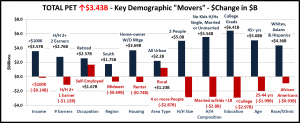
In the next chart we’ll “Show you the money”! We’ll identify the demographic segments within each category with the biggest gain or loss (or smallest gain) in Pet $pending from 2013-14.

DemoChge2

Age & Occupation – Want proof of the impact of the Baby Boomers? Almost half the industry’s growth comes from the over 65 age group…and “retired” was the #1 “occupation” in growth contribution. Over 600K “Boomer” H/H’s turned 65 in 2014. Now on the Flip side: The tech, sales, clerical occupation lost 5% in income and 2% in H/H’s so their Pet purchases fell sharply. The 45-54 age group makes the most money and their H/H Pet spending went up…but over 600K “Boomers” moved up to the 55-64 so group spending fell.

Income – 14% of the H/H’s (over $120K) account for 82% of the Industry’s growth. The lowest incomes are being impacted by rising Veterinary prices.

Race/Ethnic – 70% of H/H’s (White) account for 87% of Pet Spending and 105% of the increase. There is definitely a racial/ethnic disparity in Pet spending.

Highest Education in H/H – Although Consumers with a Master’s Degree or above spend more on their pets, pet parenting is not about education. 61% of U.S. H/H’s don’t have a college degree but their pet spending increased 15% and they accounted for 64% of the $6.6B increase. Those H/H’s with a BA/BS spent significantly less on services, driving their overall Pet expenditures down.

H/H Size – It just takes 2…or more! Single person H/H’s spending was down.

H/H Composition – Married Couples, with or without children, accounted for 124% of the increase. The combined Pet spending for Singles, Single Parents and all other combinations was down…a total of $1.6B.

Region – Pet Spending was up in all Regions. However the Midwest was up 26% and the South…only 1%.

Area Type – Consumers in areas with under 2500 population spend the most but we are growing more Urban every day. There is strong growth both in Rural sections within metro areas and center cities. The Suburbs have the biggest share of Pet Spending at 46% but their spending per H/H dropped 4% in 2014.

Housing Tenure – Homeowners account for 80% of Pet Spending but 2014 was a really good year all-around as Renters pet expenditures increased $2.9B..↑23%.

Three “opportunities” seem readily apparent.

  1. Keep the aging/retiring “boomers” spending on their pets.
  2. Get the under 25 group started faster.
  3. Investigate the racial/ethnic disparity in Pet Spending

Pet Prices Update: November 2015 – Supply Prices Plummet↓↓↓

In November, the Pet Industry set several dubious records. The Consumer Price Index for the Pets & Supplies Segment fell 1.72%. This is the biggest November drop on record, edging out 2009, during the recession. Add this to the 0.73% drop in October and Supply Prices fell 2.44% in two months. This is an all-time record for any 2 month period by a big margin…29%. The previous “leader” was Oct-Nov 2009, which marked the beginning of the ongoing deflationary period in this segment.

Total Pet prices fell 0.43% in November. The drop was mitigated by the continued strong inflationary trend in the Service segments and “Flat” Food prices. Here are the NOVEMBER PET CPI SPECIFICS:

Veterinary Services

  • Nov – Up ↑ 0.12% (slightly less than 2014 when Nov went Up ↑ 0.18%)
  • Year To Date: Up ↑4.17%

NonVet Services

  • Nov – Up↑ 0.31% (Slightly more than 2014 when Nov was Up↑ 0.21%)
  • Year To Date: Up ↑2.97%

Pet Food

  • Nov- Up ↑0.02%% (In 2014 Nov went Up ↑0.03% – Almost exactly the same)
  • Year To Date: Down ↓-1.74%…Still big!

Pets & Pet Supplies

  • Nov- Down ↓-1.72% (Last year Nov went Up ↑0.3%…A -2.02% Swing!)
  • YTD:↓-2.56%…A precipitous drop!!

Total Pet

  • Nov- Down↓ 0.43% (Last year Nov went Up ↑0.17% – Supplies Segment is driving the difference.)
  • Year To Date: Up ↑0.21% – Still on track for a moderate annual increase.

There is no doubt that the CPI “headliners” for 2015 are the Food and Supplies Segments. After a big pricing drop in January, both Food and Supply prices remained relatively stable until the second half of the year. Then July-Aug brought a record drop in the Food CPI and the same thing happened to Supplies in Oct-Nov. This resulted in a 1.41% pricing drop from June to November in this combined Food/Supplies segment. This is the biggest Jun-Nov drop (by 56%) in this grouping since they began keeping records in 1977 – 38 years ago! (the 3rd and final record breaker for the month!)

Here’s a “visual” on the first 11 months of 2015 for all segments and Total Pet.

Nov-15-CPI-1

What strikes me most about the chart is the relatively calm movement of the Total Pet Pricing in 2015 which “masks” the underlying turmoil in the segments. The Service Segments basically just go up. After a big drop in January, the Food and Supply segments were also relatively calm until the second half when both literally “fell off a cliff” with record drops.
Here’s an updated status and “best case” projection for the total year.

Nov-15-CPI-2

Veterinary Services – Prices continue to inflate at a high rate. We’ll see what impact this has on 2015 consumer expenditures. The inflation in 2014 helped push sales to a record level but the increase was primarily limited to the higher income households. Lower income groups decreased spending by $1B.

Non-Vet Services – Although inflation is less than the Veterinary Segment, it has started to slow the increase in consumer spending. Income (over $120K) and need (age 65+) are big drivers in this segment.

Pet Food – Pet Food prices have only deflated in 3 years since 1997. They will fall in 2015 for the second year in a row, the third time since the recession and the drop in the CPI will be about 3 times as large as the previous worst plunge. Things have changed in this segment. Since the recession, the consumer is more value driven, less brand motivated and better informed. Couple this with the increased availability of improved quality products in nearly 200,000 outlets plus the internet…and you get an extraordinarily competitive environment. Remember that food is a “need” product group. Lower prices do not drive consumers to buy “more”. They just spend less.

Pet Supplies – For most of the year, it appeared that the Supply segment was moving out of the deflationary slide which began in 2009. However, the record Fall plunge probably spoiled that. If 2015 mimics 2009, then December prices should increase slightly, if not…. Major categories in this segment have become commoditized, driving down prices. Innovation is the key to reversing this trend. Make it functionally better and consumers are willing to pay more. If not, then retail price is their focus.

Total Pet – Projecting a moderate 1.02% increase. 2 Negative situations have combined to produce at least the appearance of a positive. What we have seen in the Pet CPI is a powerful argument for looking beneath the surface of all data.

When December’s numbers are published, we’ll do a detailed annual CPI review.

U.S. Pet Spending Demographics: The “Ultimate” Pet Spending Household and…more!

It’s early in the New Year. Let’s have a little fun by taking a look at the demographics of the “Ultimate” Pet Spending Household. If there were more of these, Pet Spending would be in the stratosphere.

The “Ultimate” Pet Spending Household consists of 3 people – a married couple with an 18+ year old child, still living at home. Mom and Dad are in the 55 to 64 age range. They are White, but not of Hispanic origin. At least one of the Parents has an advanced College Degree. Everyone works in the H/H. Mom and Dad are “managers” or professionals. Their child also works, at least part time. They’re doing OK with a total Household income in excess of $120K. They own their home or to be more accurate, share ownership with the bank. They live in a rural area (under 2500 population) in the Midwest or Western U.S., but it is adjacent to a good sized metropolitan area. This gives them plenty of space for their companion animals, but they are still close enough to commute to the City for work, shopping and entertainment – the benefits of the Urban environment.

The Chart below details the specifics along with how the Total Pet Spending of each of the demographic factors compares to the National Average. There is also a chart on “Pet Products” Spending – just pets, food and supplies – no Veterinary or other services. The “ultimate” households are similar, but there are also some distinct differences. Take a look.

Ultimate1

Differences in the Ultimate “Pet Products” Spending Household

The Parents in the Top Pet Products Spending Household are younger – 45 to 54 age range. They still have 3 children at home and the oldest is not yet 18. They are well educated and make over $120K per year like the “Total Pet” group, but they are self-employed. They are firmly anchored in the Midwest, but not near any big metropolitan area. They live in a truly rural environment. Our modern world has made it much easier to work out of your home.

These two “ultimate” households would be easy to sell to but there are not enough of them. Let’s look at where the bulk of the business is going – the biggest market share by key demographics.

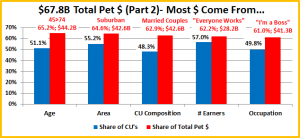
The chart below compares the share of Consumer Units (H/H’s) to the share of Total $ and Total Pet Products $ for Key Demographic measures. The goal was to bundle the subsets within a demographic category, like gross income until we reached a dominant market share of 80%. Sometimes this is simple, sometimes not. There are also Key Subsets listed for certain Demographics.

You will note a similar pattern in Total Pet and Pet Products. Differences will be noted in the comments.

Ultimate2

Income – This is usually the first demographic that anyone looks at and it is generally true that increased income results in increased pet spending. The midpoint (50%) is generally recognized as $70K. This is substantially correct although the over $70K group spends more on services. To get to the 80+% market share, you have to go down to the over $30K level. The upper 2/3 of the households in income spend over 80% of the pet $. You can also get to 80% by grouping everyone who makes less than $150K. However, this requires 91% of the total households. Pet ownership is popular across all income levels but as expected, there is a great disparity in spending between the high and low ends.

# Earners – This is an easy one. To get to the 80+% level, someone in the house has to have a job. It is interesting to note that 23% of U.S. households have no earner but they still account for about 15% of Pet Spending. I’m sure the retired group is a major factor.

Occupation – To reach 80% market share of spending you have to include all wage & salary earners, self-employed and retired people. The Managers/Professionals spend the most money of any group, especially on services. However, “retired” people are second. This is an important and growing group.

Race & Hispanic Ethnicity – White, non-Hispanics make up 70% of the consumer units in the U.S. but account for 87% of both the total pet and pet products expenditures. (Note: Native Americans and Pacific Islanders are included in the white grouping). African Americans, Asians and Hispanics account for 30% of the households but only 13% of Pet Spending. This is a situation which should be reviewed.

Age – We should note that the 55-64 age group has the largest share of Total Pet Spending and the 45-54 group is the Pet Products winner. Together they account for over 40% of Spending. However, there is significant pet spending in all ranges. To get to the 80+% level in spending share for either Pet Products or Total Pet you have to include everyone from 25 to 74 – 50 years. This reinforces that Pet ownership is a commitment for a lifetime.

Highest Education Level – It’s true that College graduates spend more per household and have a slightly larger share of Total Pet $ (51%). However, when you look at Pet Products spending only, the less than college degree group moves to the top at 55%. The subgroup with a Bachelor’s degree spends 25% of all Pet Products $. However, the subgroup with a High School diploma or less (and no college classes) actually accounts for 26%. Pet ownership and spending encompasses all education levels.

Consumer Unit Size – Another easy one. 70% of U.S. households consist of 2 or more people. Although single people definitely have pets, the 2+ group is more likely to have a pet…and definitely spends more.

Consumer Unit Composition – One of the industry stereotypes is the married couple with their children – both human and 4 legged. To some extent this is true as 48% of U.S. households are married couples and they spend over 60% of Pet $. Only 22% of U.S. households are married couples with children. They do spend more on their pets but still only account for 1/3 of total Pet $. On the other hand, 72% of U.S. households have no children at home and their share of Pet spending is also over 60%. The biggest key to pet spending seems to be to put 2+ people together in a consumer spending unit. This = 80% Pet $.

Housing Tenure – When you own your home, you have a “permanent” residence and you set “most” of the rules for having pets (can’t forget HOA’s). 63% of Americans own their own home and they account for 80% of Pet Spending. Home ownership is a key factor in both Pet Ownership and Pet Spending.

Type of Area – 91.5% of American Households are within defined Metropolitan Statistical Areas (MSA’s) so it’s not surprising that over 85% of Pet Spending comes from this Urban environment. However, the Central Cities have lower pet ownership and spending. The lion’s share (2/3) of the $ come from “other urban”, which consists of the suburbs and rural areas included in the MSA’s. The largest share goes to the stereotype – the suburbs – with 50% of all U.S. households and almost 46% of Pet Spending. However, it also should be noted that the “rural” areas (under 2500 population) included in the MSA’s account for 11% of all U.S. households and 19% of Pet spending. These folks spend some $ on their pets.

Population – Urban environments (over 2500 population) generate the largest share of Pet $ – 2/3. However, you just can’t discount rural households which generate 1/3 of total pet spending from only 20% of the total households. As you get more space – moving from the central city to the suburbs to “the country”, you spend more money on your pets.

Region – Pet Spending is dependent upon # of H/H’s, but the Midwest and West perform slightly better.

Pet ownership and spending is obviously widespread across U.S. Households. Just for fun, here is one thought on the minimum Household Demographic “requirements” to “Max Pet Spending Market Share”: 2+ people living together; who own their own home in an urban area, but not in the “city”; at least one person works or has retirement earnings; the household income is over $30K and they are White, but not of Hispanic ethnicity. That’s a lot of people, a lot of pets and a lot of spending!

In a follow up, we will look at how the demographic groups are performing compared to the number of households…earning their share…and which ones are the big gainers…or losers.

U.S. PET SPENDING: COMPARING GENERATIONS – “BOOMERS” WIN!

U.S. Consumers spent $6.8 Trillion dollars in 2014. Of this huge sum 0.95%, $64.3B was on our companion animals. In our recent posts, we have started to look at the key demographics behind “who” is spending the money. By looking deeper, all of the industry participants can better target their products and marketing efforts to maintain and gain retail sales…keep the industry strong and growing.

In terms of demographics, nothing has a higher profile in the media than comparing the actions between generations. How do the Millennials compare to the Baby Boomers? What’s happening with Generation X? These are valid questions and the Generation Demographic is the one measure that defines a very specific group of individuals for a lifetime. Emigration, immigration or death can change the mix and of course, marriage and divorce will affect the number of households. However, we can still track how aging, technological changes, economic events, in fact any change in society affects the behavior of a specific group of individuals.

The USBLS which provides us with a variety of helpful business reports, including the CPI and the Consumer Expenditure Survey, just announced an addition to the CE Survey – spending by Generation. The first report is for 2014. It is still officially in the experimental stage, as they fine tune the details. The “official” inclusion in the CE is currently scheduled for 2016. The published version of this CE Report includes over 150 line item details – (2 Pet – Total & Supplies). The “prepublished” version is much more detailed, with over 1500 items including all Pet Industry Segments. Obviously, we looked at the “prepublished” version.

Unfortunately, the data had to be sorted by birth year so it can’t be compared to previous years, which were sorted by age. However, this new report provides an immediate “snapshot” of purchases for an incredibly topical demographic that will become even more valuable as time goes by and we can track changes.

Before we get into the specifics of Pet Spending, let’s look at a few key overall Generational demographics:

Gen-1KeyDemo

Observations

  • # of CU’s (H/H’s) – Baby Boomers are by far the largest group. The Millennials will be adding H/H’s as more of them become independent adults but all the others will inevitably decline.
  • CU Composition – Other CE reports show that households with children and 2 Earners are both important demographic groups in regard to Pet Spending. Both peak with Gen X. The 2 earner households are relatively strong from Gen X through the Boomers but the “with children H/H” fades with the aging Boomers.
  • Housing – Home owners, especially those with mortgages, buy the largest share of Pet Products and Services among the Housing demographic groups. The Millennials are still renting. Home ownership doubles with Gen X but reaches a peak, in fact a plateau, with the Boomers and Older Generations. 75% of Americans over 85 are homeowners and 70% of them have no mortgage!
  • Race/Hispanic – The data presented from this particular survey is very simplistic. In terms of Hispanics, you can clearly see the radical increase in Gen X due to changes in Immigration rules in 1965 and a significantly higher birthrate for this group. In regard to African Americans, a huge migration from the South began in 1940, first driven by job opportunities relating to WWII. The effect of improved economics and an increased birthrate shows up in the Baby Boomers. The Racial and Hispanic demographics are relevant to the Pet Industry as African Americans and individuals of Hispanic descent spend an average of 60+% less per household on their pets than White, non-Hispanics. Income is a factor but such a large disparity also indicates significantly fewer “Pet” H/H’s. This is a situation which should be researched further.
  • Spending – Let’s start the discussion. Here is a summary of 2014 U.S. Pet Spending:

Gen-2Summary

The chart below shows how each generation compares to the U.S. Consumer Unit (H/H) average in terms of gross income, annual expenditures and pet spending.

Gen-3HHSpend

Observations

  • Note: You will see similarities to our recent post on Age Groups. However, it’s not an exact match as the Age Groups fall into 10 year increments while Generations range from 16 to 19 years.
  • Income: Gross Income peaks with Gen X but is still strong with the Boomers. The previous generations are into retirement and the Millennials are still building.
  • Expenditures: Gen X and the Boomers are pushing the National average up. However, the expenditures of both the earlier and later generations are significant contributions in relation to their lower incomes.
  • Pet Expenditures: The “Pet” Boomers are obviously the biggest spenders. However, you can see the importance of companion animals across the generations, even after age 85.

Let’s translate averages into total Pet $. Here’s how much each Generation spent on their Pets in 2014.

Gen-4-PieChart

Now, let’s put each group’s spending into perspective with their…

  1. Share of Households (127 Million Total)
  2. Share of Gross Income ($8.5 Trillion Total)
  3. Share of Pet Spending ($64.3 Billion Total)

Gen-5Share

Observations

  • The Baby Boomers are still the major market for the Pet Industry. They lead the pack in all categories…number of H/H’s, gross income and they spend it on their Pets.
  • Generation X is the only other group “earning their share” of Pet Spending vs number of H/H’s.
  • The Pet Spending of Millennials is lagging, considering their numbers, but is actually pretty good in relation to their income.
  • While their share of Pet spending is not equal to their H/H numbers, the contribution of the older generations is excellent considering their significantly reduced income.

Let’s look a little deeper…at spending by Industry Segment. First: Food & Supplies…Comments will follow the graphs.Food

Supplies

Food and Supplies Observations

  • Both these segments are very similar to the Total Pet Spending Chart.
  • Food – Spending in this “necessity” segment shows a commitment across all groups. The most encouraging observation is the fact that the Millennials share is higher than their share of Total Pet. They are adding pets to their “families”.
  • Supplies – The Supply Segment does have more “discretionary” spending items and the group with the highest income, Gen X, buys more….but still not as much as the Boomers.

Now, The Service Segments

Gen-8Vet

Gen-9Serv

Veterinary and Pet Services Observations

  • Veterinary – A “need” segment, increasing prices have become a major factor to everyone but… Boomers, who spend an incredible 59% of the total. However, 80% of the spending comes from them and Gen X which represents 62% of the households but 74% of the total U.S. income.
  • Services – Convenience, Need & Cost. Once again, Baby Boomers and Gen X are the leaders with 75%. However, there is a bit of an “uptick” in the “retired” Silent Generation.

Overview By Generation

  • The Greatest Generation – (Born: <1929) – With the youngest members 85 years old, pet ownership and spending have significantly declined in this group. However, they still spend 0.65% of all their annual H/H expenditures on their pets.
  • The Silent Generation – (Born: 1929>1945) This Group is over 70 years old. Their income and expenditures have fallen but not their commitment to their pets. Their share of spending in every Pet Segment exceeds their share of income. In fact, 0.94% of their H/H spending is on their pets. (National ave is 0.95%)
  • Baby Boomers – (1946>1964) Accounting for 45% of all U.S. Pet Spending, this group could be called the Pet Boomers as they have largely driven the spectacular growth of the Pet Industry. They lead the way in every Industry Segment, including a spectacular 59% of Total Veterinary Spending. Boomers spend 1.19% of their total household spending on their Pets. However, they are starting to retire and income will fall. Based upon what we have seen from the Silent Generation, the Boomers will continue to spend a significant percentage of their income on their Pets but their overall market share will inevitably begin to fall.
  • Generation X – This group has the second largest share of Pet Spending $ at 26.7%. However, they have 24% fewer households and spend Pet $ at a 21% slower rate than the Boomers. Their Total Pet Spending is $12B (40%) less than the Boomers….Now, the good news. They are just approaching the “prime” pet spending age (55>64). Their Pet Spending should steadily increase for at least the next 15 years. Because they are a significantly smaller group, they will probably not match the dominance of the Boomers but they are on track to take over the #1 position.
  • Millennials (Born: 1980>) – They are justifiably getting a lot of media attention because they are the future of the consumer market. Guess right on their needs and wants and your future success is assured. Guess wrong and… The final birth year has not yet been set. My vote would be for 1999. That would make their span the same as the Boomers and start the next generation with the start of a new century. They still have “growing up” to do before they all become independent adults. Their Pet Spending is not yet equal to their share of households but there are encouraging signs. Their annual H/H spending on Food is 83% of the national average and their share of the Total Food expenditures is greater than their share of Total Gross Income. Pets are a current and growing commitment. Their spending on the Service segments is well below average but cost is definitely a factor….And, remember they don’t even start to reach the peak age for pet spending for over 20 years.

Some Final Thoughts

The Baby Boomers truly are the major source for the current and past success of the Pet Industry. Gen X and The Millennials seemed to be well positioned to ultimately take their turn at #1. However, it is critically important to transition the Boomers into retirement. Income will become an issue so we need to encourage their spending with …products designed to meet the needs of Senior Pet Parents…Senior discounts. This Demographic view also shows that a commitment to pets spans all the current generations…a lifetime commitment.

One question is sure to come up. “Just what is the term of years for each Generation?” The years used by the USBLS come from PEW Research, a well-respected, non-partisan “fact tank”. I have read their rationale and it makes sense, but there is no shortage of opinions on this issue.

As we said, this report is still in the process of being revised and finalized. The USBLS has mentioned the possibility of making the data available by individual birth year. This would be a huge amount of data but one could build reports to exactly match up with other generational research efforts.

I look forward to their next report. Hopefully, we will then be able to begin to track movement in the spending of the Generations.

A detailed Appendix on Pet Spending by Generation is available through the link below. Just click on the button to download and save the file as a PDF. If you would like this in Excel format, send me an e-mail request.

[button link=”https://petbusinessprofessor.com/wp-content/uploads/2015/12/PetSpendingByGeneration.pdf” type=”icon” newwindow=”yes”] Download Data (PDF)[/button]

Pet Prices Update: October 2015 – Supply Prices In Record Drop↓

In September things were “looking up”. All segments posted increased prices – even Food and Supplies. Based upon the CPI history since the recession, we expected a calm marketplace for the balance of 2015, with moderate increases in October and November…and a possible “dip” in December. However, this is the Pet Industry where the “unexpected should be expected.”

The October CPI data was released shortly before Thanksgiving. Veterinary Prices were up slightly…no surprise. Pet Food Prices were also up…stronger than expected at 0.49%. Pet Services had a 0.24% drop in the CPI. This is unusual but helped to mitigate a 1% price increase from July to September. However, the Supplies segment gets all the headlines. October saw a price drop of 0.73%. This is the first price decrease in October since 2009, which is the month that started the deflation in this segment. It is also the biggest October drop since they began keeping records for each segment back in 1997. We’ll take a look at the impact of October’s unexpected volatility.

Here are the first 10 months of 2015.

CPI-10-15-1

SPECIFICS ON CPI CHANGES

Veterinary Services

  • Oct – Up ↑ 0.18% (Last year Oct went Up ↑ 0.08% – about the same)
  • Year To Date: Up ↑4.05%

NonVet Services

  • Oct – Down↓ -0.24% (Last year Octt was Up↑ 0.03% – big difference)
  • Year To Date: Up ↑2.65%

Pet Food

  • Oct- Up ↑0.49%% (Last year Oct went Down ↓-0.05% – A welcome change!)
  • Year To Date: Down ↓-1.76%…Still big!

Pets & Pet Supplies

  • Oct- Down ↓-0.73% (Last year Oct went Up ↑0.69%…A -1.42% Swing!)
  • Year To Date:-0.85%a big stumble!

Total Pet

  • Oct- Up ↑ 0.04% (Last year Oct went Up ↑0.14% – A flat month – drops in Supplies & Services)
  • Year To Date: Up ↑0.65% – Still on track for a moderate increase.

OBSERVATIONS

  • Food prices are still trying to climb out of the deep hole that was dug in the summer. We are entering the highly competitive holiday season. It could bring a drop, probably in December.
  • Supply prices – The huge price drop in October has certainly put a damper on the “recovery” in this segment. We’ll have to wait and see what the holiday season brings.
  • Veterinary prices continue to climb at an unhealthy rate. The “correction” in Service prices in October has helped to slow their inflation rate to a more reasonable level.
  • The Total Pet Market CPI was basically flat for October but will definitely stay positive this year. The YTD increase of 0.65% looks pretty calm and reasonable. However, it is being generated by turmoil in the individual segments. Inflation, Deflation, roller coaster price oscillations…you name it. We’ve got it!

Next, let’s look at the monthly history over the last 24 months to put this month’s data into perspective. October of 2015 and 2014 are outlined so you can see the journey over the last 12 months.

CPI-10-15-2

COMMENTS

Since the recession, October has been an “up” month…until 2015. Food and Veterinary showed increases but Services and Supplies turned sharply down. This chart makes it easy to visualize our concerns. Over the last 2 years, the Service Segments are basically going steeply up while the Supplies and Food Segment are truly on a roller coaster. The prices for Food have been consistently down during the ride. Supply prices are currently lower than 2013 and 2014 but “on average” are better than 2014.

The chart below consolidates key data and compares the 2015 YTD CPI to the 2014 annual CPI. It also includes an updated projection of the annual CPI change for 2015.

CPI-10-15-3

COMMENTS – BY INDUSTRY SEGMENT

Pet Food – Since this is the largest segment in the industry, the ongoing deflation is of great concern. Prices are still trying to recover from the huge -2.35% drop in July and August. They are 1.76% below the level in December 2014 but just 2 months ago they were down 2.93%. They’re moving in the right direction. Let’s hope that they continue upward through December, like 2014 and avoid a December drop. A second consecutive deflationary year is a certainty but it would be great to keep the annual decrease under -1.0%. Right now Pet Food prices are actually -0.2% below October 2012 – three years ago. We are projecting a –0.92% decrease in the annual Food CPI.

Pets and Pet Supplies – The big drop in October certainly clouded the recovery in this segment. Prices are down -0.85% since December but the 2015 average is up 0.34% versus last year. We will definitely see an increase in the CPI for Supplies in 2015. Prices would have to drop 2.0% in the last 2 months to get to a 0.0 change. That won’t happen. The question is how much will prices increase. We need a significant increase, probably in the 0.4>0.5% range to begin to break this deflationary spiral. Right now we are projecting an increase of 0.54%, so why the concern? Two Reasons: December has shown price drops of at least 0.75% in 4 of the last 5 years. November: The last time we had a price drop in October it was followed by a -1.7% drop in November. We’ll just have to wait and see.

NonVet Services – Inflation in this segment is becoming an increasing concern. October’s decrease slowed down the acceleration. We now expect prices to increase 2.3% in 2015 but they could go higher. They are actually 2.65% above December 2014. This could slow the segment’s overall growth and limit the appeal to key price sensitive consumers, like the over 65 age group.

Veterinary Services – Prices in the Veterinary Services Segment are projected to be Up 3.63% in 2015. They are 4.05% above December 2014 and 4.4% above 1 year ago. In the Consumer Expenditure Survey we have seen the results of this high inflation rate. Lower income consumers are delaying or cutting back on Veterinary Services.

Total Pet Market – In September, we thought that we were seeing the “beginning of the end” of the deflation in the Supplies segment that began in October 2009. With the record price drop in October, the situation is in doubt again. It remains to be seen if 2015 will mark the end of deflation in Supplies or just a brief pause in the downward pricing spiral. A second consecutive year of deflation in the huge Food segment is a certainty. Since they began keeping records by segment in 1997, Food prices have only dropped in 2010(-0.4%), 2014(-0.3%) and 2015(-?%). Two consecutive years of deflation is not the kind of “record” that you want to set. Deflation puts extraordinary pressure on Manufacturers and Retailers and in a “need based” category like Food it doesn’t spur increased purchases. The Consumer just spends less. To break the deflation spiral, you have to improve the quality and appeal of the products. Today’s “instantly informed” consumer will pay more if a product has more benefits – a better value. Make it better!

It’s the opposite problem for the Service Segments. A high inflation rate may increase revenue but eventually it will limit the appeal resulting in a reduction in the amount of services sold. This is true for both need based and discretionary services.

The Total Pet Market is projected to have a CPI increase of 1.09%. This is moderate and certainly reasonable in today’s economy. For the Pet Industry, the Total certainly doesn’t tell the whole story. This “moderate” increase comes from extremely volatile pricing activity in the individual segments

This last chart should help compare the status of each segment over the last 3 years:

CPI-10-15-4

The Segments are “divided” into 2 teams – The “Ups” and the “Downs”. The Negative October clearly impacted the Supply Segment. You can also see the ongoing deflation problem in Food. Prices are still slightly below 3 years ago. The rising prices in the Service Segments are obviously accelerating in 2015 and a big contrast to the Product Segments. This chart clearly shows the turmoil in the segments that produces the very calm 1% Total Industry Inflation Rate.

U.S. PET SPENDING: Does the buyer’s “age” matter?

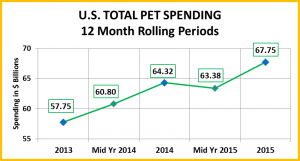
In our recent post on Pet Spending in the U.S. during 2014 we reported a 11.4% increase from 2013 to 2014 – $6.6B. The numbers were based upon the Consumer Expenditure Survey conducted in a cooperative effort by the USBLS and the Census Department. Here are the summary numbers:

PetAge-1

The obvious question was, “Where did the $6+ Billion dollars come from?” Are there demographic groups that are buying more…and conversely, are there groups that are underperforming? The best way to maintain and increase growth is by targeting your efforts to build on strengths and to correct weaknesses.

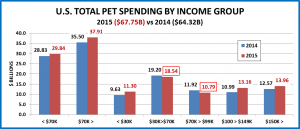
Since we were looking at Pet Spending, the first thing to do is “follow the money”. The first demographic that we looked at was income level. As expected, it was a complex answer but there were 2 household income levels driving overall Pet Spending: $120K and above….and $30 > $70K

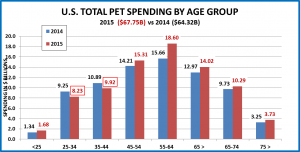
The $120K+ was no surprise but the $30>$70K group raised questions. An initial review showed a connection with another demographic…age. Two age groups, 25 to 34 and 65+ were showing exceptional increases in Pet spending. It’s worth a closer look at the consumer’s age in relation to Pet Spending.

First, let’s get an overview of the various age groups. The chart below shows how each age group compares to the U.S. average in terms of gross income, annual expenditures and pet spending.

PetAge-2

Observations

  • Income: Gross Income increases rapidly up to the 35>44 age group and peaks at 45>54. Then comes a gradual decline until age 75+, where it is about 19% higher than the under 25 group.
  • Expenditures: The “under 25” group actually spends more than their gross income. Expenditures rise in a pattern which closely follows Income, peaking at age 45>54. The ensuing decline is not as steep as income. However, at age 75+ expenditures once again exceed income.
  • Pet Expenditures: At age 25>34 Pet Expenditures “take off”, more than doubling. Pet Parents are “born”. Pet Expenditures begin 30 years of increases but peak at 55>64. This peak occurs when both income and total expenditures have started to decline. Pet Parents spend at a rate equal to or greater than the national average for 40 years. The big drop comes at 75+.

Let’s translate this into total $. Here’s how much each age group spent on their Pets in 2014.

PetAge-3

Now, let’s put each group’s spending into perspective with their…

  • Share of Households
  • Share of Pet Spending
  • Share of the $6B increase

PetAge-4

Observations

  • Age does matter as 71.3% of the increase is coming from consumers over 55 years of age. The 65>74 group is especially strong accounting for almost 40% of the growth.
  • The 25>34 age group is generating 23% of the increase. Young people are including Pets as a part of their “startup” households which is important for the future of the industry.
  • The largest pet spending group, 55>64 is showing a strong increase, accounting for 23.8% of the total increase. The second largest group, 45>54 is showing a decline largely due to 945K less H/H’s.
    Let’s take a look at spending by Industry Segment:

PetAge-5

Observations

  • Since Food spending is an absolute necessity for Pet ownership, it is obvious that the young people are “adopting” pets. It may also be an indication of their feelings in regard to higher quality brands.
  • The drop in the 45>54 age group is huge. The reason is basically twofold – 945K fewer H/H’s combined with a drop in actual household food expenditures – probably due to value shopping.
  • At age 55+ as their children start to “leave the nest”, older adults may turn their focus more to their Pets…spending more and even “adopting new family members”…up to age 75.

Next…Supplies

PetAge-6

Observations

  • The increase in supplies spending is almost universal across age groups, except for “under 25”.
  • The 25>34 group is the leader again, but the over 65 consumers are not far behind.
  • Significantly, the 45>54 group is showing a strong increase which is counter to their trend in Food.

On to Non-Vet Services…

PetAge-7

Observations

  • The Service segment appears to be driven by a combination of “need” and finances.
  • The 35>54 group certainly can afford Pet Services but they are choosing to “do it themselves”.
  • As consumer’s age, the need for Pet Services increases. In fact, 114.6% of the increase came from consumers 55 years old and older. Even the over 75 group had a significant increase despite their reduced resources.
  • The “startup” Pet Parents, 25>34 also had a huge increase. Their “need” may not be “physical” but could come from a lack of time due to a more active lifestyle.

Finally, Veterinary Services…

PetAge-8

Observations

  • The largest share of Vet Spending comes from the 55>64 age group. Through personal experience, as consumers age they become even more “aware” of the medical necessities of life. This carries over to their pets. This group has the greatest resources and they spend whatever is needed on Veterinary Care for their pets.
  • Almost all (97.8%) of the increase in Veterinary Spending comes from the over 55 group. The 65>74 group is the leader by far, accounting for 50.9% of the $3B increase.
  • The 45>54 age group accounts for 20.8% of Veterinary spending but only 7.9% of the increase. They spent slightly more per H/H but the drop in the number of H/H’s minimized the increase.
  • In a big change, the 25>34 group accounts for a relatively small share of Vet spending and it is decreasing. These new Pet Parents may not yet be aware of the value of regular Veterinary care.

Overview By Age Group

  • Under 25 – Not yet a significant factor with only 6% of households and 2% of Pet Spending.
  • 25>34 – This group, with 16% of the households and increasing income, is the future of the Pet Industry. Right now the future looks bright as they are showing significant increases in all Pet Segments except Veterinary.
  • 35>44 – With 17.1% of Households and 16.9% of Pet Expenditures, this is the point where Pet Parents start “earning their share” of the Pet Business. Only the Service segment is “soft” in spending. Perhaps this healthy, active group is the least likely to need “help” with their Pet.
  • 45>54 – This group is #2 in Pet Spending at 22.1% but they are actually showing a decrease. Their Pet Spending per Household actually increased slightly but there are 1,000,000 fewer households in this group. This is evidence of the “slump” after the “baby boom”. At this point, their income is high but so are their expenses, especially in regard to their human children. As a result, this group can be very value conscious in terms of Food and selective in their need for Non-Vet Services.
  • 55>64 – At this age, income and total expenditures start to decline, but Pet Spending reaches its peak as consumers focus on their “pet children”. Both Service Segments become big factors in spending. Supplies are just “holding their own”, but Food spending significantly increased in a tough market.
  • 65>74 – The average Pet Spending per household drops about 10% from the 55>64 group. However, they still spend 1.19% of all their expenditures on their Pets. Also, the number of households in this group increased 624,000 in 1 year. That produced a $2.6B jump in Pet Spending – 39.7% of the industry’s $6.6B total increase. This group is a major driving factor in the growth all segments of the industry.
  • 75+ – With 541,000 more households, this is also a rapidly growing age group. Although their Pet Expenditures per household are only about 50% of the national average, the growth in the number of households produced significant increases in spending for all segments other than Food. Actually, 25.2% of the increase in Non-Vet Services came from the 75+ group, which represents only 9.9% of all U.S. households.
  • 65+ – 23% of U.S. H/H’s; 1.1M more in 1 yr; Produced 47.5% of the total increase in Pet Spending.

A couple of Final Thoughts

  1. The over 65 group is a fast growing segment and dedicated to their pets. Develop products and programs to make “continuing” their pet experience easier and more affordable.
  2. There are a lot of “new” Pet Parents in the 25>34 age group. They need education and quality, affordable products to insure that their pet experience is rewarding…for a lifetime.

A 2 page detailed Appendix on Pet Spending by Age Group is available through the link below. Just click on the button to download and save the file as a PDF. If you would like this in Excel format, send me an e-mail request.

[button link=”https://petbusinessprofessor.com/wp-content/uploads/2015/11/Pet-Spending-by-Age-Group.pdf” type=”icon” newwindow=”yes”] Download Data (PDF)[/button]

Pet Prices Update: September 2015 – Things are looking UP↑

All segments – even Food, saw price increases in September. Overall we are rebounding after the huge July drop in Food  & Supplies prices took the whole industry negative. October and November should be calm with moderate increases leading up to December. That is the big question remaining. Except for 2014, prices for Food and Supplies have fallen in December since the recession. We’ll see.

Why does all this pricing info matter? Pricing is intimately linked with Consumer Expenditures. In our recent Post on 2014 Pet Expenditures we saw how steadily rising prices on Food and Supplies in the second half of the year helped change 2014 from a good year to a great year for supplies…and turned a negative into a positive for Food. By the same token, rapidly rising Veterinary prices contributed to lower income households spending $1B less on Veterinary Services. However, it’s not just low prices. It’s value. You can charge more if it’s “worth it”…and you can prove it to the consumer, who now can compare products and prices instantly.

First, let’s take a look at what 2015 looks like so far…

CPI-9-15-1

SPECIFICS ON CPI CHANGES

Veterinary Services

  • Sept – Up ↑ 0.15% (Last year Sept went Up ↑ 0.19% – about the same)
  • Year To Date: Up ↑3.71%

NonVet Services

  • Sept – Up ↑ 0.28% (Last year Sept was Flat 0.00% – big difference)
  • Year To Date: Up ↑2.90%

Pet Food

  • Sept- Up ↑0.70%% (Last year Sept went Up ↑0.40% – welcome increase)
  • Year To Date: Down ↓-2.24%…Huge!

Pets & Pet Supplies

  • Sept- Up ↑0.55% (Last year Sept went Up ↑1.38%…Less Volatile)
  • Year To Date:↓-0.12%…coming back!

Total Pet

  • Sept- Up ↑ 0.44% (Last year Sept went Up ↑0.60% – All segments are up – more moderation)
  • Year To Date: Up ↑0.61% – On track for a moderate increase.

OBSERVATIONS

  • Food prices are still “in the cellar”. Let’s hope the September increase continues through December to moderate the impact of the deflation on annual revenues.
  • Supply prices are moving in the right direction and with an annual increase almost certain.
  • Veterinary and Non-Veterinary services are showing greater than normal increases for this time of the year. This is the opposite problem to food but can and will affect spending by price sensitive consumers.
  • The Total Pet Market Prices will definitely stay positive for the year. The YTD increase of 0.61% looks pretty nice until you look beneath the surface and see that it is produced by strong inflation in the Services and the steep deflation in the Food Segment. The annual projection will be in an acceptable range. We just need moderation in the segments.

Next, let’s look at the monthly history over the last 23 months to put this month’s data into perspective. September of 2015 and 2014 are outlined so you can see the journey over the last 12 months.

CPI-9-15-2

COMMENTS

September is often a down month for Supplies but moderate for other segments. This year all segments turned up. This chart makes it easy to visualize our concerns. The Service Segments are basically going steeply up while the Supplies and Food Segment are on a roller coaster. Unfortunately, for Food the rollercoaster is “under water”. Total Pet is up about 1.1% versus a year ago.

The chart below consolidates key data and compares the 2015 YTD CPI to the 2014 annual CPI. It also includes an updated projection of the annual CPI change for 2015. December could produce a drop in Food and/or Supplies but October & November are generally up…across the board.

CPI-9-15-3

COMMENTS – BY INDUSTRY SEGMENT

Pet Food – The price deflation in this largest segment is the biggest concern in the industry. Prices dropped -2.35% from June to August, the largest 2 month drop in history. They finally turned up in September and should continue upward through November. If we are lucky they will continue upward through December, like 2014. There is not enough time for a full recovery but this would help to mitigate the impact of what is certain to be the second consecutive deflationary year for this segment. Prices are now down -2.24% since December, but last month they were down 2.93%. Right now Pet Food prices are still basically equal to 2012 – three years ago. Remember, with a segment like Food, deflation doesn’t cause consumers to buy more. They buy the same amount…just spend less. We are projecting an annual decrease in the CPI of o.84%

Pets and Pet Supplies – In the chart prices are down 0.12% since December. However, December was the pricing peak for 2014 which was a first since the recession. When you look at the annual numbers, we are 0.36% ahead of last year’s overall pricing with at least two more months of highly probable increases. We may still see a price drop in December but we’re looking at a projected CPI increase of 0.65%

Since 2009, Supply prices have fallen 5.0%. Prices were flat in 2011(up 0.05%) but every other year showed a decline, with the biggest drop (down -2.1%) coming in 2013. It takes time and consistency to stop deflation. Let’s hope 2015 is the marks the beginning of the turnaround.

NonVet Services – Inflation in this segment is becoming an increasing concern. Instead of prices flattening out in the summer and early fall, the increases are accelerating. We now expect prices to increase 2.24% in 2015 but they could go higher. They are actually 2.9% above September 2014. This could slow the segment’s overall growth and limit the appeal to value driven consumers.

Veterinary Services – Prices in the Veterinary Services Segment are projected to be Up 3.54% in 2015. It looks like the segment will beat last year’s price increase of 3.5%. We saw in our recent post on 2014 Pet Expenditures that the segment continues to grow strongly but the increases are generally coming from the high income Pet Parents – $120K and above. Low income households spent $1B less.

Total Pet Market – We could be seeing the “beginning of the end” of the deflation that has plagued the Supplies segment since 2010. It’s a welcome change to have good pricing news for Supplies. The huge Food segment is the biggest ongoing concern. A second consecutive year of deflation is a certainty. Historically, food prices have only dropped in one other year – 2010 (-0.4%). We should note that this decrease came after an 8.6% increase in 2009, in the heart of the recession. It’s remarkable that the drop wasn’t greater. Deflation appears to be good for the consumer. It’s cheaper…I can buy more. That doesn’t work for products like food and it puts tremendous pressure on manufacturers and retailers. This can ultimately result in reduced choices for consumers…which is not good…and there is no easy fix. Make no mistake. You can charge more for your product. There is only 1 requirement. As we have often said, today’s consumers are searching for Value (quality + price). To charge more, you just have to be able to prove that the increased price is worth it…to an increasingly informed consumer…who can compare similar products and prices from a variety of retail channels while standing in the retail aisle. The Service Segments have the opposite problem… as prices continue to spiral upward. A high inflation rate may increase revenue as consumers pay more but it can and will eventually limit the appeal, resulting in a reduced market penetration and ultimately a reduction in the amount of services sold.

With all this “turmoil”, the projected inflation rate for Total Pet is a reasonable 1.1%!

This last chart should help compare the recent up/down performance of each segment:

CPI-9-15-4

The turnaround for Supplies is apparent. You can also see the ongoing deflation problem in Food. Prices are even slightly below 3 years ago. The rising prices in the Service Segments are accelerating in 2015 and a big contrast to the Product Segments. I really like this chart as a visual reminder to look closer at what is producing the numbers in any analysis of data. The Total Pet numbers look very calm and controlled with an annual inflation rate of about 1%. However, when you look below the surface you see the turmoil in the segments that produced these “calm and controlled” overall numbers.