

Comparing the 2024 Spending Demographics of the Industry Segments – SIDE BY SIDE
The first reports of our Pet Spending Demographics analysis have been very detailed and intense. We looked at the industry as a whole and each of the individual segments. Recent years have seen some turmoil. We have seen the very real impact of outside influences on the industry. In the 2nd half of 2018, the FDA warning on grain free dog food caused a $2.3B drop in Food $ and new Tariffs flattened Supplies $, but Services had a record lift. In 2019, Food rebounded but the tariffs hit the Supplies segment with a $3B drop. Vet $ grew slightly while Services $ fell a bit. The net was -0.2% drop in Total Pet. The 2020 pandemic had varied impacts as Pet Parents focused on needs. This caused a lift in Vet and a huge increase in Food because some demographics binge bought out of fear of shortages. Services spending plummeted due to closures and restrictions while Supplies $ continued to fall because consumers saw them as more discretionary. 2021 brought a big change, Food $ fell because there was no “binge” repeat. However, Pet Parents focused on their “children” producing a widespread record lift in all other segments and a $16B increase. In 2022, after the record lift in 2021, spending fell in Supplies and Vet, but Food was +12.5% & Services continued to surge. This produced a 2.7% lift in Total Pet $. In 2023, the industry recovered with spending lifts in all segments for the 1st time since 2014. Big lifts in Veterinary and Food drove the 3rd largest increase in history, +$14.9B. Total Pet $ reached $117.6B. In 2024, Food $ fell, but a big lift in Vet & small increases in Supplies & Services pushed Total Pet up +1.1% to $118.87B.
We have often referenced the similarities and differences in spending between Total Pet and the individual industry segments. Total Pet Spending is a sum of the parts and not all parts are equal. In this final report we are going to put the segments side by side to make the parallels, differences and changes from 2023 more readily apparent. We will address:
- “The big spenders” – those groups which account for the bulk of pet spending.
- The best and worst performing segments in each of twelve demographic categories
- The segments with the biggest changes in spending $ – both positive and negative
- And of course, the “Ultimate Spending CUs”
The emphasis is on “visual” side by side comparisons to allow you to quickly compare the industry segments. We’ll try to minimalize our comments. You can always reference one of the specific reports for more details. We’ll also break the charts up into smaller pieces that are demographically related to make the comparison more focused and easier.
Let’s first take a look at the current market share of the industry segments. The following 2 charts show the 2024 share of spending for each segment and the evolution over the past 30 years. 1992 was the last year that Food accounted for 50% of Total Pet Spending. In 2024 they are 33.7% and fell to 2nd place. BTW: Total Pet Spending was $16.2B in 1992. We have come a long way, +634%; annual growth rate of 6.4%. This will help put our comparisons into better perspective.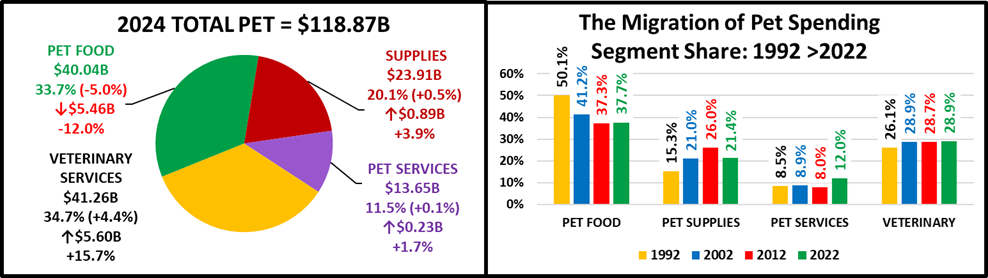
In 2024, Veterinary gained 4.4% in share in Total Pet $ from Food. The most notable trends from 1992 to 2012 were the decline in Food share while Supplies gained in importance. Both of those have ended. Supplies have been trending down since 2012, hitting bottom at 18.1% in 2020 but are again above 20% in 2024 (20.1%). In recent years, Food has been on a rollercoaster. It reached 44% in 2020, the highest level since 44.8% in 1998, but fell to 33.7% in 2024. It is now #2 in share. The Services segments have been more stable. They have generally trended up since 2012. After falling to 8.2% in 2020, Non-Vet Services peaked at 12% in 2022, then stabilized. Except for the 39%, 22>24 lift, Vet share has been in the 25>28% range. In 2024, they took the top spot from Food with 34.7%. All are impacted by outside influences but Food trends and Petflation tend to make the Product Segments more volatile than the Services Segments.
Now let’s get started with a look at the “Big Spenders”. The following 2 charts will compare the market share and performance in all Pet Industry segments by the groups responsible for the bulk of the spending in 10 demographic categories. These are the groups that we identified in our Total Pet analysis to generate at least a 60% market share of spending. As you recall, to better target the spending we altered from 1 to 4 groups in all but Supplies. However, to have a true side by side comparison we need to use the same groups for all. The groups that we chose make sense but 3 are different from 2023. You will see that in a few cases, the share of $ is close but does not meet our target of 60%. Most of these are due to Food spending becoming more balanced.
The chart makes it especially easy to compare share and performance across categories. Remember, performance levels above 120% show a very high level of importance for this category in terms of increased spending. Unfortunately, it also indicates a high spending disparity among the segments within the category. There are 2 charts, each with 5 categories. The categories are listed in share of Total Pet $ – from highest to lowest.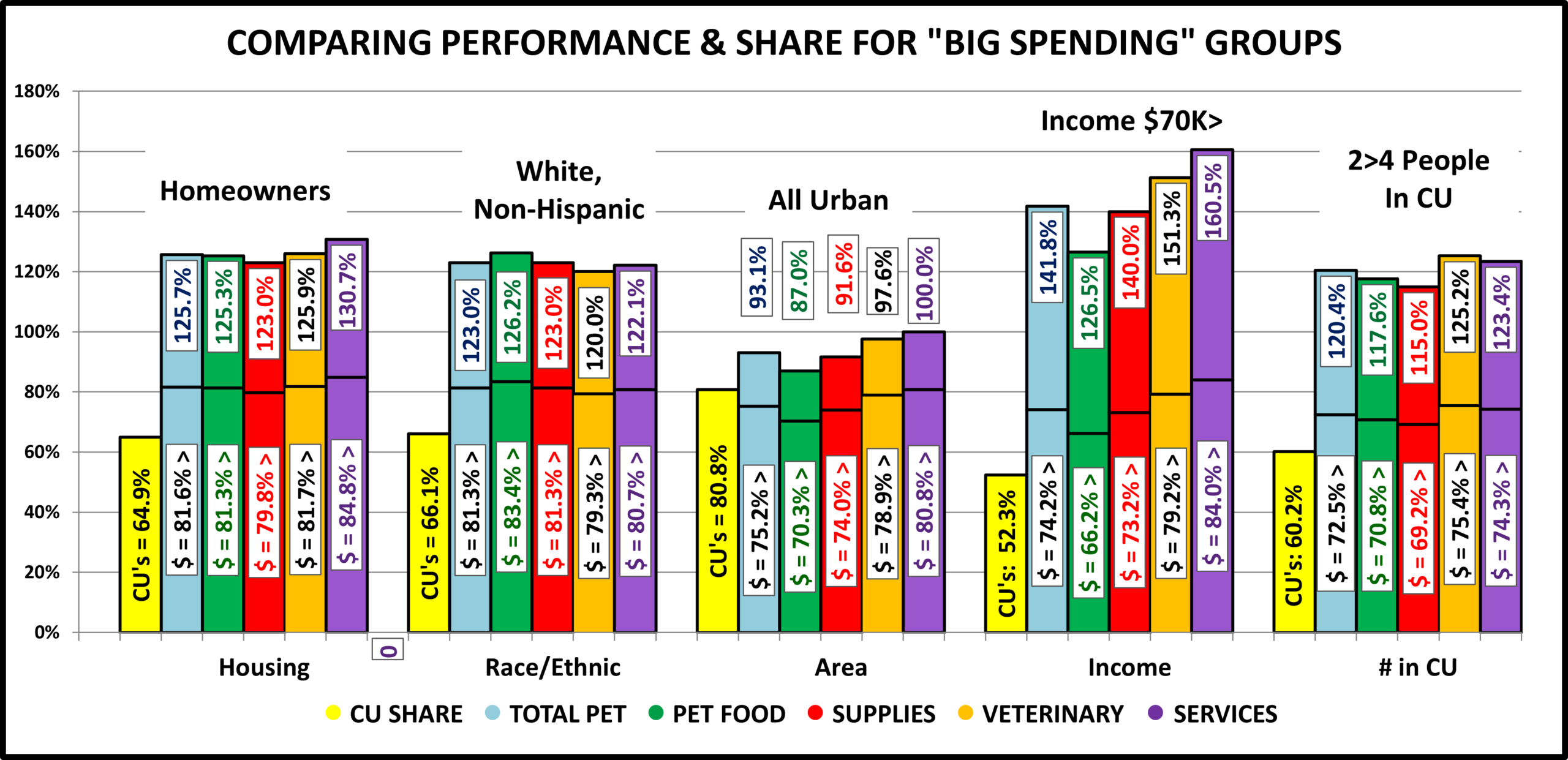
- Homeowners – Homeownership is very important in Pet Ownership and subsequently in all Pet Spending. It also increases with age. In 2024, only Supplies are below 80%. In 2023, Food & Total were also <80%. The group gained 2.0 % in Total Pet share – gains in Products, losses in Services. The group was very mixed. W/O Mtge mirrored the overall pattern. W/Mtge were only down in Food. Renters were only up in Veterinary.
- White, Non-Hispanic – This group has a 79.3+% market share in every Segment. Minorities account for 33.9% of CUs but only 16>20% of spending in any segment. Factors: Lower income for Hispanics and African Americans and lower Pet ownership in Asians and African Americans. Whites lost share in Total & in all segments but Food. Minorities gained in Total by slightly different paths. Hispanics & Afr. Amer.: ↑All but Food; Asians: ↑Food & Services only.
- Urban – They gained 1.3% in Total Pet. Gains in Supplies, Services & Food overcame a small drop in Vet. The Suburbs 2500> only gained share in Supplies & Vet. Center City had the exact opposite pattern as they only had gains in Pet Food & Non-Vet Pet Services. Rural Areas lost share in all but Veterinary.
- Over $70K Income – INCOME MATTERS MOST IN PET SPENDING! Income has grown in importance, and all segments, but Food performed at 140+%. $70K> gained 1.8% in CU share and 4.2% in Total. They had gains in all segments. Food: +5.2%; Supp: +1.1%; Serv: +3.0%; Vet: +4.0%. Spending appears less balanced in income for all segments. However, the situation is more complicated. Consider this: No income group gained in all segments but, $40>99K gained 6.6% in Food share. As I said, spending is complex, especially in Food.
- 2>4 People in CU – 2+ is still the key in pet ownership. However, the results were mixed. Singles & 3 people CUs lost share in every segment. 2 People gained share in all segments but Supplies. 4 people gained in all but Food. 5+ People only gained in Food & Veterinary. In 2022>23, 3 People was the only size to gain share in Total and in every Industry Segment. That ended. Now, no size is up for all. However, 2 People still has the biggest share in all.
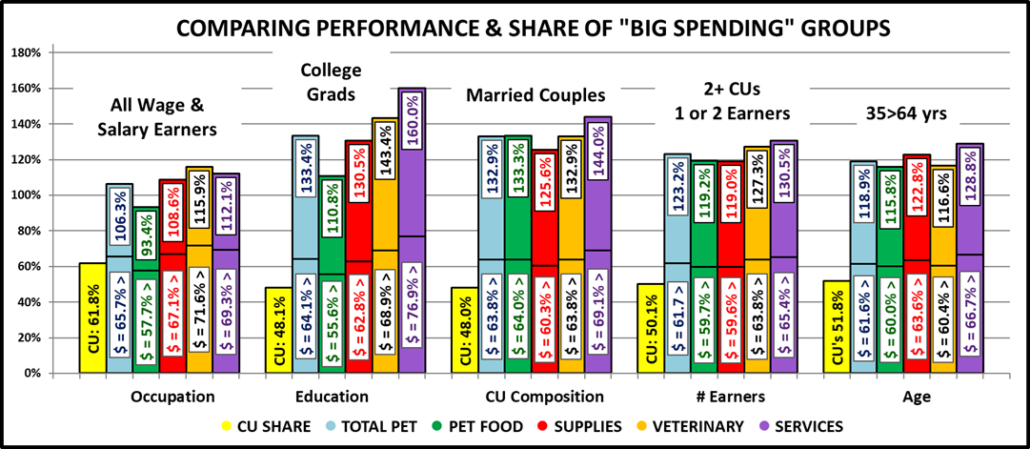

- All Wage & Salary Earners– Incomes vary widely in this group, so performance is often lower. The group gained 0.9% in CU share and 1.0% in Total Pet. Products lost share while all Services gained. The lift was driven by Managers. They spent more in all but Food but gained share in all segments. The only other occupation to have a lift in Total Pet was A/O, Not listed. They were only up in Food & Vet.
- College Graduates > – Associate’s Degree gained 0.1% in Total Pet share but it still makes sense to limit the Education group to College Grads only. College Grads increased spending and gained share in all segments but Pet Food. Their +$4.98B Pet lift was 4 times the National +$1.27B lift. Even their $5.3B Vet lift was 95% of the National +$5.6B lift. Education has gained importance. It is #2 for Total Pet, Veterinary and Supplies; #3 for Services segments but is only #8 for Food.
- Married Couples – Marriage is 1st in importance to spending in Food, 3rd in Total, Veterinary & Supplies but falls to 4th in Services. In 2024 their share & performance grew in all but Supplies. The best performer inside the group was CUs with a child 18>. Outside of the group, it was Unmarried, 2+ Adults.
- 2+ CU, 1 or 2 Earners – Income is important, but not always the # of Earners. The group’s share grew for all. It was a great year for 2 Earners. All were up with 120+% performance. It was bad for 1 Earners. They lost share in all but Services. Their Performance was <83% for all but Food, +111%. BTW – 3+ Earners lost share in all but Veterinary.
- 35 to 64 yrs – Includes the 3 highest income segments. They had share changes in all: Total Pet: +2.9%; Food: +6.5%; Supplies: +1.9%; Serv: -1.0%; Vet: +4.6%. They are now above 60% in share for all segments. Overall, spending by age group is becoming more balanced. This is especially apparent in Pet Food. 25>34 yr olds perform at 92.6%. All other age groups up to 75 perform above 98%. Definitely more balanced.
Now we’ll look at the Best/Worst performers in each category. Highlighted cells are different from Total Pet; * = New Winner/Loser; ↑↓ = 5+% Performance Change from 2023. The categories are divided into related groups. 1st, Income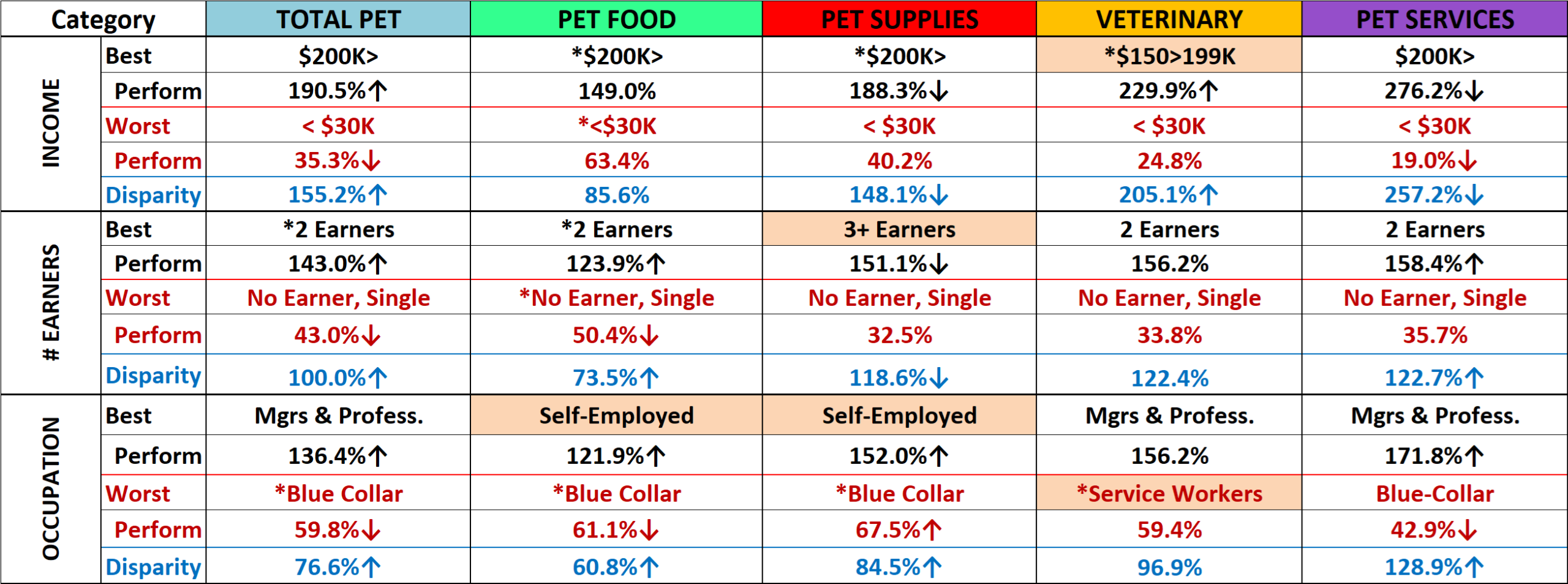
- Income – Income matters. All winners were $150K> with 3 changes from 2023. The disparity between 1st and last place in Total grew by 15%. Veterinary was +30% but Supplies fell by -32% and Services by -30%. Food disparity was unchanged and still the lowest. The most balanced spending is in Food and the least balanced is in Services.
- # Earners – The highest income 3+ Earners group fell from the top in 2 segments. They were replaced by 2 Earners in Total & Food. The most impactful changes were in Food which drove its disparity up 34% & even 26% in Total (now 100%). Disparity dropped -22% in Supplies, but it grew by 13% in Services & only 4% in Veterinary.
- Occupation– Mgrs & Professionals are #1 in CU income and expenditures, but again Self-Employed is the best performer in the Product segments. Blue Collar Workers now “rule” the bottom spots, with the only exception Service Workers in Veterinary. The spending disparity increased by 23% in Total & Food, 22% in Services and 5% in Supplies. Veterinary had no change but in 2023, it was +33% vs 2022.
Next are demographics of which we have no control – Age, Generation and Racial/Ethnicity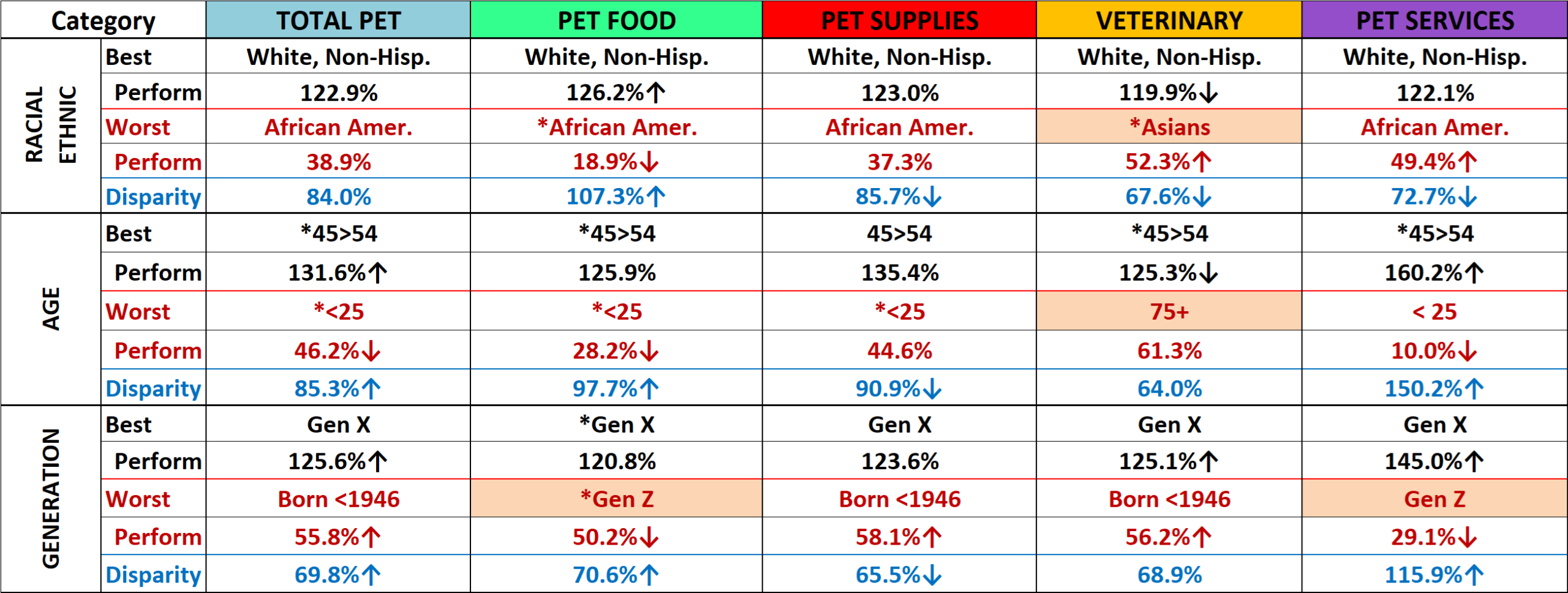
- Racial/Ethnic– White Non-Hispanics are the top performer in all segments and African Americans are on the bottom in all but Vet They have the lowest income and only 25% own Pets. High income Asians did replace them in Vet., but they also have low Pet ownership. Total Disparity was -3%. All but Food were down. Food: +24%; Supplies: -7%; Vet: -35%; Services: -19%. Food is now significantly less balanced. All others improved.
- Age – The 45>54 yr-olds are again the “rulers”. They replaced older groups. The bottom is even younger. Only 75+ in Vet is not <25. The Total disparity grew +17%. 2 Segments were down – Supp: -7% & Vet: -4%. 2 Segments were up – Food: +42% & Services: +43%. Some big swings, but again only 1 is over 100% – again Services. In 2022, it was Vet.
- Generation – Gen X now “rules” all. Gen Z is now at the bottom in Food & Services while Born <1946 is the worst in the others. Disparity was +14%. Supplies (-24%) & Vet (-2%) were down. Food (+15%) & Services (+20%) were up.
In the next 6 categories, we have at least some control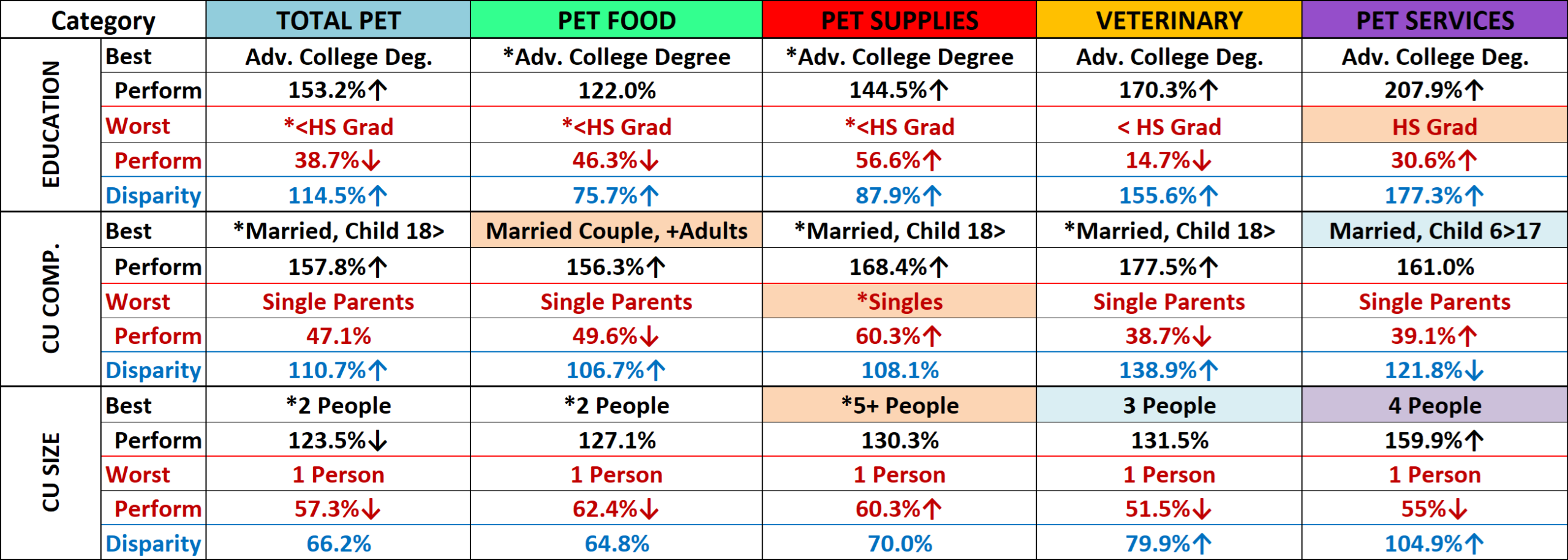
- Education – Higher Education generally correlates with income. The winners have Adv College degrees while only 1 loser finished HS. The Disparity gap rose +33%. Food: +40%; Supp: +14%; Vet: +32%; Serv: +10%. Income matters.
- CU Composition – Only 4 of 10 are different from 23. In 23, there were 9. Except for Food, married w/kids wins. The loser is Single Parents for all, but Supp. Disparity rose 23%. Food: +24%; Supp: -3%; Serv: -6%; Vet: +43%.
- CU Size – 3 different winners, while 1 Person remained solidly on the bottom. Disparity rose +4%. Food:+4%; Supp: -2%; Vet: +6%; Serv: +43%. A big increase in Services (now 100%>) & small lifts in Vet & Food, but a drop in Supplies.
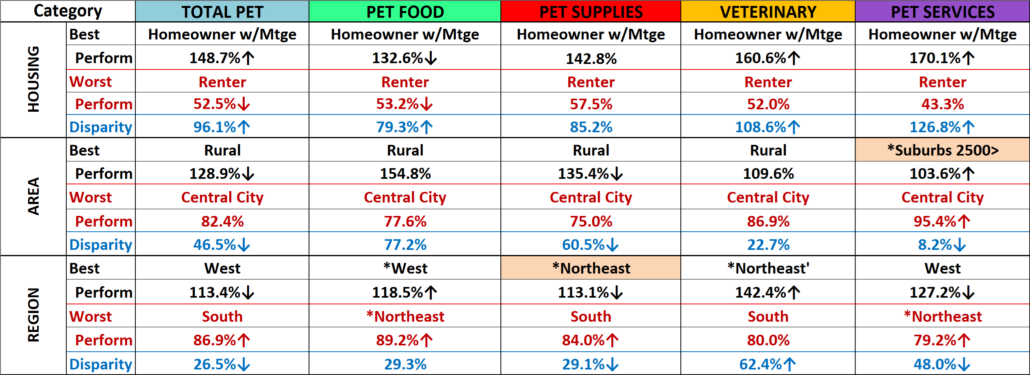
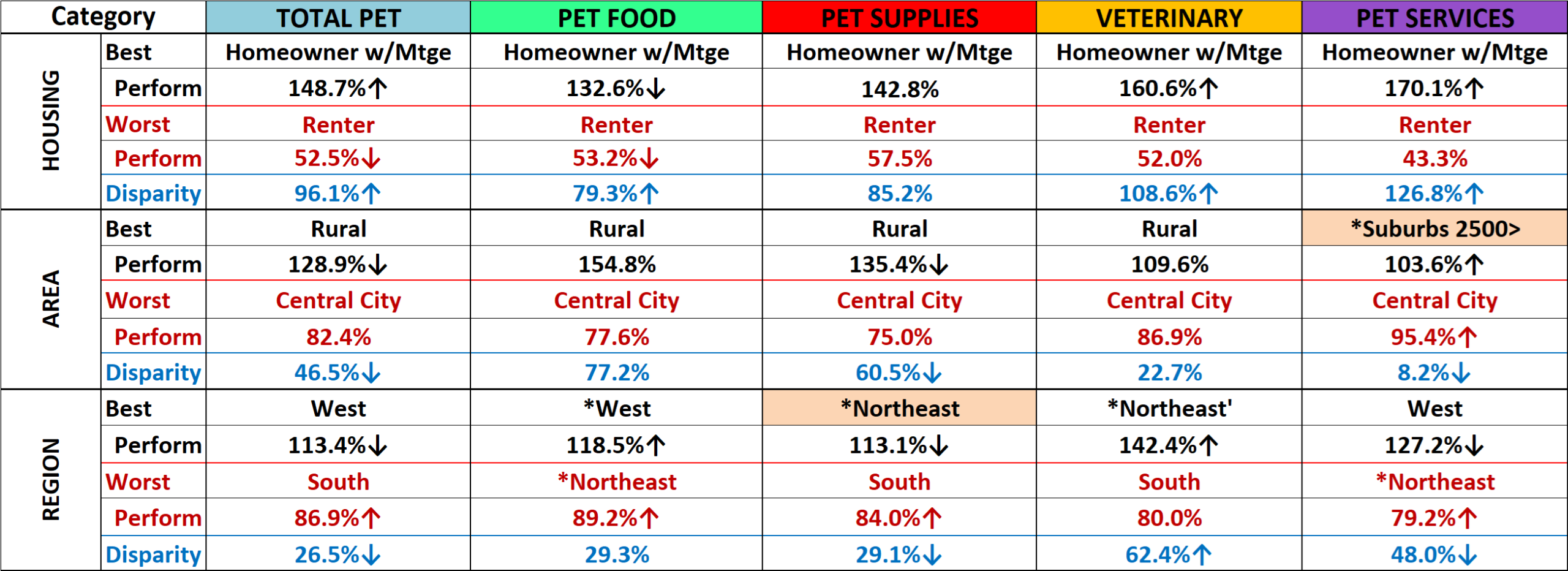
- Housing – The perennial winner and loser. Disparity rose 11%. Food (+6%), Supp. (+4%), Vet (+20%), Serv (+9%).
- Area– Another perennial winner (except for Serv) & loser. The disparity fell -9%. Food (-5%), Supp (-14%), Vet (+1%) and Serv (-14%). The most notable change was the big lift in Services spending in Center City areas.
- Region – The West is on top for 3, The Northeast 2. South is at the bottom in 3, Northeast 2. Midwest is off of the chart. Disparity fell -14%. Food (-0.7%), Supp (-26%), Vet (+9%) and Serv (-12%). This is the lowest disparity category.
Here are the categories with the biggest & smallest disparities for Total Pet & each industry segment.
The fact that income produces the biggest spending disparity is no surprise. Pet spending is driven by income. The low Food Income disparity and the Regional “wins” reflect a growing balance in spending in a few categories. In Area Type, Services spending is expanding beyond high population areas while Veterinary spending is now growing in Center City.
Now, here are two summary charts. The first compares the averages.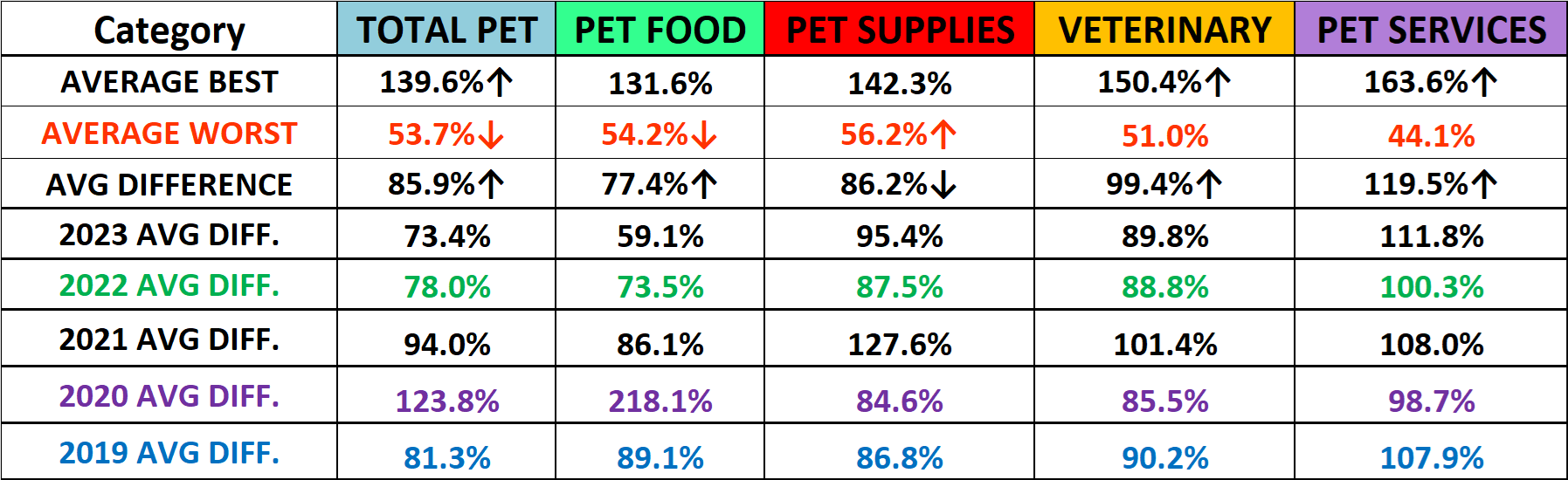
The disparity grew for all but Supplies. A big increase by Food helped drive Total up. Only the disparities for Food & Supplies are below 2019 levels. Food has the lowest disparity for the 4th straight year. The gap generally grows as you move from Products to Services. Non-Vet Services is again on top & have the only gap over 100%. The Vet disparity also grew and it moved up from 3rd to 2nd highest. Total Pet is up 10% from 22 & 17% from 23, less balanced.
- Food – Up 31% from 2023, but -13% from 2019 and -65% from the 2020 binge. They are still the most balanced.
- Supplies – The record 2021 increase produced a record disparity. Disparity fell in 24 & made them equal to 2019.
- Veterinary – Their 2021 lift increased the difference to 100+%. With the 2024 lift, they are now above 2019.
- Services – Only a small $ lift in 2024, but the gap widened by 7%. They are again the only segment over 100% .
This chart shows the number of new winners/losers.
There was slightly more turmoil than in 2023, (40 changes, up from 39) but Food again led the “pack” with over half of the winners & losers changing as their spending plummeted in 2024.
- With a huge $5.46B decrease in 2024, the turmoil in Pet Food grew with 15 changes (up from 11). However, there were more new losers than winners – the opposite of 2023.
- Supplies spending grew in 24 and the # of changes rose from 8 to 9. Winners: Again 5; Losers: 4 up from 3
- The Veterinary lift was again big and the # of changes fell to 6 from 9.
- Services growth slowed but the # of changes fell from 4 to 3. Winners: 2 (down from 4); Losers: 1 (up from 0)
Now, let’s look at the Demographic Segments with the Biggest Changes in $. We’ll truly see some differences between the Industry Segments. We have color highlighted differences from Total Pet. Plus: ↔ = Winner/Loser same as 2023; ↕ = Flipped from 1st to Last or vice versa
First, the Income related categories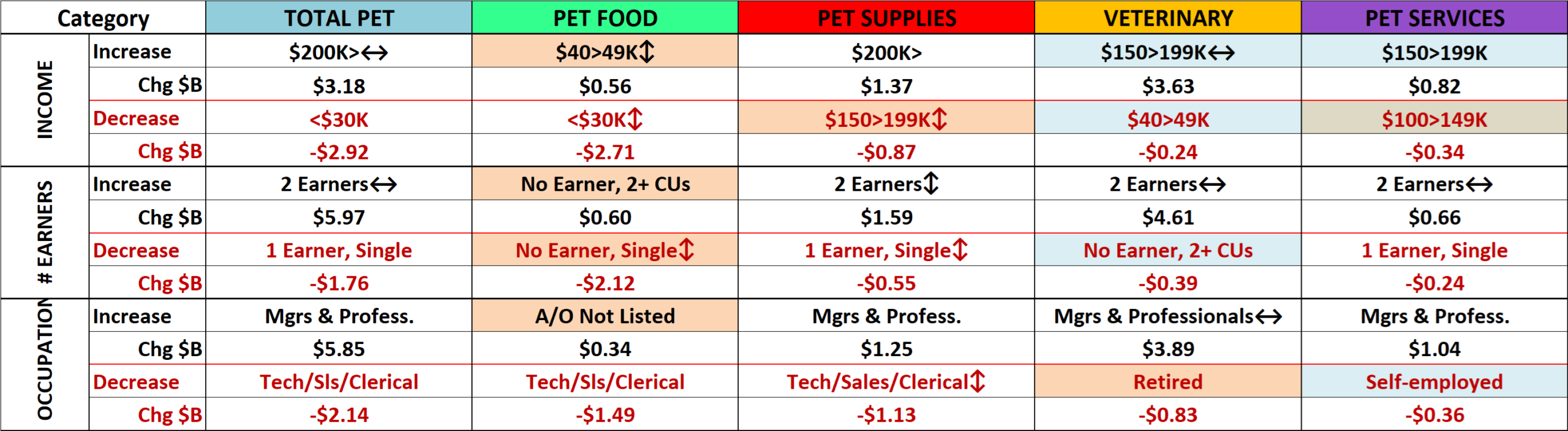
- Income – 3 winners & 5 losers were new with 3 flips. 4 winners are over $100K and 2 losers. 3 losers were below average income and <$50K. It looks like the win by $40>49K in Food was accomplished by trading Vet $.
- # Earners – All but 3 are new with 3 flips. In all but Food, the winners were high income. The losers are all low income. Stability only in Service segments. All flips were in Products. Both the winner & loser flipped in Supplies.
- Occupation – Only 1 repeat and 1 flip. The high income, Mgrs & Professionals won in 3 segments & Total. The low income A/O which includes unemployed won in Food. Tech/Sls/Clerical flipped to the bottom in Supplies and also lost Food & Total. Retirees lost Veterinary. The biggest surprise was that the high income Self-employed lost in Services. We should also note that there are no Blue Collar workers on the 2024 chart – win or lose.
Now the Age and Racial/Ethnic Categories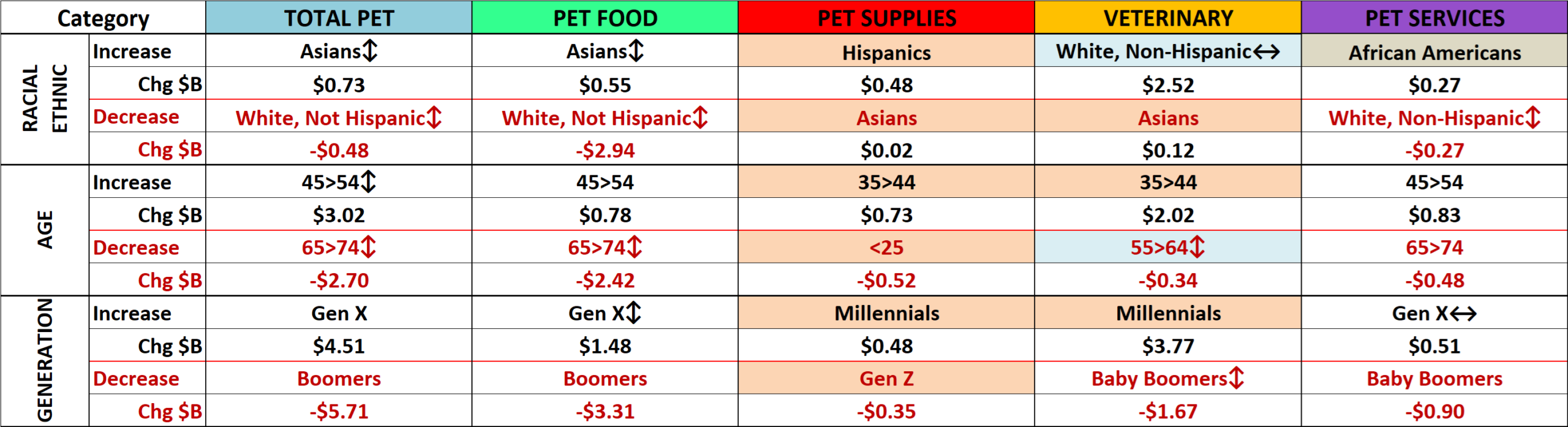
- Racial Ethnic – 1 repeat & 5 flips. White, non-Hispanics won in all in 2023. In 24, they only won Vet and flipped to the bottom in Services, Food & Total. Asians lost Supplies & Vet (smallest lifts) but won in Food & Total. 2 surprise winners – Hispanics in Supp & Afr. Amer. In Serv. 2024 was good for Minorities: +8.5% in Total Pet $. Whites: -0.5%.
- Age – No repeats and 4 flips. There were only 2 different winners, 45>54 & 35>54. In 2023, 4 were 55>. In 2024, 65>74 was the big loser. They lost Services & flipped from 1st to last in Food and Total. There were 3 different losers. 55>64 lost in Veterinary and the <25 yr-olds lost Supplies. This is not surprising as they had a 63% lift in 2023. <25 had a great year in 2023 with lifts in all segments, but they are by far the smallest segment. 2024 was a big turnaround. Total was -33%. Their only lift was in Vet. All other segments were down over -50%.
- Generation – 1 repeat & 2 flips. Spending skewed a little younger. Millennials won in Supplies and Veterinary. The high income Gen Xers won everything else, including flipping to the top in Food. Boomers were the big losers. They flipped to the bottom in Veterinary but lost in all segments but Supplies. That “honor” was saved for the youngest group, Gen Z. The drop was not surprising, after a +75% lift in 2023.
Now, here are more Demographic Categories in which the consumers can make choices.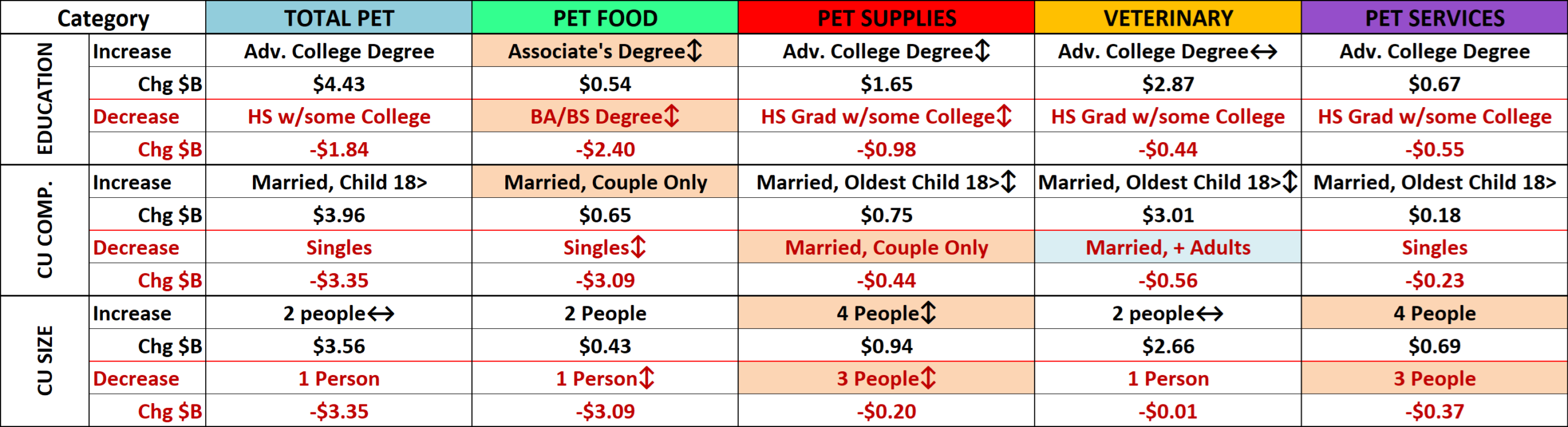
- Education – 1 repeat & 4 flips. Higher education is usually tied to increased income and pet spending but not always. It was a strong year for Adv Degrees with wins in all but Food (Assoc.) HS Grads w/some College lost all but Food (BA/BS). It appears that having a Master’s Degree or PhD really mattered in 2024.
- CU Comp. – No repeats but 3 flips. Married, Couple Only won Food. The other wins were by Married, Oldest child 18>. None of the losers had children. Singles lost 3 – Food, Services & Total. Married, Couple Only lost Supplies. Married, + Adults, No Kids lost Veterinary.
- CU Size– 2 repeats & 3 flips. Only 2 different winners. In 23 there were 4. 2 People won in Food, Veterinary and Total Pet. There appears to be a pattern: 2 & 4 people win; 1 & 3 people lose.
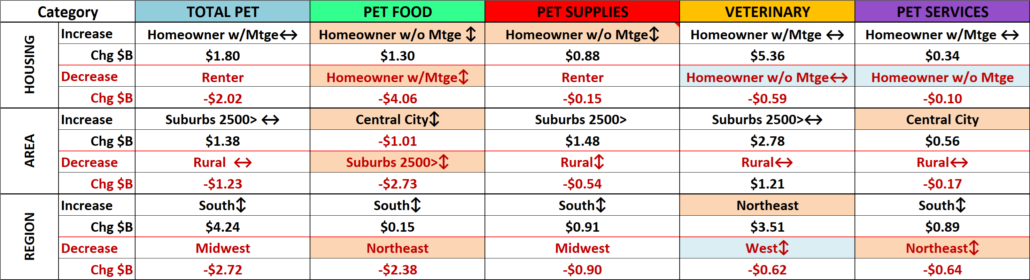
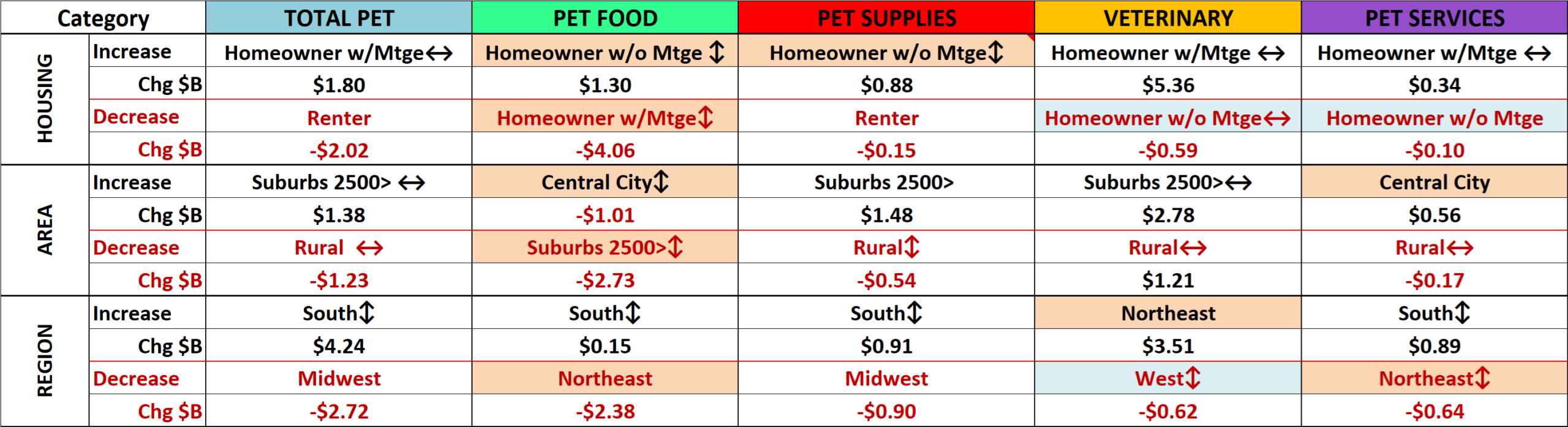
- Housing – 4 repeats & 3 flips. No segment where all spent more. In 23, there were 3. Homeowners w/Mtges are on top in Services, Vet & Total. W/O Mtge won in Products. Renters lost in Supplies and Total Pet. Homeowners w/o Mortgage lost in segments. We should note the dual flip in Food but only a single flip in Supplies. This is the first year since 2021 that Supplies didn’t have a dual flip.
- Area – 5 repeats with 3 flips. The big Suburbs are the normal winner. They held onto the top spot in Vet & Total and won in Supplies. The only other winner was a surprise, Central City. They won Services & Food. Food was unusual as they won with the smallest drop. All groups spent less on Food. Rural stayed on the bottom in Veterinary, Services and Total and flipped to the bottom in Supplies. The only other loser is usually a winner. Suburbs 2500> spent $3.1B more on Food in 23. In 24, their Food spending was -$2.73B so they flipped to the bottom in this all-negative group.
- Region – Again no repeats but 6 flips. The South flipped to the top in Total and all segments but Veterinary. The Northeast won Veterinary. The loser list provides our only view of the Midwest – lost in Total & Supplies and the West – lost in Veterinary. The Northeast is still around. They lost in Food & Services.
The next chart compares the number of repeats, “flips” and new segments among the 12 winners and 12 losers for each industry segment. The idea is to look for patterns in the data that cross segments. Let’s take a look.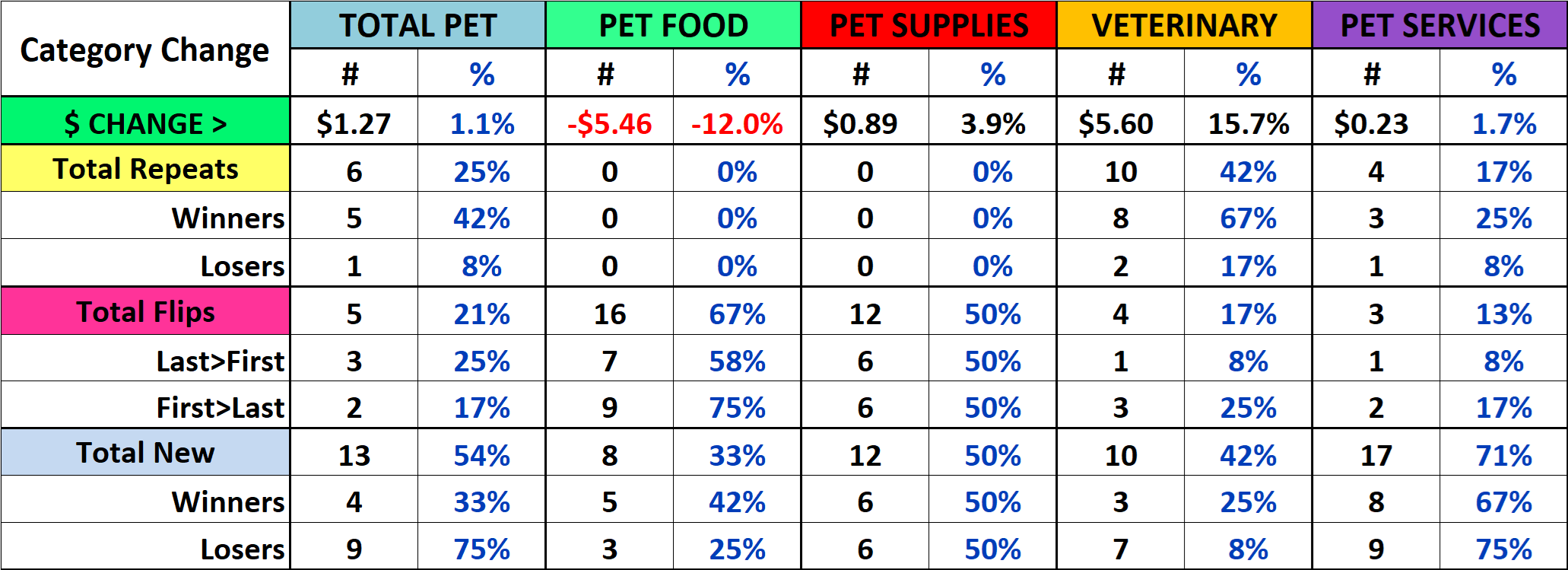
- All $ales but Food were up. Food had a big drop. Vet had a big lift while the Supplies & Services increases were small.
- After 2 big increases, Vet is the biggest $ segment. They are also the new repeat leader (10, up from 1)
- Total Pet also shows slightly increased stability. 6 repeats, up from 4 in 23. They did have 5 flips, up from 3 in 23.
- Services dropped from 7 repeats to 4, behind Vet & Total. However, they again have the fewest flips, 3 (up from 2)
- With a big drop in Food spending and a small lift in Supplies, Products showed the most turmoil. Neither had any repeats. Food was the leader in flips, 16 (up from 4) and Supplies was #2, with 12 (up from 9).
- There are 24 winners/losers. Here’s the number different from 23. (last yr vs 22) Food: 24 (19); Supplies: 24 (20); Vet: 14 (23); Services: 20 (17); Total: 18 (20). More turmoil in all but Vet & Total, especially bad in Products.
Next, there were many positive contributors so that in each individual report we recognized 6 segments that didn’t win but still performed so well that they deserved Honorable Mention. I reviewed that list again and came up with segments that won Honorable Mention at least twice. Here are the 5 “SUPER Honorable Mentions” for 2024…
5 segments made the list, 2 less than 2023. Services & Total Pet tied for the lead with 4 segments on the “Super” list. Supplies had 2 and Food & Vet had only 1. All segments but Millennials on this year’s list are generally “low profile” but contributed notably to the industry. We should give special kudos to 75+ yr olds and the low middle income $70>99K group. These 2 groups won Honorable Mention in 2 Industry segments and Total Pet.
Although the results were mixed, with numerous individual changes, here are some trends of note:
- Older Youth Movement – Boomers may be fading. The Gen Xers had a strong year are the spending leader in Total Pet and all segments but Food. Spending is skewing towards their 45>54 yr old, wealthiest members. Millennials had a good year as they prepare to take their turn on top. Gen Z had drops in Products & Total but they’re “in the game”.
- The “Magic” number may be 2, but any number but 1 – As spending has skewed a little younger the best performing CUs vary by segment. Total’s best is 2; Food: 2; Supp: 5+; Serv: 4; Vet: 3. However, 2 person CUs still have the largest share of CU’s, 33.2% and 106+% performance in Total Pet and every segment. Definitely magical.
- Best spending balance in Food – The performance gap between the best and worst is the lowest in Food but only narrowed in Supplies. It widened in all others. The disparity is slightly less than in 2019 for Supplies, but only significantly less for Food. The Service segments have the biggest disparity. Non-Vet Services is the worst, 119.5%.
- Income is still the most important factor – The gap between best & worst did not significantly change in Food, narrowed in Services & Supplies, but grew in Total & Vet. The disparity in income is still the biggest of any category.
And Finally, What you have all been waiting for…
THE ULTIMATE 2024 PET SPENDING CUs – Side by Side
Color Highlighted cells are different from Total Pet; * = New in 2024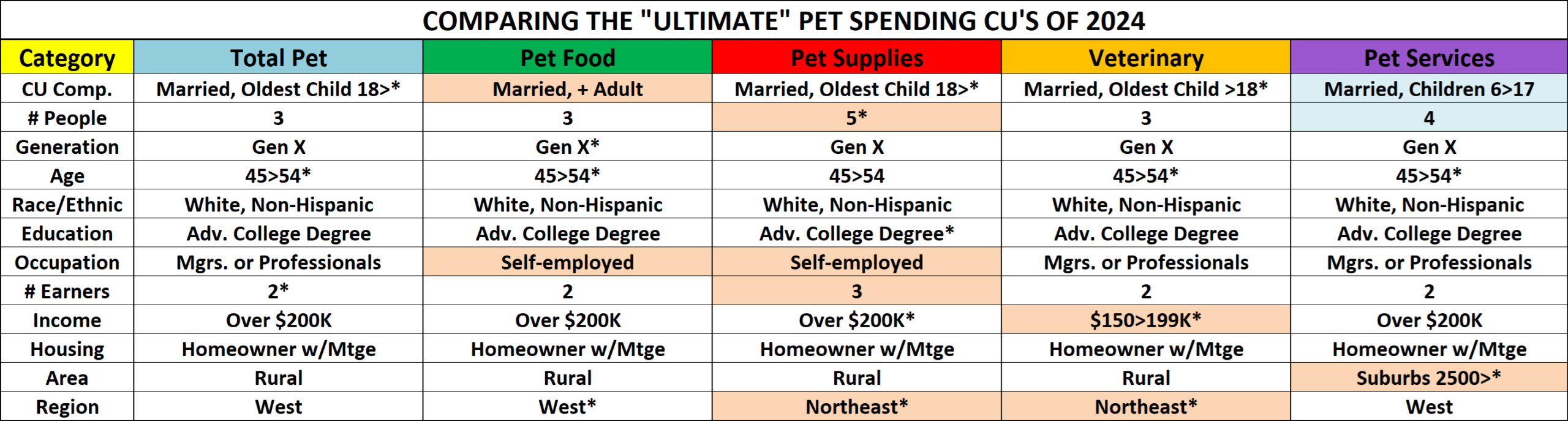
Methodology – The segments are chosen because they have the highest annual CU spending of any segment in the category. They may or may not have the most total dollars. That would depend upon the number of CUs in the group.
Final Comment – These “winners” further reinforce the key factors in increased pet spending:
Marriage– A commitment to another person demonstrates that you can make a commitment to your pet “children”.
CU Size – The “magic” number is 3 for Total, Food & Veterinary. Non-Vet Services: 4; Supplies: 5+.
Homeownership/Area – Owning and controlling your own space has long been a key factor in Pet Parenting.
More space – Small suburbs near a big metro area offer the convenience of the city, plus room for more pets. Bigger Suburbs work better for Services because there are more outlets.
Income Matters Most – High Income, A High Paying Occupation, An Advanced College Degree, At least 2 Earners. These are characteristics present in all of the Ultimate Pet Spending CUs.
Generation/Age – Gen X now rules. The 45>54 yr olds are the highest income group and all Gen X.
Region – Take your pick – Northeast or West, just not the Midwest or South.
I hope that this Visual Comparison helped you to get a “satellite view” of Pet Industry Spending in 2024 . Please refer back to the individual segment reports to get more details.
There is one consistent winner in the Pet Industry…
…OUR PET CHILDREN

