Petflation 2025 – July Update: Jumps up to +2.6% vs Last Year

The monthly Consumer Price Index peaked back in June 2022 at 9.1% then began to slow until it turned up in Jul/Aug 2023. Prices fell in Oct>Dec 23, then turned up Jan>Oct 24 but fell -0.1% in Nov. However, they have now risen for 7 straight months, including a 0.2% lift in July to a new record high. The CPI vs 24 also increased slightly to +2.70% from +2.67% in June. Grocery prices rose 0.1% from June but the YOY inflation slowed from 2.4% to 2.2% due to a +0.3% Jun>Jul price lift in 24. Even minor price changes can affect consumer pet spending, especially in the discretionary pet segments, so we will continue to publish monthly reports to track petflation as it evolves in the market.

Petflation was +4.1% in Dec 21 while the overall CPI was +7.0%. The gap narrowed as Petflation accelerated and reached 96.7% of the national rate in June 22. National inflation has slowed considerably since then, but Petflation generally increased until June 23. It passed the CPI in July 22 but fell below it from Apr>Jul 24. It exceeded the CPI in August, fell below in Sep>Oct, rose above in Nov, then fell below in Dec>Jul 25. As we drill into the data, all reports will include:

  • A rolling 24 month tracking of the CPI for all pet segments and the national CPI. The base number will be pre-pandemic December 2019 in this and future reports, which will facilitate comparisons.
  • Monthly comparisons of 25 vs 24 which will include Pet Segments and relevant Human spending categories. Plus
    1. CPI change from the previous month.
    2. Inflation changes for recent years (23>24, 22>23, 21>22, 20>21, 19>20, 18>19)
    3. Total Inflation for the current month in 2025 vs 2019 and vs 2021 to see the full inflation surge.
    4. Average annual Year Over Year inflation rate from 2019 to 2025
  • YTD comparisons
    1. YTD numbers for the monthly comparisons #2>4 above

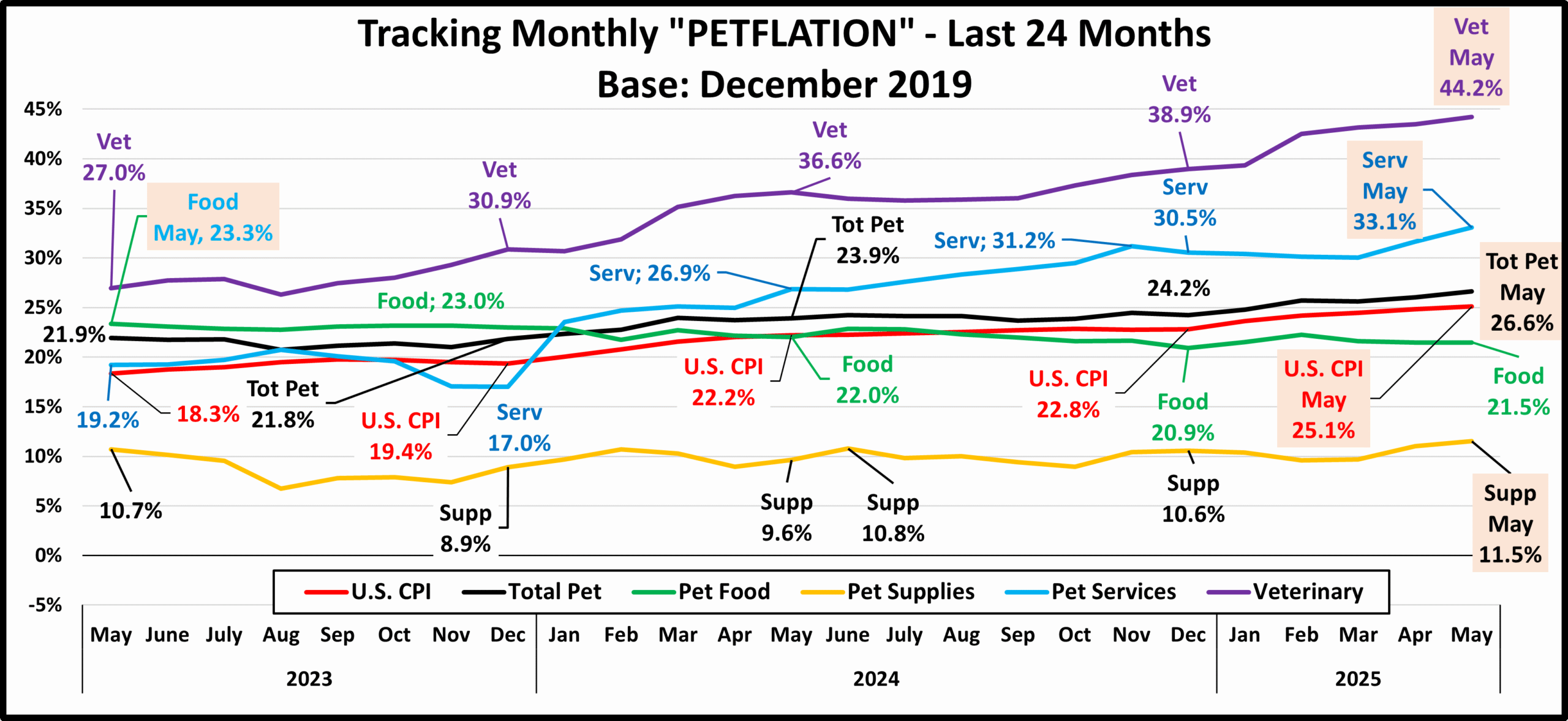
In our first graph we will track the monthly change in prices for the 24 months from July 23 to July 25. We will use December 2019 as a base number so we can track the progress from pre-pandemic times through an eventual recovery. This chart is designed to give you a visual image of the flow of pricing. You can see the similarities and differences in segment patterns and compare them to the overall U.S. CPI. The year-end numbers from 12 and 24 months earlier are included. We also included and highlighted (pink) the cumulative price peak for each segment. In July, Pet prices were up 0.4% from June. All segments were up – Food (+0.5%); Vet (+0.2%); Services (+1.0%); Supplies (+0.003%)

In July 23, the CPI was +19.0% and Pet was +21.8%. The Services segments inflated after mid-20, while Product inflation stayed low until late 21. In 22, Food prices grew but the others had mixed patterns until July 22, when all rose. In Aug>Oct Petflation took off. In Nov>Dec, Services & Food inflated while Vet & Supplies prices stabilized. In Jan>Apr 23, prices grew every month for all segments except for 1 Supplies dip. In May Product prices grew while Services slowed. In Jun/Jul this reversed. In Aug all but Services fell. In Sep/Oct this flipped. In Nov, all but Food & Vet fell. In Dec, Supp. & Vet  drove prices up. In Jan>Mar 24 prices grew. In April, prices in all but Vet fell. In May, all but Food grew. In June, Products drove a lift. In July, all but Services fell. In Aug, Food drove a drop. In Sep, Products fueled a drop. Services drove a lift in Oct. In Nov, all were up. Prices dropped in March 25, but all but Food set records in May or July.

  • U.S. CPI – The inflation rate was below 2% through 2020. It turned up in January 21 and continued to grow until flattening out in Jul>Dec 22. Prices rose Jan>Sep 23, fell Oct>Dec, rose Jan>Oct 24, fell Nov, then rose Dec>Jul 25 to a record high but 26.5% of the increase since Dec 19 happened from Jan>Jun 22 – 9.0% of the time.
  • Pet Food – Prices were at the Dec 19 level Apr 20>Sep 21. They grew & peaked May 23. Jun>Aug , Sep>Nov, Dec>Feb, Mar, Apr>May, June, Jul>Oct, Nov, Dec, Jan>Feb, Mar>May, Jun>Jul. 99% of the increase was in 22/23.
  • Pet Supplies – Supplies prices were high in Dec 19 due to tariffs. They had a deflated rollercoaster ride until mid-21 when they returned to Dec 19 prices & essentially stayed there until 22. They turned up in Jan and hit a record high. They plateaued Feb>May, grew in June, flattened in July, then turned up in Aug>Oct to a new record. Prices stabilized in Nov>Dec but grew in Jan>Feb 23. They fell in Mar, but the rollercoaster continued with Dec>Feb, Mar/Apr, May/Jun, July, Aug, Sep/Oct & Nov/Dec, Jan>Feb 25, Mar>May(record), Jun, Jul.
  • Pet Services– Inflation is usually 2+%. Perhaps due to closures, prices increased at a lower rate in 2020. In 2021 consumer demand increased but with fewer outlets. Inflation grew in 21 with the biggest lift in Jan>Apr. Inflation was strong in 22 but prices got on a rollercoaster in Mar>Jun. They turned up Jul>Apr 23 but prices fell in May. Jun>Aug, Sep>Dec, Jan>Mar 24, Apr, May, June, Jul>Nov, Dec>Mar 25, Apr>Jul, a record!
  • Veterinary – Inflation has been consistent. Prices turned up in Mar 20 and grew through 21. A surge began in Dec 21 which put them above the overall CPI. In May 22 prices fell and stabilized in June causing them to fall below the CPI. However, prices rose again and despite some dips they have stayed above the CPI since July 22. In 23>25 prices grew Jan>May, leveled Jun/Jul, fell Aug, grew Sep>Dec, fell Jan, grew Feb>May, fell Jun>Jul, then grew Aug>Jul.
  • Total Pet – Petflation is a sum of the segments. In Dec 21 the price surge began. In Mar>Jun 22 the segments had ups & downs, but Petflation grew from Jul>Nov. It slowed in Dec, grew Jan>May 23 (record), fell Jun>Aug, grew Sep/Oct, then fell in Nov. In December prices turned up and grew through Mar 24 to a record high. Prices fell in April, rose May>Jun, fell Jul>Sep, rose Oct>Nov, fell in Dec, rose Jan>Feb 25, fell Mar, then set records in Apr>Jul.

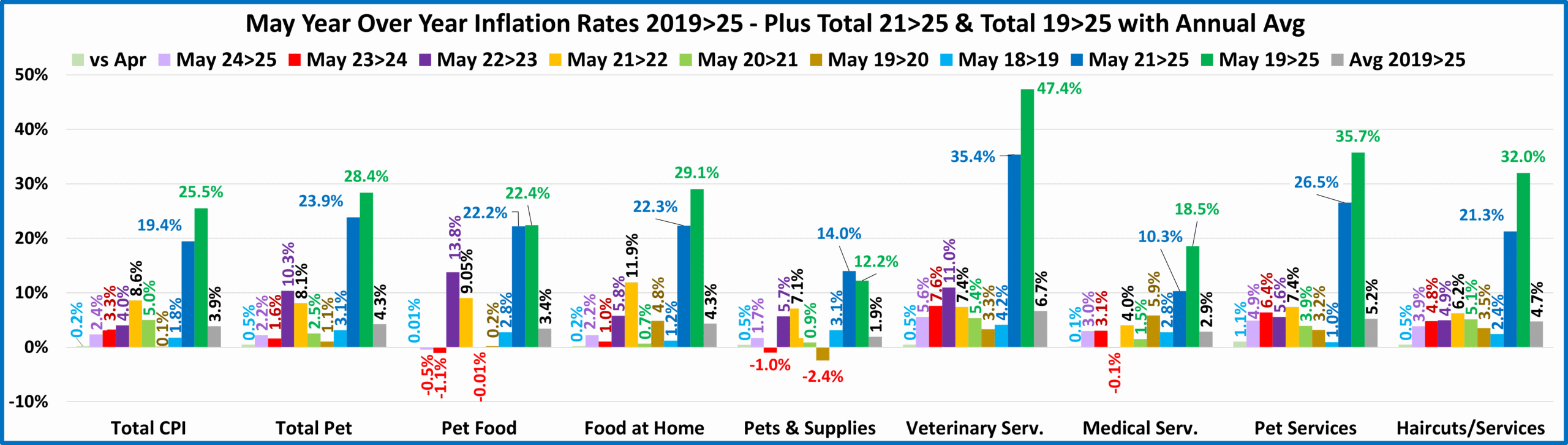
Next, we’ll turn our attention to the Year Over Year inflation rate change for July and compare it to last month, last year and to previous years. We will also show total inflation from 21>25 & 19>25. Petflation grew from 2.1% to 2.6% and it is now just -3.7% below the National inflation rate. The chart will allow you to compare the inflation rates of 24>25 to 23>24 and other years but also see how much of the total inflation since 2019 came from the current pricing surge. We’ve included some human categories to put the pet numbers into perspective.

Overall, prices were up 0.2% from June and were +2.7% vs July 24, the same as last month. Grocery inflation slowed to 2.2% from 2.4%. None had a price decrease from last month, down from 1 in June but the same as May. There were 2 drops in Apr/Oct/Nov but 3 in Aug/Sep/Dec/Mar and 5 back in July 24. The national YOY monthly CPI rate of 2.7% is 7% below 23>24, 16% below 22>23 and 68% less than 21>22. The 24>25 rate is above 23>24 for all others but Pet Services & Haircuts. In our 2021>2025 measurement you also can see that over 75% of the cumulative inflation since 2019 has occurred in 4 segments, all Pet – all but Services (73.3%). Except for Pet & Vet Services, where prices have surged, Service Segments have generally had higher inflation rates so there was a smaller pricing lift in the recent surge. Pet Products have a very different pattern. The 21>25 inflation surge provided 98% of their overall inflation since 2019. This happened because Pet Products prices in 2021 were starting to recover from a deflationary period. Services expenditures account for 63.8% of the National CPI so they are very influential. Their current CPI is +3.8% while the CPI for Commodities is 0.7%. This shows that Services are driving almost all of the current 2.7% inflation. There is an even greater disparity in Pet, but products have a bigger share of $. Petflation is 2.6%. The combined CPI for the Service Segments is 5.6%, while the Pet Products CPI is 0.3%.

  • U.S. CPI– Prices are +0.2% from June. The YOY increase is stable at 2.7%. It peaked at +9.1% back in June 2022. The targeted inflation rate is <2% so we are 35+% higher than the target. The Apr>Jul lifts follow Feb/Mar drops, 4 straight lifts and 6 consecutive drops from Apr>Sep 24. The current rate is below 23>24 but the 21>25 rate is still +18.3%, 70.7% of the total inflation since 2019. The Inflation surge took off in April 2021, +4.2%, up from 2.6%.
  • Pet Food– Prices are +0.5% vs June and +0.1% vs July 24. Deflation in June flipped to Inflation in July. However, they are still far below the Food at Home inflation rate of +2.2%. The YOY Pet Food CPI has deflated in 15 of the last 17 months. The 2021>2025 inflation surge has generated 99.6% of the 22.9% inflation since 2019. Inflation began for Pet Food in June 2021, +0.9%, after 12 straight deflationary months.
  • Food at Home – Prices are +0.1% from June, but the YOY increase fell to 2.2% from 2.4%. This is radically lower than Jul>Sep 2022 when it exceeded 13%. The 29.8% Inflation for this category since 2019 is 15% more than the national CPI but only in 4th place behind 3 Services expenditures (2 Pet). 70.1% of the inflation since 2019 occurred from 2021>25. This is about the same as the CPI, but we should note that Grocery prices began inflating in 2020>21 then the rate accelerated. It appears that the pandemic supply chain issues in Food which contributed to higher prices started early and foreshadowed problems in other categories and the overall CPI surge.
  • Pets & Supplies– Prices were +0.003 from June and the CPI flipped to +0.7% from -0.1%. They still have the lowest rate vs 2019. Prices were deflated for much of 20>21. As a result, the 2021>25 inflation surge accounted for 97% of the total price increase since 2019. Prices set a record in October 2022 then deflated. 3 lifts pushed them to a record high in Feb 23. Prices fell March, rose Apr/May, fell Jun>Aug, grew Sep/Oct, fell Nov, grew Dec>Feb 24, fell Mar/Apr, rose May/Jun, fell July, rose Aug, fell Sep/Oct, rose Nov/Dec, fell Jan/Feb, rose Mar>May. (record), fell Jun, rose July.
  • Veterinary Services– Prices are +0.2% from June and their YOY CPI vs 24 grew to +6.4% from +6.1%. They remain #1 in inflation vs 24 and are still the leader since 2019 with +46.5% and since 2021, +36.7%. For Veterinary, high annual inflation is the norm. However, the rate has increased during the current surge, especially since 23. They have the highest rate in 25, and 79% of the cumulative inflation since 2019 occurred from 2021>25.
  • Medical Services – Prices turned sharply up at the start of the pandemic but then inflation slowed and fell to a low rate in 20>21. Prices were up +0.6% from June and inflation vs 24 grew to +4.3% from +3.4%. Medical Services are not a big part of the current surge as only 60% of the 19.0%, 2019>25 increase happened from 21>25.
  • Pet Services – Inflation slowed in 20 but grew in 21. In 24 prices surged Jan>Mar, fell in April, rose in May, fell in June, rose Jul>Nov, fell Dec>Mar to 3.9%, Apr grew to 5.4%, May fell to 4.9%, rose to 5.9% in June & 6.3% in July. They are #2 in inflation vs 24, 21 & 19. 73.3% of their total 19>25 inflation is from 21>25. In Dec 23, it was 49%.
  • Haircuts/Other Personal Services – Prices are +0.1% from June and +3.8% from July 24. 13 of the last 19 months have been 4.0+%. Inflation has been pretty consistent. 60.2% of the 19>25 inflation happened 21>25.
  • Total Pet– Petflation grew to 2.6% from 2.1%. The biggest driver was that Products flipped from Deflation to Inflation. 2.6% is 36.8% more than the 23>24 rate but still 3.7% below the U.S. CPI. Plus, 2.6% is 16% below the average July Total Pet rate since 1997. July prices rose 0.4% from June, driven by all segments. A Jun>Jul increase has happened in 70% of the years since 1997 (avg Chge: +0.2%, just ½ of 2025). The Pet CPI grew from 2.1% to 2.6%, a 23.8% increase. Another factor in the big July CPI lift was that prices fell -0.1% in Jun>Jul 24, compared to a 0.4% lift in 25. Pricing is very important in Retail Sales, but the CPI is a complex measurement.

Now, let’s look at the YTD numbers.

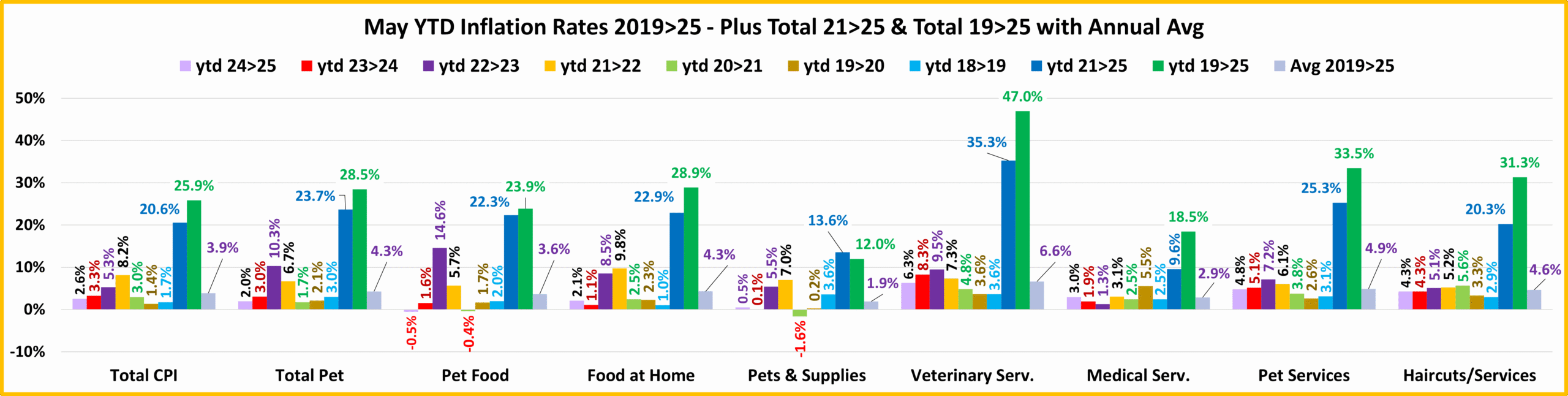
The 24>25 rate is lower than 23>24 for all but Medical Services, Pet Supplies & Groceries. The 22>23 inflation rate was the highest for all pet categories but Supplies. 21>22 has the highest rate for Pet Supplies, Groceries, Haircuts and the National CPI. The average national inflation in the 6 years since 2019 is 3.9%. Only 3 of the categories are below that rate – Medical Services (2.9%), Pet Supplies (1.9%) and Pet Food (3.6%). It is no surprise that Veterinary Services has the highest average rate (6.6%), but all 4 other categories are +4.3% or higher.

  • U.S. CPI – The 24>25 rate is 2.6%, down 19% from 23>24, but it is down 43% from 22>23, 68.7% less than 21>22 and 33.3% below the average increase from 2019>2025. However, it’s still 79% more than the average increase from 2018>20. 77% of the 25.9% inflation since 2019 occurred from 2021>25. Inflation is a problem that started recently.
  • Pet Food – Ytd prices are still deflating, -0.4%, up from -0.5% in May/Jun and significantly up from -1.1% in Jan. That’s a big change from 1.3% in 23>24, 14.2% in 22>23 and even the 1.7% 18>20 average. It’s even below 20>21. Pet Food has the highest 22>23 rate but is only tied for #4 in the 21>25 rates. Deflation in the 1st half of 2021 kept YTD prices low then they surged in 22 and especially in 23. 95% of the inflation since 2019 occurred from 2021>25.
  • Food at Home – The inflation rate is up 91% from 23>24 but at 2.1%, it is down 71% from 22>23, 80% from 21>22 and even 9% less than 20>21. However, it is still 2% more than the average rate from 2018>20. It is only in 4th place for the highest inflation since 2019 but still beat the U.S. CPI by 12%. You can see the impact of supply chain issues on the Grocery category as 77% of the inflation since 2019 occurred from 2021>25.
  • Pets & Pet Supplies – A true roller coaster, prices rose Jan>Feb 24, fell Mar>Apr, rose May>Jun, fell July, rose Aug, fell Sep>Oct, rose Nov>Dec, fell Jan>Feb 25, then rose Mar>May. Prices vs 24 flipped from inflation to deflation in June & back to inflation in July. Supplies still have the lowest inflation since 2019. The biggest YOY lifts since 2019 were in 22 & 23. The 2021 deflation created an unusual situation. Prices are up 11.9% from 2019 but 112% of this lift happened from 21>25. Prices are up 13.3% from their 2021 “bottom”.
  • Veterinary Services – Inflation was high in 2019 and steadily grew until it took off in late 2022. The rate may have peaked in 2023, but it is still going strong in 2025, +6.3%, the highest on the chart. They are also #1 in inflation since 2019 and since 2021. At +6.6%, they have the highest average inflation rate since 2019. It is 69% higher than the National Average but 2.3 times higher than the Inflation average for Medical Services. Strong Inflation is the norm in Veterinary Services.
  • Medical Services – Prices went up significantly at the beginning of the pandemic, but inflation slowed in 2021. In 2025 it is 3.2%, 10% above the 2.9% 2019>25 average rate. We should also note that 3.2% is also 5 times higher than the lowest rate of 0.6% in 21>22.
  • Pet Services – After falling in late 2023, prices surged in 2024, then fell in 2025 until an Apr>Jul resurgence. The 24>25 inflation rate of 5.2% is 2nd, behind Veterinary on the chart. It is only their 4th highest rate, but it is double their 2018>20 average rate. Pet Services is also 2nd in both 19>25 and 21>25 inflation.
  • Haircuts & Personal Services – The services segments, essential & non-essential, were hit hardest by the pandemic. The industry responded by raising prices. 2025 inflation is 4.1%, 23% below its 21/22 peak, but 26% above the 18>20 average. Consumers are paying over 30% more than in 2019, which usually reduces the purchase frequency.
  • Total Pet – 2025 Petflation is 2.1%, up from 2.0% in May/Jun but 22% less than 23>24. It’s also 9% lower than their 2018>21 avg. and 19% below the CPI. Petflation is still at its lowest rate since early 2021. This was primarily driven by deflation in Pet Products and lower inflation in Services. However, in Apr>Jul, Pet prices have generally turned up

The Petflation recovery paused in Aug 24, came back Sep>Oct, paused in Nov, resumed in Dec>Jan, paused in Feb, restarted in Mar, paused Apr>Jun, then in July jumped to the highest rate in 2025. We tend to focus on monthly YOY inflation while ignoring one critical fact. Inflation is cumulative. Pet prices are 24.0% above 2021 and 28.3% higher than 2019. Those are big lifts. In fact, current July prices for Vet, Services & Total Pet are the highest in history. Note: Pet Products are within 0.6% of their record high. Only Supplies prices (+11.4%) are less than 22.9% higher than 2019. Since price/value is the biggest driver in consumer spending, inflation will affect the Pet Industry. Services will be the least impacted as it is driven by high income CUs. Veterinary will see a reduction in visit frequency. The product segments will see a more complex reaction. Supplies will likely see a reduction in purchase frequency and some Pet Parents may even downgrade their Pet Food. Products will see a strong movement to online purchasing and private label. At SZ and GPE 24 & 25, a huge number of exhibitors actively offered their OEM services. Strong, cumulative inflation has a widespread impact, but tarifflation can hit even harder. Supplies would likely be the most impacted by new high tariffs. We’ll see…


INFLATION’S IMPACT ON RETAIL SALES GROWTH – June 2025

Inflation seems simple – just compare this year’s prices to the same time last year. In fact, it is more complex. The most important thing to remember is that it is cumulative so even when the YOY rate slows, it can cause a range of issues – selling less product and even a drop in revenue. One impact that is often ignored is slowed $ growth. That is the focus of this report. In order to give an accurate reading of the situation we will include charts for the Big Retail Groups and the “Advance” Relevant Retail Channels. We will also include separate charts for Monthly & Ytd data to better show trends.

First the Jan>Jun Monthly Report for Big Groups (100% of U.S. Retail $)

We also included the Y/E numbers for 2024, both actual & average, to show our 1st goal – Beat these lifts!

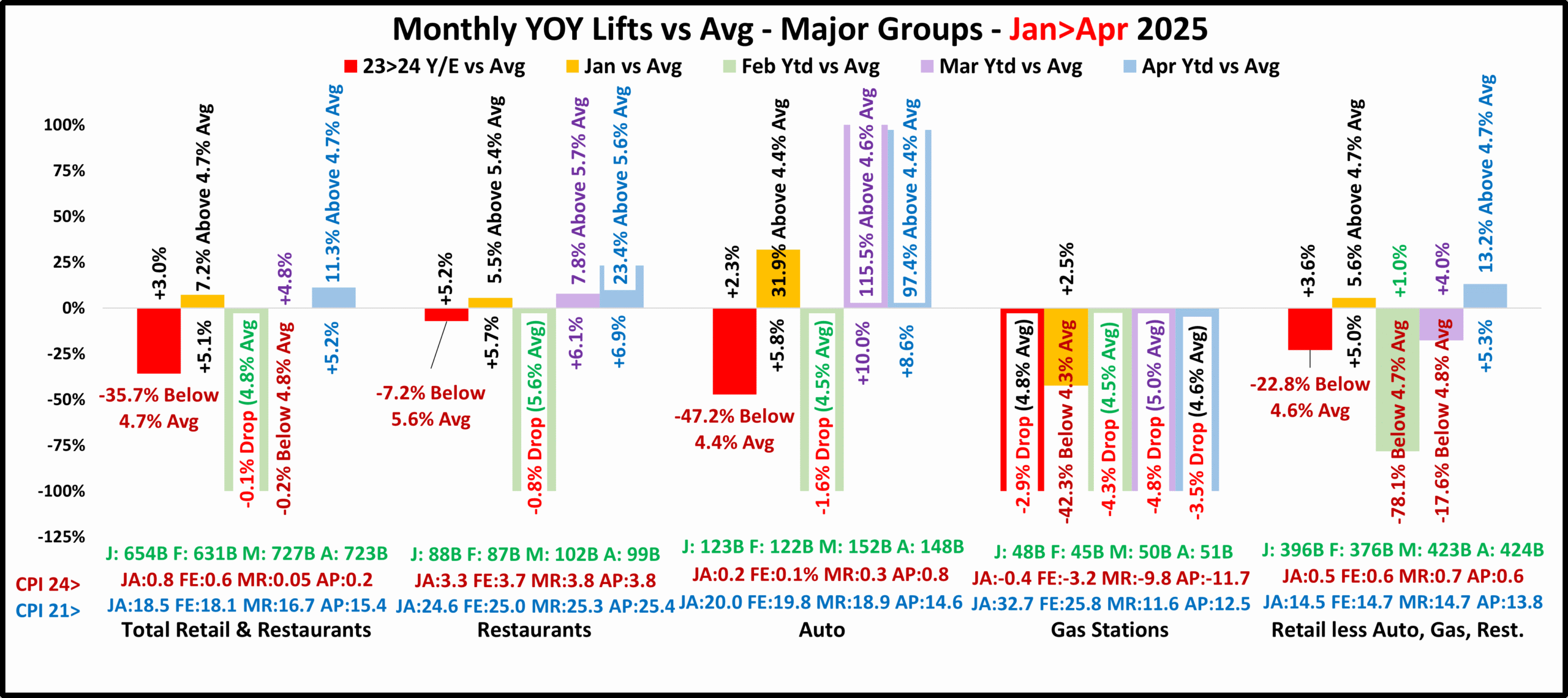
There are things that immediately stand out. One is expected – a BAD February. It is often the low point of the Retail year. In 2025, the lift vs 24 was -78% below avg for Relevant Retail, but Total and all other groups had drops. A big positive is January. Gas Stations had their only monthly lift in 25. It was below avg but all other groups had above avg lifts. Now April, 1 drop but 4 above avg lifts, including Total. In May>Jun, the situation worsened. Still 1 drop, but only 1 above avg lift (May: Restaurants; Jun: Auto) and 3 below avg. Total & Relevant were a little less below avg in June.

Restaurants – The February drop was small and the Mar>May lifts were above avg. Those lifts were 6+%, peaking at 7.5% in May, 34.8% above average. Things worsened in June as their lift slowed to +5.4%, -3.8% below average.

Auto – Until May>Jun, their pattern was the same as Restaurants but with bigger changes, especially in March & April. The Mar & Apr lifts were basically double the average. The 25% tariff was effective 4/3/25. Consumers saved thousands of dollars, but the binge buy ended in May, -58.5% below avg. Sales did bounce back in June, +5.3%, 23% above avg.

Gas Stations – They are truly in turmoil. Their only plus month was -42% below avg and all drops were bigger than 2024.

Relevant Retail – They do about 60% of Total Retail $ so it’s no surprise that they have a similar pattern. 1 big difference is that they were +1% in Feb – no drop. The Feb/Mar & May/Jun lifts were below avg while the Jan & Apr lifts were above avg. Their 23>24 lift was above Total Retail. In May their lift was much better than Total. In June, the gap narrowed. Their progress has essentially stabilized.

Total Retail – They had a drop in February, but March was basically equal to the average and Jan & Apr were slightly above average. All non-Feb months had lifts above the 3.0% 23>24 Y/E increase but the May lift was only +3.2%, -33.7% below avg. The situation improved a little in June, +3.7%, but the lift is still -19% below avg.

 TOTAL 6 MONTHS IN 2025: $↓: 8; ↑Avg: 12; ↓Avg: 10

Jan: $↓: 0; ↑Avg: 4; ↓Avg: 1; Feb: $↓: 4; ↑Avg: 0; ↓Avg: 1; Mar: $↓: 1; ↑Avg: 2; ↓Avg: 2

Apr: $↓: 1; ↑Avg: 4; ↓Avg: 0; May: $↓: 1; ↑Avg: 1; ↓Avg: 3; Jun: $↓: 1; ↑Avg: 1; ↓Avg: 3

Now let’s take a closer look at Relevant Retail. We will report on the 11 channels in our Advance report.

11 Relevant Retail Channels (98% of Ytd Rel Rtl $)

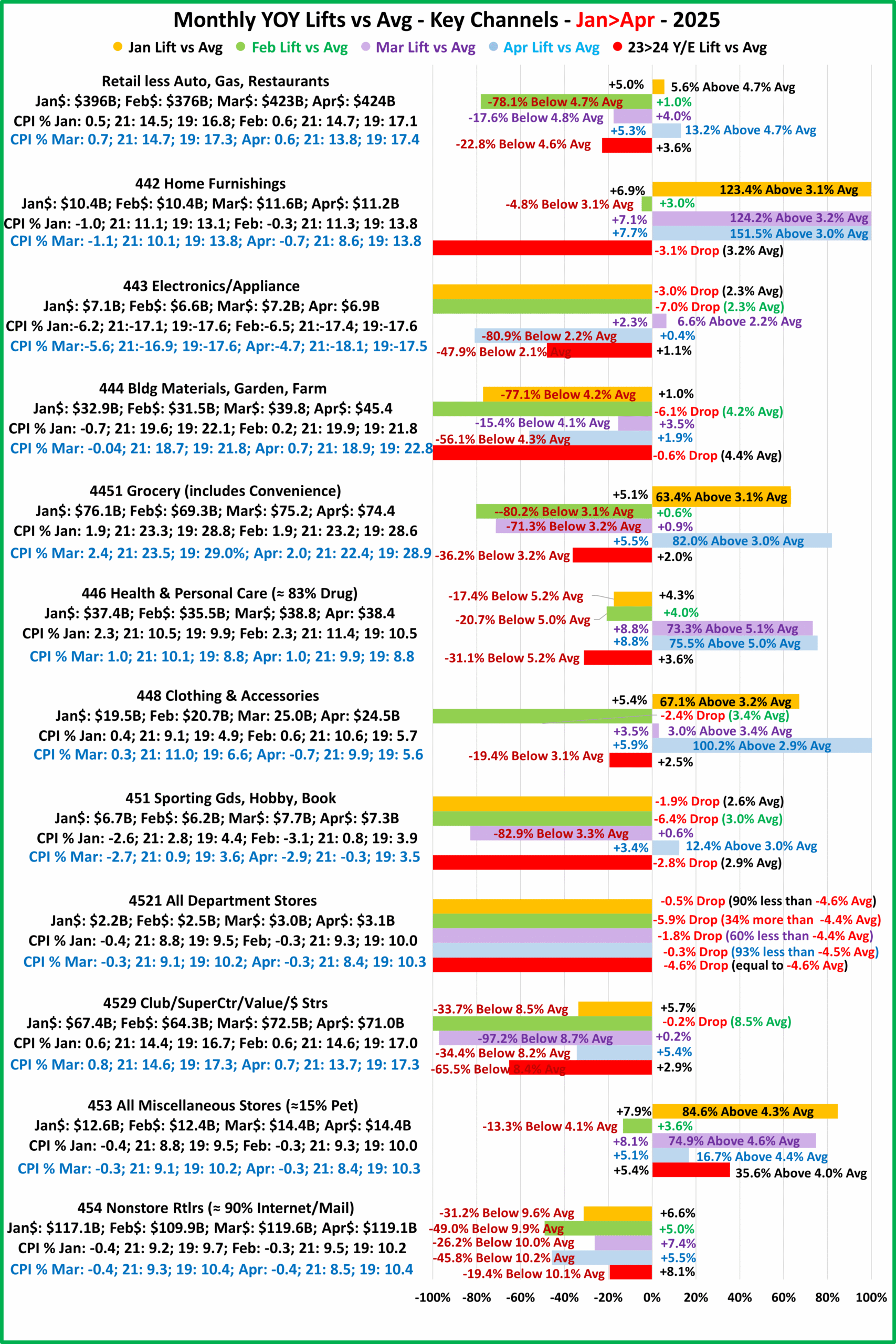
Relevant Retail – Their +3.6% lift in 24 was -22.8% below average. No drops in 25. The lifts for February, March, May & June were below average, but January & April were above average. The lift is now +3.9%, -17.5% below avg.

Furniture – No drops. Lifts were double the average in January, March & April but still big in May & June. The huge lifts in Mar>Jun were probably due to fear of skyrocketing prices from impending tariffs.

Electronics/Appliances – They have ongoing high deflation. $ Drops in both January & February. Sales turned positive in Mar, dropped in Apr>May, then returned to slightly positive, +0.7% in June. The 2 lifts were both below average.

Bldg Matl/Garden/Farm – They had the smallest of the 4 drops in 23>24, -0.6%, but the 3rd biggest decrease (of 6) in February, -6.1%. They had lifts in Jan, Mar, Apr & Jun but all were below average. The April increase was -77% below avg and May saw their 2nd 2025 drop. June was nearly a drop, only +0.2%, 96.1% below avg.

Grocery – Sales were only +2.0% in 24, -36% below average but they surged in January to +5.1%, 63% above average. Growth slowed to 1% or less in Feb>Mar, 70+% below avg. They had a strong rebound in April. Sales were +5.9%, 94% above average. The lifts slowed markedly in May>Jun. June is down to +1.5%, -52.3% below avg.

Health/Drug – Sales were +3.6% in 24, -31% below avg. The lift grew in Jan>Feb to 4+%, about -20% below avg. Sales surged in Mar>Apr to +8.8%, 75% above avg, slowed to +6.7% in May, then June hit a 25 high of +9.7%, 93% above avg.

Clothing – 24 $: +2.5%, -19% below avg. A strong start to 25, +5.4%, 67% above avg. Sales fell -2.4% in Feb, but the Mar lift was 1% above avg. Sales “took off” in Apr to +6.9%, more than double the avg lift. The strong lift continued in May, +5.4%, 62% above avg. The pre-tariff buying binge ended in June as the lift slowed to +2.4%, 24% below avg.

Sport/Hobby/Book – They were -2.8% in 24. This trend continued in Jan>Feb, hitting bottom at -6.4% in February. In Mar>Jun they turned slightly positive, peaking at +2.1% in May, -35% below avg. Jun slowed to +0.9%, -72% below avg.

Department Strs – It’s difficult to find something positive. They were -4.6% in 24 and had drops Jan>Jun in 25. The biggest drop was -5.9% in Feb, but Jun was #2, -4.5% – no surprise. Sort of good news: 4 of 6 drops were below avg.

Clubs/SupCtrs/Value/$ – They offer value and the convenience of 1 stop shopping. They have had strong growth since their creation. COVID accelerated growth so it is no surprise that all lifts are below avg. They even had small <-0.3% drops in Feb/Mar. Things improved in April, +5.3%, then slowed to +3.8% in May and +1.9% in Jun. Jan was best, +5.7%.

Miscellaneous – Pet Stores account for 15+% of this group’s sales. They had 2 below avg lifts, Feb & Apr. The Jan & Mar lifts were 80+% above avg and the May>Jun lifts were more than double the avg. They have the 2nd best performance of any channel, behind Furniture Stores, and they achieved it without the benefit of a pre-tarifflation buying surge.

Nonstore – 90% of $ are from internet/mail order (vast majority is internet). The Internet has had strong sales growth since its inception, but it skyrocketed due to COVID’s “stay at home” behavior. They have an average lift of about 10%.

Their 24 lift was +8.1%. All lifts in 25 were below this and below average – no surprise. Low: Feb +5.0%; High: Mar +7.2%

SUMMARY

23>24:$↓: 4; ↓Avg: 6; ↑Avg: 1      6 MONTHS IN 2025: $↓: 17; ↓Avg: 30; ↑Avg: 19

                                                       Jan: $↓: 3; ↓Avg: 4; ↑Avg: 4; Feb: $↓: 6; ↓Avg: 5; ↑Avg: 0; Mar: $↓: 2; ↓Avg: 5; ↑Avg: 4                                                          Apr: $↓: 2; ↓Avg: 5; ↑Avg: 4; May:$↓: 3; ↓Avg: 4; ↑Avg: 4;  Jun: $↓: 1; ↓Avg: 7; ↑Avg: 3

In the above Summary, regarding Drops and Above Average lifts, a green number indicates the best and a red is the worst. The best months are Mar & Apr and the worst is Feb. However, the biggest positive change occurred in March. 4 channels with drops turned positive. 3 became below average and 1 above average. 3 with below average lifts moved up to above average. The classification of 4 were unchanged so 7 fueled the improvement. April was the same as Mar. May was worse than April due to 3 drops. In Jun, Drops fell to 1 but above avg fell to 3. Note: 4 has become the norm in above avg lifts. We also can’t forget January. The number of positive lifts vs Y/E 24 moved up from 7 to 8 but the number with above average increases rose from 1 to 4 – a significant change. Even with 8 drops/below avg lifts, the situation has improved since hitting bottom with 11 in Feb. The CPI is low, but up for all in Jun. Pre-tariff binge buying may be over.

Now let’s take a different view of the data from the Big Groups and the same 11 channels. Rather than monthly sales, we we will look at Ytd numbers. We will still view them monthly so we can see any trends.

The Ytd numbers are arguably the most important. In December, they become Year-End, which is the most quoted and remembered data in any year. While the monthly data shows what’s happening in the marketplace right now, the Ytd data consolidates the data. This blending extends the impact of big sales spikes – positive or negative. This can be either good or bad. The impact of the big drop in February 25 was lessened by the widespread Above Average January lift. It can also work the other way. The big February drop reduced the positivity of stronger lifts in Mar>Jun. Overall, progress stalled in May & June. We’ll begin our analysis with the Big Retail Groups.

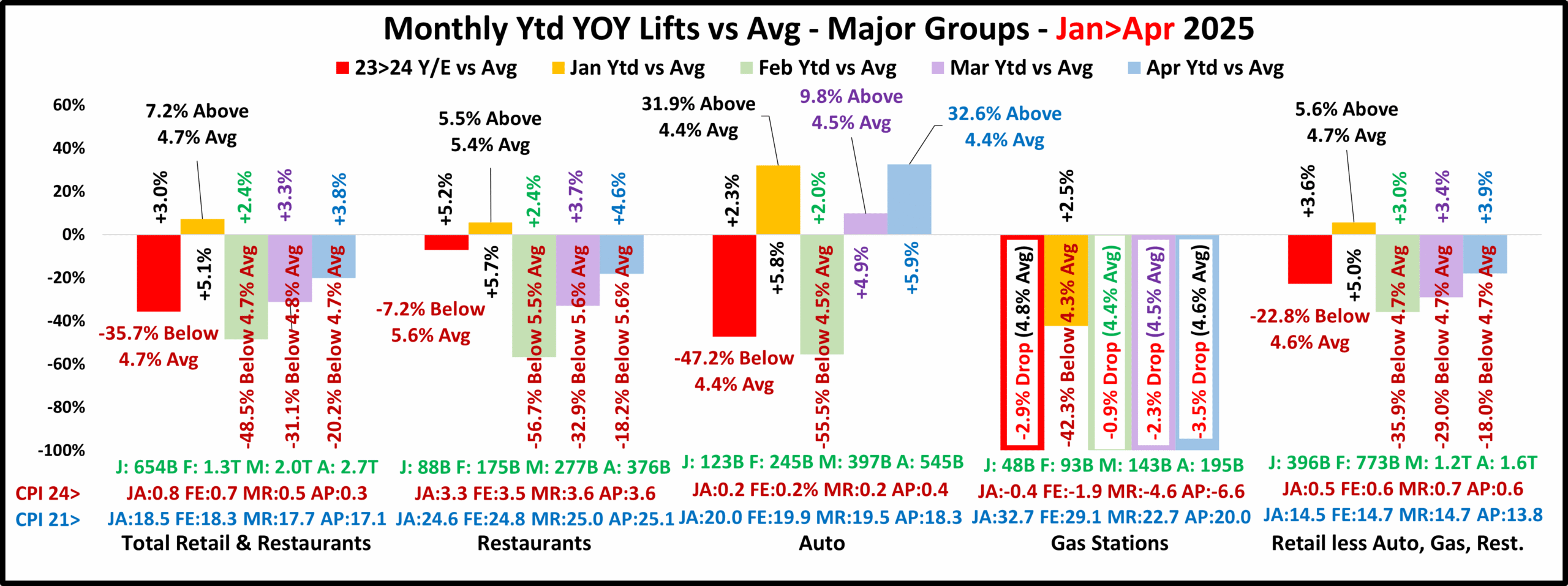
The first thing that you notice is that the spending patterns for Restaurants and Relevant & Total Retail are virtually identical. All groups had January lifts and all, but Gas Stations were Above Average. However, only Auto had Above Average lifts in Mar>Jun. Also, only Gas Stations had any sales drops. Overall, the improvement paused in May>Jun.

Restaurants – Sales for 24 were +5.2%, -7% below average. They flipped in January as the lift vs last year grew to +5.7%, 5.5% above average. The lift radically slowed in February to +2.4%, -57% below average. The situation steadily improved in March/April, even slightly in May but essentially stabilized in June at +5.1%, 9.3% below average.

Auto – Sales were +2.3% in 24, -47% below avg and the worst “positive” performance of any group. They turned it around in Jan with a +5.8% lift, 32% above avg. The lift dropped to +2.0% in Feb, -56% below avg and the smallest lift of any positive big group. Due to pre-tarifflation buying the lift took off in Mar/Apr, reaching +5.9% in April, 33% above avg. In May>Jun the surge ended, and the lift fell to ≈5%. They are the only Group with Mar>Jun above avg lifts.

Gas Stations – Whether you look at the data monthly or Ytd, they are doing bad. The June Ytd sales drop of -4.0% is even 38% worse than the -2.9% at Y/E 24. That does not bode well for 2025.

Relevant Retail – Except for January, +5.0%, they seem to be stuck in the 3% lift range. Thanks to an Above avg monthly  lift, April Ytd, +3.9%, did finally exceed the +3.6% of 2024. The lift stayed at +3.9% in May>Jun, it also stayed at about -18% below the Ytd avg. Their slow, steady Mar>Apr progress paused in May>Jun.

Total Retail – The pattern matches Relevant Retail but the YOY changes for all but January & March are smaller. With similar averages, Total has bigger disparities. Total includes Auto & Gas Stations which have had extreme lifts & drops. Their steady Mar>Apr progress also paused in May>Jun, but their Ytd lift has been above 24 from March through June.

Summary and Comparison of Monthly to Ytd

Monthly: Drops: 8; Below Avg Lifts: 10; Above Avg Lifts: 12

      Ytd: Drops: 5; Below Avg Lifts: 17; Above Avg Lifts:  8

Mon: Jan: $↓: 0; ↓Avg: 1; ↑Avg: 4; Feb: $↓: 4; ↓Avg: 1; ↑Avg: 0; Mar: $↓: 1;↓Avg: 2; ↑Avg: 2

Ytd:   Jan: $↓: 0; ↓Avg: 1; ↑Avg: 4; Feb: $↓: 1; ↓Avg: 4; ↑Avg: 0; Mar: $↓: 1; ↓Avg: 3; ↑Avg: 1

Mon: Apr: $↓: 1; ↓Avg: 0;↑Avg: 4; May: $↓: 1; ↓Avg: 3; ↑Avg: 1; Jun: $↓: 1; ↓Avg: 3; ↑Avg: 1;

Ytd:  Apr: $↓: 1; ↓Avg: 3;↑Avg: 1;  May:$↓: 1; ↓Avg: 3; ↑Avg: 1; Jun: $↓: 1; ↓Avg: 3; ↑Avg: 1;

In the summary the orange numbers show that the Ytd report levels the Feb>Jun data. The situation doesn’t look good Ytd but it’s better than 24 for all but Gas Stations. Monthly, the Big Groups stabilized in May. In Ytd data, they stabilized in March.

Now, Let’s look at Ytd Sales for Key Relevant Retail Channels

The Ytd chart looks a little more consistent than the Monthly chart. This is true. Ytd extends the impact of big lifts or drops. The Ytd version has 27% less Below Avg lifts (middle ground), but 29% more Drops & 16% more Above Avg lifts. The result is balance. Ytd also has 3 channels that had drops every month in 2025. Monthly has only 1. However, Ytd has 2 channels with Above Average lifts every month. Monthly has none. It’s a complex situation. Let’s get into the specifics.

Furniture Stores – They are going strong. Their huge January lift pushed the February Ytd lift from below to above avg. Now, all months are above average. Tarifflation fear caused binge buying in Mar>Jun so the current lift is still huge.

Electronics/Appliance – Ytd they are all negative. This version hides the small Mar & June lifts. The positive impact in the Ytd chart was that their YOY drop slowed from -5.0% in February to -1.5% in June.

Bldg Matl/Garden/Farm – Their big February drop turned March from a below average monthly lift to a -0.4% Ytd drop. In a reversal, Mar/Apr lifts made Ytd April slightly positive, +0.1%. Sales fell -2.8% in May so Ytd May & Jun were negative.

Grocery – Their big January lift made  their situation look significantly better in Ytd. However, the Ytd view essentially hid the huge above average lift in April. Note: The current Ytd lift (+2.8%) is 40% above 24 Y/E and just 11% below the annual average.

Health – Monthly & Ytd have a similar pattern – Jan>Feb, below average lifts; Mar>Jun, above avg. The May monthly lift was smaller than Mar/Apr but the June lift was huge, almost double the avg. Ytd is now 97% better than 2024.

Clothing – They had a +5.4% lift in January, 67% above avg. This eliminated the Feb drop in Ytd but the Feb drop changed Mar from above to below average in Ytd. Apr/May Monthly lifts were big. Jun was small but Apr>Jun was above avg Ytd.

Sport/Hobby/Book – They had drops in Jan>Feb. Feb was -6.4%. This turned Ytd all negative. It also hid the possible start of a recovery. Mar>May had increasing monthly lifts. June slowed but Ytd it is -0.4%, much better than -2.8% in 24.

Department Strs – Both reports show drops every month. They have been fading for years. It continues.

Club/SupCtr/Value/$ – They offer value and convenience, the biggest shopping drivers. Some $ stores are struggling but SuperCenters/Clubs are still going pretty strong. Besides the internet, one problem in sustaining strong growth is that they are running out of new customers. The Monthly report had a -0.2% drop in February and a -0.3% drop in March. The Ytd numbers look better. There are no drops, but the June Ytd lift is only +2.6%, 69% below avg and 10% below 24.

Miscellaneous – This is probably our favorite channel because it includes pet stores. They also have great performance. In the Monthly report, only the YOY lifts for Feb & Apr are below avg. All others are above avg. The Ytd report is even better. All months are above avg and June is +7.4%, 72% above average and 37% more than Y/E 24.

Nonstore – They are driven by the internet which has had the strongest growth and became the biggest $ channel in 2020. The Monthly & Ytd reports have similar patterns – all months below avg. June Ytd is +6.4%. That sounds great but it is -37% below average. We’re seeing that it is difficult, if not impossible to maintain double digit growth…forever.

Relevant Retail – Their $ come from a mixture of different spending patterns. They had no drops and both Monthly & Ytd show Mar>Apr growth and a May>Jun pause. Ytd hides the Above avg April lift but shows that the group’s performance in Apr>Jun now exceeds 24…+3.9% to +3.6%. Here is a summary and comparison of Monthly to Ytd for the 11 channels.

 Monthly: Drops: 17; Below Avg Lifts: 30; Above Avg Lifts: 19

Ytd: Drops:22; Below Avg Lifts: 22; Above Avg Lifts: 22

Mon: Jan: $↓:3; ↓Avg: 4; ↑Avg: 4; Feb: $↓: 6; ↓Avg:5; ↑Avg: 0; Mar: $↓: 2; ↓Avg: 5; ↑Avg: 4

Ytd:   Jan: $↓:3; ↓Avg: 4; ↑Avg: 4; Feb: $↓: 4; ↓Avg:5; ↑Avg: 2; Mar: $↓: 4; ↓Avg: 4; ↑Avg: 3

Mon: Apr: $↓: 2;↓Avg:5; ↑Avg: 4; May: $↓: 3; ↓Avg: 4; ↑Avg: 4; Jun: $↓: 1; ↓Avg: 7; ↑Avg: 3

   Ytd: Apr: $↓: 3; ↓Avg:3; ↑Avg: 5; May: $↓: 4; ↓Avg: 3; ↑Avg: 4; Jun: $↓: 4; ↓Avg: 3; ↑Avg: 4 

The key differences between the Monthly & Ytd reports are in the lingering Ytd impact of big drops and lifts. Both views are critically important. Monthly shows what is currently happening in the marketplace and Ytd puts it into perspective. They also show trends over time. Ytd provides an overview while Monthly shows the details fueling the movement.

Inflation negatively affects retail growth both in the short term, with spikes or drops, and in the long term, with cumulative high prices. It can even have an impact before it happens. We saw this with pre-tarifflation “fear” buying. The current retail situation is not good. The YOY lifts vs 24 are generally below the long term avg for most channels. Retail “hit bottom” in Feb but most channels (not Gas Stations or Dept stores) showed improvement in Mar/Apr. The situation got a little worse in May/Jun but Ytd it is stable & better than 24. Inflation is low, but prices are still high. We’ll see…

Finally, for your reference, here are the May and June inflation rates for the CPIs of the retail groups and channels in this report. This includes special aggregate CPIs created with the instruction and guidance of personnel from the US BLS. I also researched data from the last Economic Census to review the share of sales by product category for the various channels to help in selecting what expenditures to include in specific aggregates. Of course, none of these specially created aggregates are 100% accurate but they are much closer than the overall CPI or available aggregates. The data also includes the CPI changes vs 2021 to show cumulative inflation. The chart shows both monthly and Ytd inflation so it can be used as a reference for both measurements in the sales growth report.

Monthly YOY CPI changes of 0.2% or more are highlighted. (Green = lower; Pink = higher)

  • In the Big Groups, Restaurant inflation was unchanged. All others got worse.
    • Total Retail flipped from -0.1% deflation to +0.6% inflation
  • The monthly inflation also worsened for 10 of 11 smaller channels
    • The biggest change was Furnishings jumped from 0.5% to 3.4%.
    • Department Stores, Miscellaneous and Nonstore all flipped from deflation to inflation
    • For 4 channels, the worsening was just a slower deflation rate
  • The 1 smaller channel with improved inflation was Health/Drug – from +0.3% to +0.2%
  • Cumulative inflation vs 2021 is still high & stable for most channels, especially Ytd

Retail Channel $ Update – May Monthly & June Advance

In June, the Commodities inflation CPI flipped to 0.6% from -0.1% and Total Retail sales were +3.7% vs 24, -19.4% below their average June Lift. The Relevant Retail CPI rose to 1.2% from 0.8% and sales were +3.9% vs 24, -17.5% below average. There are other factors currently impacting sales, including high cumulative inflation and pre-tarifflation binge buying. The situation is complex but the problem with YOY drops and the size of sales lifts is still very real.

We’ll continue to track the retail market with data from 2 reports provided by the Census Bureau and factor in a targeted CPI. The reports are the Monthly and the Advance Retail Sales Reports. Both are derived from sales data gathered from retailers across the U.S. and are published monthly at the same time. The Advance Report has a smaller sample size so it can be published quickly – about 2 weeks after month end. The Monthly Report includes data from all respondents, so it takes longer to compile the data – about 6 weeks. Although the sample size for the Advance report is smaller, the results over the years have proven it to be statistically accurate with the Monthly reports. The biggest difference is that the full sample in the Monthly report allows us to “drill” a little deeper into the retail channels.

We will begin with the May Monthly Report and then go to the June Advance Report. Our focus is comparing to last year but also 21 & 19. We’ll show both actual and the “real” change in sales as we factor inflation into the data.

Both reports include the following:

  • Total Retail, Restaurants, Auto, Gas Stations and Relevant Retail (removing Restaurants, Auto and Gas)
  • Individual Channel Data – This is more detailed in the Monthly reports, and we’ll focus on Pet Relevant Channels.

The data will be presented in detailed charts to facilitate visual comparison between groups/channels. The charts will show 11 separate measurements. To save space they will be displayed in a stacked bar format for the channel charts.

  • Current Month change – % & $ vs previous month
  • Current Month change – % & $ vs same month last year and vs 2021.
    • Current Month Real change vs last year and vs 2021 – % factoring in inflation
  • Current Ytd change – % & $ for this year vs last year, 2021 & 2019.
    • Current Ytd Real change % for this year vs last year and vs 2021 and 2019
  • Monthly & Ytd $ & CPIs for this year vs last year and vs 2021 which are targeted by channel will also be shown. (CPI Details are at the end of the report)

First, the May Monthly. Only Auto was down from April and there were only 2 actual YOY sales drops, Gas Stations vs 24. Note: They are still selling less product than in 2019. 3 groups are “all positive”, the same as March & April. Relevant Retail has been all positive in 14 of the last 18 months and in 10 of the last 12. ($ are Not Seasonally Adjusted)

The May Monthly is $0.2B more than the Advance report. Restaurants: +$1.1B; Auto: -$0.7B; Gas Stations: +$0.6B; Relevant Retail: -$0.8B. Only Auto was down from April. An Apr>May increase in Total Retail  has happened 5 every year since 1992. However, the 4.3% lift was 28.3% less than the 6.0% average. There were only 2 YOY drops in actual sales, the same as March & April. There were only 3 “real” sales drops, down from 4 in April and 5 in March. 3 groups were again “all positive” (None in Feb). Restaurants still have the biggest increases vs 21 & 19 but Relevant Retail stayed at the top of “real” performance vs 2019. However, only 53% of their growth is real.

Now, let’s see how some Key Pet Relevant channels did in May (83% of May Ytd Rel Retl $)

Overall– All 11 were up from April. Vs Apr 24, 8 were actually and 9 “really” up. Vs Apr 21, 8 were up but only 6 were real increases. Vs 2019, The only negatives were Off/Gift/Souv & Dept Strs. Both were actually & really down.

  • Building Material Stores – The pandemic focus on home has produced sales growth of 29.6% since 2019. Prices for the Bldg/Matl group have inflated 18.0% from 21 and 22.5% from 2019 which is having an impact. Sales vs April were +3.7% for HomeCtr/Hdwe and +5.3% for Farm Stores. Vs other years, Farm stores are actually up for all and Home Center/Hardware are actually & really down monthly and Ytd for all but 2019. Farm stores are really down monthly & Ytd vs 21. Plus, only 20% of the Bldg Materials group’s 19>25 lift was real. Avg 19>25 Growth: HomeCtr/Hdwe: 4.0%, Real: 0.6%; Farm: 6.2%, Real: 2.7%
  • Food & Drug – Both are truly essential. Except for the pandemic food binge buying, they tend to have smaller changes in $. In terms of inflation, the Grocery rate is now 7 times the rate for Drug/Med products. Drug Stores are positive in all measurements and 67% of their 2019>25 growth is real. Supermarkets’ actual $ are up in all comparisons. They are only “really” down monthly and Ytd vs 2021. However, only 11.0% of their 19>25 increase is real growth. Avg 19>25 Growth: Supermarkets: +5.0%, Real: +0.6%; Drug Stores: +5.2%, Real: +3.6%.
  • Sporting Goods Stores – They also benefited from the pandemic in that consumers turned to self-entertainment, especially sports & outdoor activities. Sales are up 12.3% from April, but their only positives are vs 2019 & real vs 2024. Prices are still deflating, -4.7% vs 24. Deflation started in April 23 and is a big change from +1.1% in 22>23 and +7.9% in 21>22. This caused 72.8% of their 33.4% lift since 19 to be real. Avg 19>25 Growth Rate is: +4.9%; Real: +3.7%.
  • Gen Mdse Stores – Sales were +8.3% vs Apr and all YOY sales – actual & real were up for Club/SupCtrs and $ Stores. Department Stores are only up vs April 25. Their Actual sales are even -29.1% from 19 (Real: -35.8%). The other channels have an average of 43.9% in real growth. Avg 19>25 Growth: SupCtr/Club: 5.2%, Real: 2.4%; $/Value Strs: +5.4%, Real: +2.6%; Dept. Strs: -5.6%, Real: -7.1%.
  • Office, Gift & Souvenir Stores – After a -8.7% drop last month sales surged +34.3% from April. They are now only really down Ytd vs 21. Their recovery started late, but their progress may be slowly restarting again. However, we should remember that they are still actually & really down vs 2019. Avg Growth Rate: -0.1%, Real: -1.8%
  • Internet/Mail Order – Sales are only +3.3% from April but set a new May record of $117.3B. All measurements are positive, but their YOY growth, +7.3%, is only 50% of their average since 2019. However, 83.2% of their 127.1% growth since 2019 is real. Avg Growth: +14.6%, Real: +12.8%. As expected, they are by far the growth leader since 2019.
  • A/O Miscellaneous – Pet Stores are 22>24% of total $. In May 2020 they began their recovery which reached $100B for the first time in 2021. In 2022 their sales dipped in January, July, Sept>Nov, rose in December, fell in Jan>Feb 23, grew Mar>May, fell Jun>Aug, rose Sep>Nov, fell Dec>Jan 24, grew Feb>May, fell Jun>Sep, grew Oct, fell Nov, rose Dec, fell Jan>Feb, grew Mar>May. All comparisons are again positive, and they are in 2nd place, behind the Internet, in the % increase vs 19 and vs 21. Also, 77% of their 69.7% growth since 2019 is real. Average 19>25 Growth: 9.2%, Real: +7.4%

May had its usual lift vs Apr. All Big groups but Auto had an increase. Plus, all small channels were also up. The YOY May lift was 34% below avg for Total Retail and 21% below for Relevant Retail – better but still well below avg. Prices are deflating in 5 channels (= to Apr) but cumulative inflation still impacts sales as only 6 channels were really up vs May 21. The Retail Recovery is still slow. The May commodities CPI was -0.1% but flipped to 0.6% in June. Let’s see if it impacts Retail.

May>Jun sales were down for all. A May>Jun Total Retail lift has happened in all but 4 years since 1992 but the 5.3% decrease is 1.7 times bigger than average. There were 2 YOY $ drops, the same as Apr & May. $ for all Big Groups but Gas Stations were up vs June 24 but the Total Retail lift of 3.7% vs Jun 24 was 19.4% below their +4.6% 92>24 avg. The Relevant Retail 3.9% increase vs 24 was also below their +4.7% avg (-17.5%). Inflation is still a factor. The CPI for all commodities is only 0.6% but it is still 12.6% vs 21. The inflation surge was accelerating back then (+9.0%). There is some good “real” news. 3 “real” measurements were down, the same as May, but down from 4 in April. Also, like Mar>May, 3 Big Groups were all positive. Relevant Retail has been all positive in 11 of the last 13 months.

Overall Inflation Reality– The Total Retail CPI rose to 0.6% and the $ lift vs 24 was -19% below avg. The Restaurant CPI stayed at +3.8% but their $ lift was now -3.8%  below avg. Gas prices rose to -8.2% and they are still in turmoil. Auto inflation rose to 1.2% but it is only 5.4% vs 21. Auto sales grew 5.3% vs 24 (23% above avg – pre-tariff buying). Inflation rose to 1.2% for Relevant Retail. Their YOY lift was 17.5% below avg but they are again all positive. Slow progress…

Total Retail – Since Jun 20, every month but Apr 23, Jun 24 & Feb 25 has set a monthly $ales record. In 2023>25, Sales were on a roller coaster. Up Jul>Aug, down Sept, up Oct>Dec, down Jan 24, up Feb>Mar, down April, up May, down Jun, up Jul>Aug, down in Sep, up Oct>Dec, down Jan>Feb 25, up in Mar, down in Apr, up in May, down in Jun. Prices are +0.6% and YOY sales are +3.7%, 19% below the 92>24 avg change of 4.6%. 42.9% of the 19>25 growth is real. Prices are now inflating, and cumulative inflation is still impacting sales. Growth: 24>25: 3.6%; Avg 19>25: +6.2%, Real: +2.9%.

Restaurants – They were hit hard by the pandemic and didn’t begin recovery until March 2021. However, they have had strong growth since then, exceeding $1T for the 1st time in 2023. June $ are up vs 24 and they have the biggest lifts vs 21 & 19. Inflation was stable at 3.8% vs 24 but is +24.8% vs 21 and +31.0% vs 19. Their 5.4% YOY lift is -3.8% below their +5.6% 92>24 avg. They are all positive again, but just 35.2% of their 57.7% growth since 2019 is real. They are 3rd in performance behind Relevant & Total Retail. Recovery started late but inflation started early. Growth: 5.1%; Avg 19>25:+7.9%, Real: +3.1%. They just account for 13.8% of Total Retail $, but their strong growth has helped Total Retail.

Auto (Motor Vehicle & Parts Dealers) – They worked to overcome the stay-at-home attitude with great deals and advertising. They finished 2020 up 1% vs 2019 and hit a record $1.48T in 2021 but much of it was due to skyrocketing inflation. In 22, sales got on a rollercoaster. Inflation started to drop mid-year, but it caused 4 down months in actual $. Their YE real 2022 sales numbers were even worse, -8.2% vs 21 and -8.9% vs 19. 23 started a sales rollercoaster but the $ hit a record, $1.595T. $ fell in Jan 24, grew Feb>Mar, fell Apr, grew May, fell June, grew Jul>Aug, fell Sep, grew Oct, fell Nov, grew Dec, fell Jan>Feb 25, grew Mar, fell Apr>Jun. June $ were +5.3% vs 24. (23% above avg – pretariff buying). Only real $ vs 21 are negative, but just 27.5% of 19>25 growth is real. Growth: 5.1%; Avg 19>25: +5.5%, Real: +1.7%

Gas Stations – Gas Stations were hit hard by “stay at home”. They started recovery in Mar 21 and inflation began. Sales got on a rollercoaster in 22 but set a record, $583B. Inflation started to slow in Aug and prices slightly deflated in Dec & Feb 23, then strongly fell in Mar>Jul to -20.2%. In Aug they rose to -3.7%. In Sep they were +2.7% but began deflating to -4.2% in Feb 24. In Mar>May their $ grew,fell June, rose July, fell Aug/Sep, rose Oct, fell Nov>Feb, rose Mar>May, then fell in June. June $ are -4.4% vs 24 (4.8% avg) but up vs A/O years. Real sales are only down Ytd vs 19. Growth: -4.0%; Avg 19>25: +3.2%, Real: -0.2%. They show the cumulative impact of inflation and how deflation can be both positive and negative.

Relevant Retail – Less Auto, Gas and Restaurants – They account for ≈60% of Total Retail $ in a variety of channels, so they took many different paths through the pandemic. Their only down month until Feb 25 was April 2020, and they led the way in Total Retail’s recovery. Sales got on a roller coaster in 2022, but all months set new records with December reaching a new all-time high, $481B, and an annual record of $4.81T. In 2023, the roller coaster continued. A December lift set a new monthly record of $494.7B & an annual record of $4.997T. Sales fell Jan>Feb 24, rose in Mar, fell in Apr, rose in May, fell in June, rose Jul>Aug, fell Sep, rose Oct>Jan 25, fell in Feb, rose Mar>May, fell in June. The June 3.9% YOY lift is 17.5% below their 92>24 avg of +4.7%, but they are all positive again and 53% of their 46.4% 19>25 growth is real – #1 in performance. Growth: 3.9%; Avg 19>25: +6.6%, Real: +3.7%. In 2024 their inflation rate dropped from 3.2% to 0.1%, stabilized at 0.5% Dec>Jan, rose to 0.7% in Mar, slowed to 0.6% in Apr, rose to 0.8% in May and then to 1.2% in June. Inflation is low but its cumulative impact can slow growth. We also saw tarifflation fear buying. We’ll see what happens.

YOY inflation is still low, but cumulative & impending lifts can affect sales. In June, 2 actual YOY $ comparisons were negative, the same as Mar>May. In June, there were 3 real drops, the same as May. In May, Gas Stations were down vs 24 but only Restaurants had an above avg YOY lift. In June, Gas Stations were again down vs 24, but only Auto had an above avg lift. However, in June 3 big groups were again all positive. Relevant Retail has now been all positive in 11 of the last 13 months. As expected, in June sales fell vs May, but the results were mixed. The Retail recovery is slow.

Here’s a more detailed look at June by Key Channels (98% of June Ytd Rel Retl $)

  • Relevant Retail: Growth: +3.9%; Avg 19>25: +6.6%, Real: +3.7%. All but Sport/Hobby/Books were down from May. Vs Jun 24: 10 were up, Real: 8, Vs Jun 21: 6 were up, Real: 5. Vs 19: Only Dept Stores were down – both actually & really.
  • All Department Stores – This group was struggling before the pandemic hit them hard. They began recovery in March 2021. Sales are -12.3% from May, but all actual & real YOY measurements are negative. Their -4.5% June YOY drop is equal to their avg change. Growth: -3.1%; Avg 19>25: -5.6%, Real: -7.1%.
  • Club/SuprCtr/$- They fueled a big part of the recovery because they focus on value which has broad consumer appeal. $ales are -4.6% from May, but they are positive in all measurements. However, only 43.2% of their 35.4% 19>25 lift is real. Their 1.9% YOY June lift is -77% below their 92>24 avg of +8.4%. Growth: 2.6%; Avg 19>25: +5.2%, Real: +2.4%.
  • Grocery- They depend on frequent purchases, so their changes are usually less radical. Actual $ are -4.8% from May but positive in all actual comparisons. Cumulative inflation has hit them hard as real $ are down vs 21 & vs Jun 24. Plus, only 8% of 19>25 growth is real and their 1.5% YOY lift is -52% below avg. Growth: 2.8%; Avg 19>25: +4.8%, Real: +0.4%.
  • Health/Drug Stores – Many stores are essential, but consumers visit less frequently than Grocery stores. $ are -1.7% from May, but they are positive in all comparisons. Inflation has been relatively low so 66% of their 34.4% 19>25 growth is real. Also, their +9.7% YOY lift vs Jun 24 is 93% above avg. Growth: 7.1%; Avg 19>25: +5.0%, Real: +3.5%
  • Clothing and Accessories – Clothes mattered less if you stayed home. That changed in March 2021 with strong growth through 2022. Sales are -11.0% from May but positive in all measurements but real vs Jun 24. 68% of their 19>25 growth is real. $ are +2.4% vs Jun 24, 24% below avg (pre-tariff buying over). Growth: 3.6%; Avg 19>25: +3.1%, Real:+2.2%
  • Home Furnishings – In mid-2020 consumers’ focus turned to their homes and furniture became a priority. Inflation is up to 3.4%. $ are -6.2% from May but are only actually & really down monthly & Ytd vs 21. Only 21% of their 19>25 growth is real. YOY vs Jun 24: +4.3%, 47% above avg. (pre-tariff buying) Growth: 5.7%; Avg 19>25:+2.9%, Real:+0.6%
  • Electronic & Appliances – They have had many issues. Sales fell in Apr>May of 2020 and didn’t reach 2019 levels until March 21. $ are -3.2% from May and they are only actually & really up vs 19 & monthly vs 24. Also, real vs Ytd 24. Strong deflation drove real numbers up. Sales are +0.7% vs Jun 24, -68% vs avg. Growth: -1.5%; Avg 19>25: 0.5%, Real: +3.7%.
  • Building Material, Farm & Garden & Hardware – They truly benefited from the consumers’ focus on home. In 2022 the lift slowed as inflation grew to double digits. Prices turned up in Apr>Jun 25 and sales are -7.2% from May. Actual $ are only up vs Jun 24 and vs 2019. Real sales are down for all but vs 2019. Just 19.2% of their 19>25 sales growth is real. YOY sales vs Jun 24 were +0.2%, -96% below avg. Growth: -0.5%; Avg 19>25: +4.4%, Real: +0.9%.
  • Sporting Goods, Hobby and Book Stores – Consumers turned their attention to recreation and Sporting Goods stores sales took off. Book & Hobby Stores recovered more slowly. They have been on a sales rollercoaster since June 24 and $ are +0.5% from May. Actual & real sales are only up vs Jun 24 & 19. Real sales are also up Ytd vs 24. 83% of their 19>25 growth is real. YOY Sales vs May 24 are +0.9%, -72% below avg. Growth: -0.4%; Avg 19>25: +3.9%, Real: +3.3%.
  • All Miscellaneous Stores – Pet Stores have been a key part of the strong and growing recovery of this group. They finished 2020 at +0.9% but sales took off in March 21 and have continued to grow. Sales are -3.2% vs May but positive in all comparisons. They are 2nd in the % increases vs 19 & vs 21 and 72.3% of their 51.6% 19>25 growth is real. Plus, their 11.5% YOY Jun lift is 177% more than their 92>24 avg of +4.2%. Growth: +7.4%; Avg 19>25: +7.2%, Real: 5.4%.
  • NonStore Retailers – 90% of their $ comes from Internet/Mail Order/TV. The pandemic accelerated online spending. They ended 2020 +21.4%. The growth continued in 2021 as sales exceeded $100B for the 1st time and they broke the $1 Trillion barrier. $ are -4.8% from May & their YOY lift of 6.8% is -34% below their 10.3% avg. However, they are positive in all comparisons and 82% of their 114.5% 19>25 growth is real. Growth: 6.4%; Avg 19>25: +13.6%, Real: +11.7%.

Recap – Driven by Relevant Retail, the Pandemic recovery was widespread by Y/E 2021. In 2022 we were hit with the strongest inflation in 40 years. Overall inflation has slowed considerably from its June 22 peak but only 3 channels are now deflating, down from 5 in May. Deflation helps, but cumulative inflation can still have a negative impact – slowed YOY growth and even sales drops. As expected, $ fell from May for 10 of 11 channels. The drops were above avg for all but 1 channel and Relevant Retail was 81% above avg. Their 3.9% lift vs Jun 24 was also -17.5% below avg. 1 channel had a YOY drop vs 24, 2 less than May and much less than 6 in Feb. 3 lifts were above avg, 1 less than Mar>May. There is more mixed news. In Mar>Jun 3 Big Groups were all positive. In May 5 smaller channels were also all positive. That fell to 4 in June. Relevant Retail has been all positive in 11 of the last 13 months. The biggest concern is still YOY drops and smaller lifts. In May there were 8 lifts vs 24. Relevant Retail and 7 channels were below avg. In June, the channel lifts rose to 10. However, the lifts for Relevant Retail and 7 channels were again below avg. The situation is mixed but still concerning.

Finally, here are the details and updated inflation rates for the CPIs used to calculate the impact of inflation on retail groups and channels. This includes special aggregate CPIs created with the instruction and guidance of personnel from the US BLS. I also researched data from the last Economic Census to review the share of sales by product category for the various channels to help in selecting what expenditures to include in specific aggregates. Of course, none of these specially created aggregates are 100% accurate but they are much closer than the overall CPI or available aggregates. The data also includes the CPI changes vs 2021 to show cumulative inflation.

Monthly YOY CPI changes of 0.2% or more are highlighted. (Green = lower; Pink = higher)

Here are some answers to some obvious questions. Note: 24 of 28 had a significant CPI change. All were worse!

  1. Why is the group for Nonstore different from the Internet?
    • Non-store is not all internet. It also includes Fuel Oil Dealers, the non-motor fuel Energy Commodity.
  2. Why is there no Food at home included in Nonstore or Internet?
    • Online Grocery purchasing is becoming popular, but almost all is from companies whose major business is brick ‘n mortar. These online sales are recorded under their primary channel.
  3. 5 Channels have the same CPI aggregate but represent a variety of business types.
    • They also have a wide range of product types. Rather than try to build aggregates of a multitude of small expenditure categories, it seemed better to eliminate the biggest, influential groups that they don’t sell. This method is not perfect, but it is certainly closer than any existing aggregate.
  4. Why are Grocery and Supermarkets only tied to the Grocery CPI?
    • According to the Economic Census, 76% of their sales comes from Grocery products. Grocery Products are the driver. The balance of their sales comes from a collection of a multitude of categories.
  5. What about Drug/Health Stores only being tied to Medical Commodities.
    • An answer similar to the one for Grocery/Supermarkets. However, in this case Medical Commodities account for over 80% of these stores’ total sales.
  6. Why do SuperCtrs/Clubs and $ Stores have the same CPI?
    • Big Stores sell more fresh groceries, Groceries account for ¼ of $ Store sales. Same Ctgys – different mix.


Attending SUPERZOO 2025? – It is a great Opportunity! But….You Need a Plan!

SUPERZOO is stronger than ever. With 1230+ exhibitors, over 20,000 expected attendees and 1000+ new products in the New Product Showcase, plus many more on the show floor, SUPERZOO 2025 is literally packed with opportunities. To help attendees in working this huge show there are targeted floor sections to better focus their time on the show floor. One thing is unchanged. There is a huge array of exhibitors in every product category.

Consider these 2025 SUPERZOO facts:

  • 1225 exhibitors as of 7/26, with 22 uncommitted booths to be filled from a large waiting list
  • 7 “Targeted” Floor Sections: Natural & Health; Specialty & Lifestyle; Groomers; Live Animals; Emerging Brands; Farm & Feed; International
  • 318,000+ sq ft of exhibitor booths; Plus, a 32,000 sq ft New Products Showcase
  • SuperZoo Education: Seminars on Retail and Grooming – 100 hours; 53 sessions…plus show floor talks/demos
  • Over 5 miles of aisles – just to walk the exhibit floor.

Whew! This show is huge. The show floor is open for 22 hours so…Let’s “Do the Math!”

 If you don’t attend any seminars, visit the New Product Showcase, stop to chat with anyone in the aisles or for food, a drink or to go to the bathroom and maintain a walking speed of 2.5 mph…

You can spend… 59 SECONDS …with each exhibitor…You definitely need a plan!

With a higher concentration of Pet retailer attendees and a commitment to groomers, there are subtle differences between SUPERZOO and GPE.  However, like GPE, SUPERZOO has attendees from every major retail channel and attracts a multitude of exhibitors and attendees from around the globe.

Despite the variety of offerings to fill an attendee’s time, SUPERZOO is still primarily about Pet Products. New Products are critical to maintaining and growing any business so you must take the time to visit the new product area. Knowledge is power so you should also sign up for any relevant classes. Sometimes it’s not what you know, but who you know that matters most. This makes networking with other industry professionals a priority.

Every business can improve in terms of products. If you are a retailer, what sections of your store are not doing as well as you hoped and need a “facelift” or conversely, what areas are growing and need products to fill additional space? Category managers for distributors and retail chains may only be interested in targeted visits to exhibitors relevant to their “categories”. Representatives may be looking for new manufacturers…in specific product categories. Manufacturers could be looking to find distributors to handle their products or just looking to “check out” the competition. In regard to products, there is always something to see…for everyone! Plus, there are over 600 Exhibitors at SZ 25 that weren’t at GPE 25.

SUPERZOO is a great place to review products but Business Services, everything from Private label to POS, have also become increasingly important. In fact, 2 out of every 9 exhibitors offers some type of Business Service. Attendees can now “Leave no stone unturned” in their quest for business success. SUPERZOO is about gathering information and making decisions to improve your business – whether they are made on the spot or put on your “must do” list. Your only real limitation is time. How do you make the most effective use of your time on the show floor? Here’s a suggestion.

Use the Super Search Exhibitor Visit Planner to make SUPERZOO easier and more productive. I initially designed it in 2014 and have updated the data and produced a new version for every GPE and SUPERZOO since then…including SZ 2025.

The “update” is not just exhibitor lists but also to the product category offerings for every exhibitor. I reviewed every exhibitor profile on the show site, but I also visited over 1200 websites and conducted separate internet searches to “validate” their product offerings. It is not 100% accurate, but it is close.

What does the Super Search do?…It searches for and produces a list of Exhibitors by product categories.

  • From the simplest – “give me a list that I can look at on my phone or tablet in either Booth # order or alphabetically”
  • To the most complex…”can do a simultaneous search for multiple specific product categories, allowing you to personally narrow down the initial results and see the “final” alphabetically or by booth number. The SUPERZOO Super Search Exhibitor Visit Planner does both…and more…and does it quickly!

Take a look at the Updated Quick Start Guide. You will see that it looks complex but is really quite simple.

SUPERZOO 2025 Super Search Exhibitor Visit Planner – Quick Start Guide

First: When you download the Excel file, Remember to Enable Editing & Macros!

The SZ 2025 Super Search Exhibitor visit planner is designed to make your time on the show floor more efficient and more productive. With the Super Search you can conduct up to 5 separate and distinct product category searches simultaneously with consolidated results produced in booth # order to facilitate your “journey”. There are detailed instructions for reference and to help you understand the nuances of the tool. However, it is really very simple so let’s get started. Here is the Dashboard where you set up your searches.

On the dashboard, the first things to note are the numerous category columns. There are 7 separate floor sections, 11 different Exhibitor or Animal Types and 33 Dog and/or Cat Product categories. You can search exhibitors for any combination of these.

Let’s take a specific example running 3 simultaneous searches for several Dog/Cat categories:

  • Toys
  • Treats
  • Catnip & Litter (Must sell both)

Now referring to the Dashboard, let’s take it by the numbers:

  • This column is where you activate each search. Type in a “Y” (Cells C3>C7 will auto-capitalize) This search “line” becomes active.(cell turns green) In our example we are running 3 searches, so we have 3 “Y”s.
  • Now we enter a 1 in the correct column for each search line. Search Line 1: Toys; Search Line 2: Treats.
  • In Search Line 3 we want exhibitors that sell both Catnip and Litter, so we put a 1 in both of these columns.
  • Now we just “click” the Execute Search Button. The searches are done simultaneously, and the results combined into a single list in alphabetical order.
  • If you would like to view the list in Booth # order, just click the Booth # Sort.
  • You can switch the list back to an alpha view by clicking the Alpha Sort Button.
  • To Clear all your search categories and start a new search, click the Clear Criteria Button. Then click Execute (#4) again and you will be back to the full list

Note: Any Search Line with a Y and no 1’s in any column will always deliver the entire list regardless of what is selected in other lines. Change the Y back to an N in unused search lines. Now a sample of the results:

Company A – Has Toys Only; Company B has Dog Treats Only and is also a “Startup”; Company C is on the list for Treats and also has Catnip, but no Litter. This is not unusual as Catnip is often a Treat; Company D has Treats & Toys. Company E has both Catnip and Litter and in fact, actually has it all!

Note: The Super Search highlights your search categories, so you know “why you are there”. However, it also shows all categories that are available. Some might “pique” your interest while you are visiting the booth.

You can review the exhibitors alphabetically then put the list in Booth # order to make it easier to “work”. The Super Search also allows you to “cut down” the list during your review. (Pg 2; Point #11 – “U Pick ‘em” in Detailed Instructions) But First, I suggest that you “play” with the Super Search to get a “feel” for the tool, and then review the Detailed Instructions. With your “play” experience, the detailed instructions will become a “quick read” and a valuable reference. You’ll soon be “up to speed” on the full capabilities of Super Search.

Good Luck and Good “Hunting” at SZ 2025.

Use the links below to download The 7/28 Super Search (Be Sure to Enable editing/macros/content), the Quick Start Guide and the Detailed Instructions. Then GET STARTED!  

(To save the PDF to your computer Right Click the download link and select “Save Link As…”)

(To save the PDF to your computer Right Click the download link and select “Save Link As…”)

(For the Excel file to work on your computer, be sure to enable macros/editing/content if asked.)

Note: The SZ 25 Super Search will be regularly updated with exhibitor changes. Look for the date in the file name to ensure that you are using the latest version.

There were some exhibitor changes since our 8/2 publication. There are no open booths, so this should be the “Final” version. The specifics of the changes since 8/2 are:

  • 4 Exhibitors dropped out:
    • #3000 American Kennel Club
    • #4373 Charlotte’s Web
    • #10966 PAWTASTICGRAM
    • #1616 Pupwell
  • An Exhibitor was added to an existing booth (Orange highlight)
    • #1315 is now Evolution Dog Wash/Groomer’s Choice (Groomer’s Choice was added)
  • 4 New Exhibitors were added (Green highlight)
    • #9274 EB General Bottle/Creative
    • #3001 Groom Curriculum
    • #9174 EB The Vet’s Dog
    • #3000 World Alliance of Grooming Associations (WAGA)

Note: The changes from 7/26 to 8/2 are still highlighted – light blue for new exhibitors and beige for moves and name changes.

Petflation 2025 – June Update: Slows to +2.1% vs Last Year

The monthly Consumer Price Index peaked back in June 2022 at 9.1% then began to slow until it turned up in Jul/Aug 2023. Prices fell in Oct>Dec 23, then turned up Jan>Oct 24 but fell -0.1% in Nov. However, they have now risen for 7 straight months, including a 0.3% lift in June to a new record high. The CPI vs 24 also increased to +2.7% from +2.4% in May. Grocery prices rose 0.2% from May and YOY inflation grew from 2.2% to 2.4%. Even minor price changes can affect consumer pet spending, especially in the discretionary pet segments, so we will continue to publish monthly reports to track petflation as it evolves in the market.

Petflation was +4.1% in Dec 21 while the overall CPI was +7.0%. The gap narrowed as Petflation accelerated and reached 96.7% of the national rate in June 22. National inflation has slowed considerably since then, but Petflation generally increased until June 23. It passed the CPI in July 22 but fell below it from Apr>Jul 24. It exceeded the CPI in August, fell below in Sep>Oct, rose above in Nov, then fell below in Dec>Jun 25. As we drill into the data, all reports will include:

  • A rolling 24 month tracking of the CPI for all pet segments and the national CPI. The base number will be pre-pandemic December 2019 in this and future reports, which will facilitate comparisons.
  • Monthly comparisons of 25 vs 24 which will include Pet Segments and relevant Human spending categories. Plus
    1. CPI change from the previous month.
    2. Inflation changes for recent years (23>24, 22>23, 21>22, 20>21, 19>20, 18>19)
    3. Total Inflation for the current month in 2025 vs 2019 and vs 2021 to see the full inflation surge.
    4. Average annual Year Over Year inflation rate from 2019 to 2025
  • YTD comparisons
    1. YTD numbers for the monthly comparisons #2>4 above

In our first graph we will track the monthly change in prices for the 24 months from June 23 to June 25. We will use December 2019 as a base number so we can track the progress from pre-pandemic times through an eventual recovery. This chart is designed to give you a visual image of the flow of pricing. You can see the similarities and differences in segment patterns and compare them to the overall U.S. CPI. The year-end numbers from 12 and 24 months earlier are included. We also included and highlighted (pink) the cumulative price peak for each segment. In June, Pet prices were up 0.2% from May. All but Supplies were up – Food (+0.8%); Vet (+0.01%); Services (+0.9%); Supplies (-0.8%)

In June 23, the CPI was +18.7% and Pet was +21.8%. The Services segments inflated after mid-20, while Product inflation stayed low until late 21. In 22, Food prices grew but the others had mixed patterns until July 22, when all rose. In Aug>Oct Petflation took off. In Nov>Dec, Services & Food inflated while Vet & Supplies prices stabilized. In Jan>Apr 23, prices grew every month for all segments except for 1 Supplies dip. In May Product prices grew while Services slowed. In Jun/Jul this reversed. In Aug all but Services fell. In Sep/Oct this flipped. In Nov, all but Food & Vet fell. In Dec, Supp. & Vet  drove prices up. In Jan>Mar 24 prices grew. In April, prices in all but Vet fell. In May, all but Food grew. In June, Products drove a lift. In July, all but Services fell. In Aug, Food drove a drop. In Sep, Products fueled a drop. Services drove a lift in Oct. In Nov, all were up. Prices dropped in March 25, but all but Food set records in May and/or June.

  • U.S. CPI – The inflation rate was below 2% through 2020. It turned up in January 21 and continued to grow until flattening out in Jul>Dec 22. Prices rose Jan>Sep 23, fell Oct>Dec, rose Jan>Oct 24, fell Nov, then rose Dec>Jun 25 to a record high but 26.7% of the increase since Dec 19 happened from Jan>Jun 22 – 9.1% of the time.
  • Pet Food – Prices were at the Dec 19 level from Apr 20>Sep 21. Then they grew & peaked May 23. Jun>Aug , Sep>Nov, Dec>Feb, Mar, Apr>May, June, Jul>Oct, Nov, Dec, Jan>Feb, Mar>May, Jun. 99% of the increase was in 22/23.
  • Pet Supplies – Supplies prices were high in Dec 19 due to tariffs. They had a deflated rollercoaster ride until mid-21 when they returned to Dec 19 prices & essentially stayed there until 22. They turned up in Jan and hit a record high. They plateaued Feb>May, grew in June, flattened in July, then turned up in Aug>Oct to a new record. Prices stabilized in Nov>Dec but grew in Jan>Feb 23. They fell in Mar, but the rollercoaster continued with Dec>Feb 24, Mar/Apr, May/Jun, July, Aug, Sep/Oct & Nov/Dec, Jan>Feb 25, Mar>May(record), June.
  • Pet Services– Inflation is usually 2+%. Perhaps due to closures, prices increased at a lower rate in 2020. In 2021 consumer demand increased but with fewer outlets. Inflation grew in 21 with the biggest lift in Jan>Apr. Inflation was strong in 22 but prices got on a rollercoaster in Mar>Jun. They turned up Jul>Apr 23 but prices fell in May. Jun>Aug, Sep>Dec, Jan>Mar 24, Apr, May, June, Jul>Nov, Dec>Mar 25, Apr>Jun, a new record!
  • Veterinary – Inflation has been consistent. Prices turned up in Mar 20 and grew through 21. A surge began in Dec 21 which put them above the overall CPI. In May 22 prices fell and stabilized in June causing them to fall below the CPI. However, prices rose again and despite some dips they have stayed above the CPI since July 22. In 23>25 prices grew Jan>May 23, leveled Jun/Jul, fell Aug, grew Sep>Dec, fell Jan 24, grew Feb>May, fell Jun>Jul, grew Aug>Jun 25.
  • Total Pet – Petflation is a sum of the segments. In Dec 21 the price surge began. In Mar>Jun 22 the segments had ups & downs, but Petflation grew from Jul>Nov. It slowed in Dec, grew Jan>May 23 (record), fell Jun>Aug, grew Sep/Oct, then fell in Nov. In December prices turned up and grew through Mar 24 to a record high. Prices fell in April, rose May>Jun, fell Jul>Sep, rose Oct>Nov, fell in Dec, rose Jan>Feb 25, fell Mar, then set records in Apr>Jun.

Next, we’ll turn our attention to the Year Over Year inflation rate change for June and compare it to last month, last year and to previous years. We will also show total inflation from 21>25 & 19>25. Petflation slowed from 2.2% to 2.1% and it is even further below the National inflation rate (now by -22.2%). The chart will allow you to compare the inflation rates of 24>25 to 23>24 and other years but also see how much of the total inflation since 2019 came from the current pricing surge. We’ve included some human categories to put the pet numbers into perspective.

Overall, prices were up 0.3% from May and were +2.7% vs June 24, up from +2.4% last month. Grocery inflation grew to 2.4% from 2.2%. Only 1 had a price decrease from last month. This is up from 0 in May but down from 2 in April. There were also 2 drops in Oct/Nov but 3 in Aug/Sep/Dec/Mar and 5 back in July 24. The national YOY monthly CPI rate of 2.7% is up from 2.4%, but 10% below the 23>24 & 22>23 rates and 70% less than 21>22. The 24>25 rate is above 23>24 for 3 – Groceries, Medical Services & Total Pet. In our 2021>2025 measurement you also can see that over 75% of the cumulative inflation since 2019 has occurred in 4 segments, all Pet – all but Services (close at 74.5%). Except for Pet & Vet Services, where prices have surged, Service Segments have generally had higher inflation rates so there was a smaller pricing lift in the recent surge. Pet Products have a very different pattern. The 21>25 inflation surge actually provided 104% of their overall inflation since 2019. This happened because Pet Products prices in 2021 were starting to recover from a deflationary period. Services expenditures account for 63.8% of the National CPI so they are very influential. Their current CPI is +3.8% while the CPI for Commodities is 0.6%. This shows that Services are driving almost all of the current 2.7% inflation. There is an even greater disparity in Pet, but products have a bigger share of $. Petflation is 2.1%. The combined CPI for the Service Segments is 5.6%, while the Pet Products CPI is -0.5%.

  • U.S. CPI– Prices are +0.3% from May. The YOY increase is 2.7%, up from 2.4%. It peaked at +9.1% back in June 2022. The targeted inflation rate is <2% so we are 35+% higher than the target. The Apr>Jun lifts follow Feb/Mar drops, 4 straight lifts and 6 consecutive drops from Apr>Sep 24. The current rate is below 23>24 but the 21>25 rate is still +18.7%, 72.2% of the total inflation since 2019. The Inflation surge took off in April 2021, +4.2%, up from 2.6%.
  • Pet Food– Prices are +0.8% vs May and -0.3% vs June 24. YOY deflation slowed from -0.5% in May. However, they are still far below the Food at Home inflation rate of +2.4%. The YOY Pet Food CPI has now deflated in 15 of the last 16 months. The 2021>2025 inflation surge has generated 98.7% of the 23.3% inflation since 2019. Inflation began for Pet Food in June 2021, +0.9%, after 12 straight deflationary months.
  • Food at Home – Prices are +0.2% from May, and the YOY increase rose to 2.4% from 2.2%. This is still radically lower than Jul>Sep 2022 when it exceeded 13%. The 29.7% Inflation for this category since 2019 is 15% more than the national CPI but only in 4th place behind 3 Services expenditures (2 Pet). 72.7% of the inflation since 2019 occurred from 2021>25. This is about the same as the CPI, but we should note that Grocery prices began inflating in 2020>21 then the rate accelerated. It appears that the pandemic supply chain issues in Food which contributed to higher prices started early and foreshadowed problems in other categories and the overall CPI surge.
  • Pets & Supplies– Prices were -0.8% from May and the CPI flipped to -0.1% from 1.7%. They still have the lowest rate vs 2019. Prices were deflated for much of 20>21. As a result, the 2021>25 inflation surge accounted for 124% of the total price increase since 2019. Prices set a record in October 2022 then deflated. 3 lifts pushed them to a record high in Feb 23. Prices fell March, rose Apr/May, fell Jun>Aug, grew Sep/Oct, fell Nov, grew Dec>Feb 24, fell Mar/Apr, rose May/Jun, fell July, rose Aug, fell Sep/Oct, rose Nov/Dec, fell Jan/Feb 25, rose Mar>May. (new record), then fell in June.
  • Veterinary Services– Prices are only +0.01% from May, but their YOY CPI vs 24 grew to +6.1% from +5.6%. They remain #1 in inflation vs 24 and are still the leader since 2019 with +47.0% and since 2021, +35.3%. For Veterinary, high annual inflation is the norm. However, the rate has increased during the current surge, especially since 23. They have the highest rate in 25, and 75% of the cumulative inflation since 2019 occurred from 2021>25.
  • Medical Services – Prices turned sharply up at the start of the pandemic but then inflation slowed and fell to a low rate in 20>21. Prices were up +0.6% from May and inflation vs 24 grew to +3.4% in June from +3.0% in May. Medical Services are not a big part of the current surge as only 58.7% of the 18.9%, 2019>25 increase happened from 21>25.
  • Pet Services – Inflation slowed in 20 but grew in 21. In 24 prices surged Jan>Mar, fell in April, rose in May, fell in June, rose Jul>Nov, fell Dec>Mar 25 to 3.9%, grew to 5.4% in Apr, fell to 4.9% in May, then rose to 5.9% in June. They are #2 in YOY inflation vs 24 and vs 21 & 19. 74.5% of their total 19>25 inflation is from 21>25. In Dec 23, it was 49%.
  • Haircuts/Other Personal Services – Prices are +0.6% from May and +3.8% from June 24. 13 of the last 18 months have been 4.0+%. Inflation has been pretty consistent. 66.8% of the 19>25 inflation happened 21>25.
  • Total Pet– Petflation slowed to 2.1% from 2.2% in May. Services had higher rates while Products deflated. 2.1% is 5.0% more than the 23>24 rate but 22.2% below the U.S. CPI. Plus, 2.1% is 32% below the average June Pet rate since 1997. June prices rose 2% from May, driven by all but Supplies. A May>Jun increase has happened in 70% of the years since 1997 (avg Chge: +0.2%, equal to 2025). The Pet CPI slowed from 2.2% to 2.1%, a 4.5% decrease. A key factor in the small 25 CPI drop was that prices rose 0.3% in May>Jun 24, compared to a 0.2% lift in 25. In 2025, we continue to move towards more normal spending patterns.

Now, let’s look at the YTD numbers.

The 24>25 rate is lower than 23>24 for all but Medical Services, Pet Supplies & Groceries. The 22>23 inflation rate was the highest for all pet categories but Supplies. 21>22 has the highest rate for Pet Supplies, Groceries, Haircuts and the National CPI. The average national inflation in the 6 years since 2019 is 3.9%. Only 3 of the categories are below that rate – Medical Services (2.9%), Pet Supplies (1.9%) and Pet Food (3.6%). It is no surprise that Veterinary Services has the highest average rate (6.6%), but all 4 other categories are +4.3% or higher.

  • U.S. CPI – The 24>25 rate is 2.6%, down 19% from 23>24, but it is down 47% from 22>23, 68.7% less than 21>22 and 33.3% below the average increase from 2019>2025. However, it’s still 79% more than the average increase from 2018>20. 78% of the 25.9% inflation since 2019 occurred from 2021>25. Inflation is a problem that started recently.
  • Pet Food – Ytd prices are still deflating, -0.5%, the same as May, but up from -1.1% in Jan. That’s a big change from 1.3% in 23>24, 14.2% in 22>23 and even the 1.7% 18>20 average. It’s even below the deflation in 20>21. Pet Food has the highest 22>23 rate but is only #5 in the 21>25 rates. Deflation in the 1st half of 2021 kept YTD prices low then they surged in 22 and especially in 23. 94% of the inflation since 2019 occurred from 2021>25.
  • Food at Home – The inflation rate is up 91% from 23>24 but at 2.1%, it is down 73% from 22>23, 79% from 21>22 and even 5% less than 20>21. However, it is still 8% more than the average rate from 2018>20. It is only in 4th place for the highest inflation since 2019 but still beat the U.S. CPI by 12%. You can see the impact of supply chain issues on the Grocery category as 78% of the inflation since 2019 occurred from 2021>25.
  • Pets & Pet Supplies – A true roller coaster, prices rose Jan>Feb 24, fell Mar>Apr, rose May>Jun, fell July, rose Aug, fell Sep>Oct, rose Nov>Dec, fell Jan>Feb 25, then rose Mar>May. Prices vs 24 flipped from inflation to deflation in June. Supplies still have the lowest inflation since 2019. The biggest YOY lifts since 2019 were in 22 & 23. The 2021 deflation created an unusual situation. Prices are up 11.9% from 2019 but 115% of this lift happened from 21>25. Prices are up 13.7% from their 2021 “bottom”.
  • Veterinary Services – Inflation was high in 2019 and steadily grew until it took off in late 2022. The rate may have peaked in 2023, but it is still going strong in 2025, +6.3%, the highest on the chart. They are also #1 in inflation since 2019 and since 2021. At +6.6%, they have the highest average inflation rate since 2019. It is 1.7 times higher than the National Average but 2.3 times higher than the Inflation average for Medical Services. Strong Inflation is the norm in Veterinary Services.
  • Medical Services – Prices went up significantly at the beginning of the pandemic, but inflation slowed in 2021. In 2025 it is 3.0%, just slightly above the 2.9% 2019>25 average rate. However, it is being measured against 2024 which had the 2nd lowest Ytd June rate since 2019.
  • Pet Services – After falling in late 2023, prices surged in 2024, then fell in 2025 until an Apr>Jun resurgence. The 24>25 inflation rate of 5.0% is 2nd, behind Veterinary on the chart. It is only their 4th highest rate, but it is 1.3 times higher than their 2018>21 average rate. Pet Services is also 2nd in both 19>25 and 21>25 inflation.
  • Haircuts & Personal Services – The services segments, essential & non-essential, were hit hardest by the pandemic. The industry responded by raising prices. 2025 inflation is 4.2%, 22% below its 21 peak, but 31% above the 18>20 average. Consumers are paying over 30% more than in 2019, which usually reduces the purchase frequency.
  • Total Pet – 2025 Petflation is 2.0%, the same as May but 31% less than 23>24. It’s even 10% lower than the 2018>21 avg rate. Plus, it is 23% below the CPI. Petflation is still at its lowest rate since early 2021. This was primarily driven by deflation in Pet Products and lower inflation in Services. However, in Apr>Jun, Pet prices have generally turned up

The Petflation recovery paused in Aug, came back Sep>Oct, paused in Nov, resumed in Dec>Jan, paused in Feb, restarted in Mar, paused in Apr>May, but “sort of” restarted in June. We tend to focus on monthly YOY inflation while ignoring one critical fact. Inflation is cumulative. Pet prices are 24.2% above 2021 and 28.5% higher than 2019. Those are big lifts. In fact, current June Pet prices for both Service segments & Total Pet are the highest in history. Note: Product prices are within 1.1% of their record high. Only Supplies prices (+11.6%) are less than 23.3% higher than 2019. Since price/value is the biggest driver in consumer spending, inflation will affect the Pet Industry. Services will be the least impacted as it is driven by high income CUs. Veterinary will see a reduction in visit frequency. The product segments will see a more complex reaction. Supplies will likely see a reduction in purchase frequency and some Pet Parents may even downgrade their Pet Food. Products will see a strong movement to online purchasing and private label. At SZ 24 and GPE 24 & 25, a huge number of exhibitors actively offered their OEM services. We’ll see the same at SZ 25. Strong, cumulative inflation has a widespread impact, but tarifflation can hit even harder. Supplies would likely be the most impacted by new high tariffs. We’ll see…


SUPERZOO 2025 – Super Charge Your Business!

SUPERZOO 2025 is only 4 weeks away. You will see in this advance look that the Pet Industry is even stronger than ever as SUPERZOO 25 reflects the ever-increasing record level of Pet Products & Services sales.

The pandemic fueled the strong growth of Pet Products sales on the internet, which has continued because of value and convenience. However, most of these $ are coming from proven products. Buyers of all kinds, from consumers to chain store executives, prefer to make in person buying decisions on new pet items. That’s what makes in person trade shows so important. You will clearly see this at SUPERZOO 2025 with an incredibly strong influx of new exhibitors.

Currently SUPERZOO 2025 has 1209 exhibitors. That is by far a new record. However, it will go even higher. There are currently 29 uncommitted booths. 19 are in the International and Emerging Brands sections. These groups are often slow to commit. However, there is no doubt that SUPERZOO 25 will have a full house of over 1230 exhibitors. Because the WPA was able to add more booth space, they are able to handle the huge influx of new exhibitors. This added space also allowed some exhibitors to fulfill their desire to have bigger booths. SUPERZOO 25 will be truly “SUPER”!

So how big is the SUPERZOO 25 “full house”? There are 318,000 sq ft of booths, a 32,000 sq ft New Products Showcase, with over 1000 items, and 15,000 sq ft devoted to 38 Show Floor Education and demonstration sessions. There are also 53 educational sessions on grooming or business subjects in separate rooms off of the show floor. Combined, these sessions offer over 120 hours of valuable education. This is a great opportunity for the expected 10,000+ buyers but also a challenge. They need to make a plan to take full advantage of the amazing strength of SUPERZOO 25. Total attendance including Buyers, Exhibitors, Media/Guests is expected to be 20,000+. The show will be crowded.

New is always a focus at Pet Trade shows. That also applies to exhibitors. At SUPERZOO 2025:

  • 447 Exhibitors weren’t at SZ24
  • 633 weren’t at GPE25
  • And 417 didn’t do either show

Plus, over 460 are SUPERZOO 1st Timers and 365 haven’t done any other major pet show, at least from 2019>2025. Those are some strong arguments for attending SUPERZOO 2025. It is definitely a “must do” for all Pet Industry participants. Now, let’s look at some specifics of what you will see there. While a change in the booth count is important, I suggest that you also note the changes in the share of booths. Changes in this measurement will indicate how a particular group or product category is performing relative to other groups. This will help identify key trends in the industry – both positive and negative. This can be very important in corporate decision making.

First, we’ll look at the overall show floor in terms of specialized sections.

  • Because they help guide attendees’ time on the huge show floor, special sections are very important. They exceeded 50% of SUPERZOO booths for the 1st time in 2021. They are up 18% from 2024 and now 62% of all booths.
  • Natural & Health are the unquestioned biggest trends in Pet Products. WPA combined them in 2022. They almost always go together so it makes sense to put them in one section. Natural has been the biggest section for years. They are up 15% in count and now account for 29.8% of all exhibitors.
  • After years of drops, Specialty & Lifestyle (Fashion) gained share, +0.3% – a big turnaround.
  • Live Animals had a 12% lift in booths. This is an important section as non-dog/cat pets started the industry.
  • Feed & Farm was stable in count, largely because poultry products have become part of the mainstream.
  • Grooming is a major focus of SUPERZOO. This section lost ground and dropped from 2nd to 3rd
  • The International Pavilion exploded in growth and reflects the importance of 250+ exhibitors from outside the U.S.
  • The big lift by Emerging Brands shows the importance of new although many new companies choose a special section/open floor to have a bigger booth. In fact, 1st Time SZ exhibitors occupy 38% of booths at the show.

Now let’s look at the Exhibitors by type, including animal.

  • 4 classifications have more exhibitors, but only Business Services gained share.
  • In terms of Animals, there are still plenty of exhibitors offering products to cover every need for Pet Parents of all animal types. Dogs are still the “Pet Kings”. They lost 2.8% in share but are still found in 4 of every 5 booths.
  • Business Services is again the exhibitor type leader. This segment includes companies that offer services to improve existing businesses and those that help in private label production – ingredients, packaging or finished products. In 2015 there were 65 SUPERZOO exhibitors in this category. In 2024 there were 212. In 2025, there was a huge 24% lift to 267. OEM services is the biggest driver. The recent inflation surge and cumulative high prices have made Private Label products very appealing to consumers. Retailers also usually make more profit.

Let’s take a closer look at the “Pet Royalty”. Here are the top 10 Dog and/or Cat Categories at SUPERZOO 2025.

  • This chart shows the performance by the top Cat & Dog products. In the top 5, only Treats grew in booths but all loss share. #6 > 10 had 3 with increases in count but only 2 – Food & Waste Pickup, gained share.
  • Waste pickup replaced Apparel at #10, the 1st change in the group since 2021. In the other 9, only 1 moved up and 1 down one spot in ranking from 2024.
  • Treats & Meds/Supp secured their place in the top 2 spots and have 106 or more booths than #3.
  • Toys had -4.1% fewer booths and loss -2.1% in share but stayed #3 in rank.
  • Collars/Leads loss -5.3% in booths and -2.2% in share (the biggest) but stayed 4th in rank.
  • Feeding Accessories had a -2.7% loss in booths and a -1.6% loss in share but stayed 5th in ranking.
  • Food is the biggest $ producer and had a lift in both # & share. However, it stayed 6th in rank.
  • Grooming Tools only had 4 more booths and lost -0.5% in share but moved up to #7 from #8.
  • Beds & Mats had 13 fewer booths and lost -2.0% in share. They fell from #7 to #8.
  • Shampoos had no change in booths but a -0.8% share loss. They stayed #9.

SUPERZOO will have a Record Exhibitor count, and the house will be full. In 2025 the average SUPERZOO booth was 271 sq ft, basically 10’x30’. This is down -3.9% from 2024 but it is +36% from 200 sq ft in 2016. New exhibitors trend towards smaller booths. This allowed the WPA to find room for the surge in “new”. New and existing Products and Services are available to fill virtually every need or want of the attendees. Plus, the growing strength of targeted special floor sections, which helps attendees fulfill their primary needs along with a massive amount of educational sessions are 2 prime examples of the WPA’s ongoing efforts to continually improve the show.

997 exhibitors (82.5%) focus on Dog and/or Cat. Let’s take a closer look.

There will be many more Exhibitors at SUPERZOO 2025 than at 2024. Those offering Dog and/or Cat products grew by 51 (+5.4%) but the Dog/Cat share of exhibitors decreased slightly from 84.3% to 82.5%. However, Dogs and Cats remain the unquestioned “royalty” of the industry. Here are some of the changes from SUPERZOO 2024

  • 15 of 33 categories increased their number of exhibitors; 16 had decreases; 2 had no change
  • 4 categories increased their share of total exhibitors; 26 lost share; 3 No Change
  • Ranking changes: 11 up; 10 down; 12 no change

In terms of booth gains & losses, the Top 10 had 4 of the 15 increases. The biggest increase was 15 by the Pet Food category (#6). The Top 10 also had 5 of the 16 category decreases but Carriers/Crates had the biggest drop, -17.

When you look at share gains & losses, the Top 10 had 2 of the 4 gains. The biggest gain was only +0.6% by Stain/Odor/Cleaning. The Top 10 also had 8 of the 26 losses, including the largest, -2.2% by Collars & Leads. 9 other categories had drops over -1%, with 4 of -2%.

The Top 10 only had 2 of the 11 increases in rank & 1 of the 10 drops, but the biggest changes were outside the group.

All Dog & Cat product needs are much more than covered, with a lot of choices in each. We should also note that while the overall “Dog” share was -2.8%, 3 dog “driven” categories – Stain/Odor, Wipes & Waste Pickup all gained in share.

SUPERZOO again showcases what is “happening” in the Pet Industry and offers a great opportunity for Industry participants, both exhibitors and attendees, to drive the growth of their businesses. It still takes effort and commitment from everyone, but SUPERZOO 2025 is the surest bet in Las Vegas!

Finally, the chart below details the specifics for all 33 of the Dog/Cat product categories that I defined for the Super Search Exhibitor Visit Planner.  (Note: The SZ 2025 Super Search will be available at PetBusinessprofessor.com on 7/28.)


Retail Channel $ Update – April Monthly & May Advance

In May, Commodities deflation slowed to -0.1% from -0.2% and Total Retail sales were +3.1% vs 24, -34.4% below their average May Lift. The Relevant Retail CPI rose to 0.8% from 0.6% and sales were +3.9% vs 24, -17.4% below average. There are other factors currently impacting sales, including high cumulative inflation and pre-tarifflation binge buying. The situation is complex, but in regard to drops and the size of YOY sales lifts, May was worse than April.

We’ll continue to track the retail market with data from 2 reports provided by the Census Bureau and factor in a targeted CPI. The reports are the Monthly and the Advance Retail Sales Reports. Both are derived from sales data gathered from retailers across the U.S. and are published monthly at the same time. The Advance Report has a smaller sample size so it can be published quickly – about 2 weeks after month end. The Monthly Report includes data from all respondents, so it takes longer to compile the data – about 6 weeks. Although the sample size for the Advance report is smaller, the results over the years have proven it to be statistically accurate with the Monthly reports. The biggest difference is that the full sample in the Monthly report allows us to “drill” a little deeper into the retail channels.

We will begin with the April Monthly Report and then go to the May Advance Report. Our focus is comparing to last year but also 21 & 19. We’ll show both actual and the “real” change in sales as we factor inflation into the data.

Both reports include the following:

  • Total Retail, Restaurants, Auto, Gas Stations and Relevant Retail (removing Restaurants, Auto and Gas)
  • Individual Channel Data – This is more detailed in the Monthly reports, and we’ll focus on Pet Relevant Channels.

The data will be presented in detailed charts to facilitate visual comparison between groups/channels. The charts will show 11 separate measurements. To save space they will be displayed in a stacked bar format for the channel charts.

  • Current Month change – % & $ vs previous month
  • Current Month change – % & $ vs same month last year and vs 2021.
    • Current Month Real change vs last year and vs 2021 – % factoring in inflation
  • Current Ytd change – % & $ for this year vs last year, 2021 & 2019.
    • Current Ytd Real change % for this year vs last year and vs 2021 and 2019
  • Monthly & Ytd $ & CPIs for this year vs last year and vs 2021 which are targeted by channel will also be shown. (CPI Details are at the end of the report)

First, the April Monthly. Only 2 groups were up from March but there were only 2 actual YOY sales drops, Gas Stations vs 24. Note: They are still selling less product than in 21 & 19. 3 groups are “all positive”, the same as March. Relevant Retail has been all positive in 13 of the last 17 months and in 9 of the last 11. ($ are Not Seasonally Adjusted)

The April Monthly is only $0.5B less than the Advance report. Restaurants: -$0.8B; Auto: -$0.5B; Gas Stations: No Chg; Relevant Retail: +0.9B. Only Gas Stations & Relevant Retail were up from March. A Mar>Apr increase in Total Retail  has only happened 5 times since 1992. However, the -0.7% drop was 63.6% less than the -1.8% average. There were only 2 YOY drops in actual sales, the same as March. There were only 4 “real” sales drops (5 in Mar) and like March, 3 groups were “all positive” (None in Feb). Restaurants still have the biggest increases vs 21 & 19 but Relevant Retail stayed at the top of “real” performance vs 2019. However, only 54% of their growth is real.

Now, let’s see how some Key Pet Relevant channels did in April (83% of Apr Ytd Rel Retl $)

Overall– 7 of 11 were up from March. Vs Apr 24, 8 were actually and 8 “really” up. Vs Apr 21, 6 were up but only 4 were real increases. Vs 2019, The only negatives were Off/Gift/Souv & Dept Strs. Both were actually & really down.

  • Building Material Stores – The pandemic focus on home has produced sales growth of 32.6% since 2019. Prices for the Bldg/Matl group have inflated 18.9% from 21 and 22.1% from 2019 which is having an impact. Sales vs March were +12.5% for HomeCtr/Hdwe and +17.5% for Farm Stores. Vs other years, actual $ are down monthly & Ytd vs 21 for both & Ytd vs 24 for Home/Hdw. In Real $, both are down vs 21 and Home/Hdw is down vs 24. Plus, only 23% of the Bldg Materials group’s 19>25 lift was real. Avg 19>25 Growth: HomeCtr/Hdwe: 4.2%, Real: 0.8%; Farm: 6.0%, Real: 2.5%
  • Food & Drug – Both are truly essential. Except for the pandemic food binge buying, they tend to have smaller changes in $. In terms of inflation, the Grocery rate is now double the rate for Drug/Med products. Drug Stores are positive in all measurements and 68% of their 2019>25 growth is real. Supermarkets’ actual $ are up in all comparisons. They are only “really” down monthly and Ytd vs 2021. However, only 11.8% of their 19>25 increase is real growth. Avg 19>25 Growth: Supermarkets: +5.0%, Real: +0.7%; Drug Stores: +5.2%, Real: +3.6%.
  • Sporting Goods Stores – They also benefited from the pandemic in that consumers turned to self-entertainment, especially sports & outdoor activities. Sales are down -9.2% from March, and their only positives are vs 2019 & real vs 2024. Prices are still deflating, -5.2% vs 24. Deflation started in April 23 and is a big change from +1.1% in 22>23 and +7.9% in 21>22. This caused 73.5% of their 33.2% lift since 19 to be real. Avg 19>25 Growth Rate is: +4.9%; Real: +3.7%.
  • Gen Mdse Stores – Sales were -2.3% vs Mar, but all YOY sales were up for Club/SupCtrs. $ Stores were +2.6% vs Mar and are only really down Monthly vs 21 and Ytd vs 24. Department Stores are only actually up Ytd vs 21 & from Mar 25. Actual sales are even -29.0% from 19 (Real: -35.6%). The other channels have an average of 43.7% in real growth. Avg 19>25 Growth: SupCtr/Club: 5.2%, Real: 2.4%; $/Value Strs: +5.3%, Real: +2.5%; Dept. Strs: -5.5%, Real: -7.1%.
  • Office, Gift & Souvenir Stores – After a 19.2% lift last month sales fell -8.7% from March. However, they are now actually & really up Ytd vs 24 and actually up Ytd vs 21. Their recovery started late, but their progress may be slowly restarting again. However, they are still actually & really down vs 2019. Avg Growth Rate: -0.6%, Real: -2.2%
  • Internet/Mail Order – Sales are only +1.5% from March but set a new April record of $113.5B. All measurements are positive, but their YOY growth, +7.3%, is only 49% of their average since 2019. However, 83.5% of their 129.8% growth since 2019 is real. Avg Growth: +14.9%, Real: +13.0%. As expected, they are by far the growth leader since 2019.
  • A/O Miscellaneous – Pet Stores are 22>24% of total $. In May 2020 they began their recovery which reached $100B for the first time in 2021. In 2022 their sales dipped in January, July, Sept>Nov, rose in December, fell in Jan>Feb 23, grew Mar>May, fell Jun>Aug, rose Sep>Nov, fell Dec>Jan 24, grew Feb>May, fell Jun>Sep, grew Oct, fell Nov, rose Dec, fell Jan>Feb, grew Mar>Apr. All measurements are again positive, and they are in 2nd place, behind the Internet, in the % increase vs 19 and vs 21. Also, 78% of their 75.0% growth since 2019 is real. Average 19>25 Growth: 9.8%, Real: +8.0%

April had its usual drop vs March, but Relevant Retail turned it around, +0.6% vs -1.1% avg. Many small channels were also up. The YOY April lift was -34% below avg for Total but only -17% below for Relevant Retl – twice as good. Prices are deflating in 5 channels (7 in Mar) but cumulative inflation still impacts sales as only 4 channels were really up vs Apr 21. The Retail Recovery is still slow. The April commodities CPI was -0.2% but rose slightly to -0.1% in May. Let’s see if it impacts Retail.

Apr>May sales were only down for Auto. An Apr>May Total Retail lift has happened every year since 1992 but the 4.3% increase is -28% below average. There were 2 YOY $ drops, the same as April. $ for all Big Groups but Gas Stations were up vs May 24 but the Total Retail lift of 3.1% vs May 24 was -34% below their +4.8% 92>24 avg. The Relevant Retail 3.9% increase vs 24 was also below their +4.8% avg (-17.4%). Inflation is still a factor. The CPI for all commodities is only -0.1% but it is still 14.0% vs 21. The inflation surge was beginning to accelerate back then (+6.8%). There is some other good “real” news. 3 “real” measurements were down compared to 4 in April. Also, like March & April, 3 Big Groups were all positive. Relevant Retail has been all positive in 10 of the last 12 months.

Overall Inflation Reality– The Total Retail CPI rose to -0.1% and the $ lift vs 24 was -34% below avg. The Restaurant CPI stayed at +3.8% but their $ lift was 13.6% above avg. Gas prices fell to -11.9% but they are still in turmoil. Auto inflation rose to 1.0% and it is +10.9% vs 21. Auto sales grew 2.4% vs 24 (47% below avg – pre-tariff buying done?). Inflation rose to 0.8% for Relevant Retail. Their YOY lift was 17% below avg but they are again all positive. Slow progress continues.

Total Retail – Since Jun 20, every month but Apr 23, Jun 24 & Feb 25 has set a monthly $ales record. In 2023>25, Sales were on a roller coaster. Up Jul>Aug, down Sept, up Oct>Dec, down Jan 24, up Feb>Mar, down April, up May, down Jun, up Jul>Aug, down in Sep, up Oct>Dec, down Jan>Feb 25, up in Mar, down in Apr, up in May. Prices are -0.1% but YOY sales are +3.1%, 34% below the 92>24 avg change of 4.8%. 43.2% of the 19>25 growth is real. Prices are deflating but cumulative inflation is still impacting sales. Growth: 24>25: 3.6%; Avg 19>25: +6.3%, Real: +3.0%.

Restaurants – They were hit hard by the pandemic and didn’t begin recovery until March 2021. However, they have had strong growth since then, exceeding $1T for the 1st time in 2023. May $ are up vs 24 and they have the biggest lifts vs 21 & 19. Inflation was stable at 3.8% vs 24 but is +25.2% vs 21 and +30.8% vs 19. Their 6.4% YOY lift is 13.6% above their +5.6% 92>24 avg. They are all positive again, but just 35.8% of their 57.9% growth since 2019 is real. They are 3rd in performance behind Relevant & Total Retail. Recovery started late but inflation started early. Growth: 4.7%; Avg 19>25:+7.9%, Real: +3.2%. They just account for 13.8% of Total Retail $, but their strong growth has helped Total Retail.

Auto (Motor Vehicle & Parts Dealers) – They worked to overcome the stay-at-home attitude with great deals and advertising. They finished 2020 up 1% vs 2019 and hit a record $1.48T in 2021 but much of it was due to skyrocketing inflation. In 22, sales got on a rollercoaster. Inflation started to drop mid-year, but it caused 4 down months in actual $. Their YE real 2022 sales numbers were even worse, -8.2% vs 21 and -8.9% vs 19. 23 started a sales rollercoaster but the $ hit a record, $1.595T. $ fell in Jan 24, grew Feb>Mar, fell Apr, grew May, fell June, grew Jul>Aug, fell Sep, grew Oct, fell Nov, grew Dec, fell Jan>Feb 25, grew Mar, fell Apr>May. May $ were +2.4% vs 24. (47% below avg – pre-tariff buy is probably done). Only real $ vs 21 are negative, but just 30.0% of 19>25 growth is real. Growth: 5.1%; Avg 19>25: +5.7%, Real: +1.9%

Gas Stations – Gas Stations were hit hard by “stay at home”. They started recovery in Mar 21 and inflation began. Sales got on a rollercoaster in 22 but set a record, $583B. Inflation started to slow in Aug and prices slightly deflated in Dec & Feb 23, then strongly fell in Mar>Jul to -20.2%. In Aug they rose to -3.7%. In Sep they were +2.7% but began deflating to -4.2% in Feb 24. In Mar>May 24 their $ales grew, fell June, rose July, fell Aug>Sep, rose Oct, fell Nov>Feb 25, then rose Mar>May. In May, $ales are -6.7% vs 24 (4.8% avg) but up vs A/O years. Real sales are only down Ytd vs 19. Growth: -4.2%; Avg 19>25: +3.2%, Real: -0.3%. They show the cumulative impact of inflation and how deflation can be both positive and negative.

Relevant Retail – Less Auto, Gas and Restaurants – They account for ≈60% of Total Retail $ in a variety of channels, so they took many different paths through the pandemic. Their only down month until Feb 25 was April 2020, and they led the way in Total Retail’s recovery. Sales got on a roller coaster in 2022, but all months set new records with December reaching a new all-time high, $481B, and an annual record of $4.81T. In 2023, the roller coaster continued. A December lift set a new monthly record of $494.7B & an annual record of $4.997T. Sales fell Jan>Feb 24, rose in Mar, fell in Apr, rose in May, fell in June, rose Jul>Aug, fell Sep, rose Oct>Jan 25, fell in Feb, then rose Mar>May. The May 3.9% YOY lift is 17% below their 92>24 avg of +4.8%, but they are all positive again and 53% of their 46.7% 19>25 growth is real – #1 in performance. Growth: 3.9%; Avg 19>25: +6.6%, Real: +3.8%. In 2024 their inflation rate dropped from 3.2% to 0.1%, stabilized at 0.5% Dec>Jan, rose to 0.7% in Mar, slowed to 0.6% in Apr, then rose to 0.8% in May. Inflation is low but its cumulative impact can slow growth. We also saw some pre-tarifflation fear buying. We’ll see what happens next.

YOY inflation has slowed, but cumulative & impending lifts can affect sales. In May, 2 actual YOY $ comparisons were negative, the same as Mar>Apr. In May, there were 3 real drops, down from 4 in April. In April, Gas Stations were down vs 24 but all others had above avg lifts. In May, Gas Stations were again down but only Restaurants had an above avg YOY lift. However, in May. 3 big groups were again all positive. Relevant Retail has now been all positive in 10 of the last 12 months. As expected, in May sales rose vs April, but the results were mixed. The Retail recovery is still slow.

Here’s a more detailed look at May by Key Channels (98% of May Ytd Rel Retl $)

  • Relevant Retail: Growth: +3.9%; Avg 19>25: +6.6%, Real: +3.8%. All were up from April. Vs May 24: 8 were up, Real: 9, Vs May 21: 9 were up, Real: 7. Vs 19: Only Dept Stores were down – both actually & really.
  • All Department Stores – This group was struggling before the pandemic hit them hard. They began recovery in March 2021. Sales are +10.7% from April, but all actual & real YOY measurements are negative. Their -2.8% May YOY drop is 37% better than their -4.4% avg decrease. Growth: -2.8%; Avg 19>25: -5.6%, Real: -7.1%.
  • Club/SuprCtr/$- They fueled a big part of the recovery because they focus on value which has broad consumer appeal. $ales are +8.2% from April and they are positive in all measurements. However, only 44.1% of their 35.8% 19>25 lift is real. Their 3.8% YOY May lift is -54% below their 92>24 avg of +8.4%. Growth: 2.8%; Avg 19>25: +5.2%, Real: +2.5%.
  • Grocery- They depend on frequent purchases so their changes are usually less radical. Actual $ales are +5.1% from April and positive in all actual comparisons. However cumulative inflation has hit them hard as real $ales are down vs 21 and only 9% of 19>25 growth is real. Plus, their 2.6% YOY lift is -18% below avg. Growth: 3.0%; Avg 19>25: +4.8%, Real: +0.5%.
  • Health/Drug Stores – Many stores are essential, but consumers visit less frequently than Grocery stores. $ales are +1.7% from April and they are positive in all comparisons. Inflation has been relatively low so 65% of their 33.4% 19>25 growth is real. Also, their +6.7% YOY lift vs May 24 is 30% above avg. Growth: 6.5%; Avg 19>25: +4.9%, Real: +3.3%
  • Clothing and Accessories – Clothes mattered less when you stayed home. That changed in March 2021 with strong growth through 2022. Sales are +13.5% from April and now positive in all measurements. 68% of their 19>25 growth is real. $ales are +5.8% vs May 24, 73% above avg (pre-tariff buying). Growth: 3.9%; Avg 19>25: +3.1%, Real:+2.2%
  • Home Furnishings – In mid-2020 consumers’ focus turned to their homes and furniture became a priority. Prices stopped deflating in May. $ are +8.5% from April and are only really down monthly & Ytd vs 21. Only 28% of their 19>25 growth is real. YOY vs 24: +8.8%, 180% above avg. (pre-tariff buying) Growth: 6.8%; Avg 19>25:+3.1%, Real:+0.9%
  • Electronic & Appliances – This channel has had many issues. Sales fell in Apr>May of 2020 and didn’t reach 2019 levels until March 21. $ales are +8.2% from April and they are only actually down monthly & Ytd vs 24. Their strong deflation shows in high real numbers. Sales are -1.2% vs May 24. Avg is +2.5%. Growth: -1.9%; Avg 19>25: 0.4%, Real: +3.7%.
  • Building Material, Farm & Garden & Hardware – They truly benefited from the consumers’ focus on home. In 2022 the lift slowed as inflation grew to double digits. Prices turned up in Apr>May 25 but sales are +3.8% from April. Actual $ are only down monthly & Ytd vs 24. Real sales are down for all comparisons but vs 2019. Just 19.3% of their 19>25 sales growth is real. YOY sales vs May 24 were -3.0%. Avg is +4.4%. Growth: -0.7%; Avg 19>25: +4.4%, Real: +0.9%.
  • Sporting Goods, Hobby and Book Stores – Consumers turned their attention to recreation and Sporting Goods stores sales took off. Book & Hobby Stores recovered more slowly. This group has been on a sales rollercoaster since June 24 and $ are +10.8% from April. Actual sales are only up vs May 24 & 19. Real sales are only down Ytd vs 21. 84% of their 19>25 growth is real. YOY Sales vs May 24 are +2.8%, -13% below avg. Growth: -0.6%; Avg 19>25: +4.0%, Real: +3.4%.
  • All Miscellaneous Stores – Pet Stores have been a key part of the strong and growing recovery of this group. They finished 2020 at +0.9% but sales took off in March 21 and have continued to grow. Sales are +13.1% vs April and positive in all comparisons. They are 2nd in the % increases vs 19 & vs 21 and 72.0% of their 50.3% 19>25 growth is real. Plus, their 7.8% YOY May lift is 81% more than their 92>24 avg of +4.3%. Growth: +6.1%; Avg 19>25: +7.0%, Real: 5.3%.
  • NonStore Retailers – 90% of their $ comes from Internet/Mail Order/TV. The pandemic accelerated online spending. They ended 2020 +21.4%. The growth continued in 2021 as sales exceeded $100B for the 1st time and they broke the $1 Trillion barrier. $ales are +3.2% from April, but their YOY lift of 6.3% is -39% below their 10.4% avg. However, they are positive in all comparisons and 85% of their 115.0% 19>25 growth is real. Growth: 6.4%; Avg 19>25: +13.6%, Real: +11.7%.

Note: Almost without exception, online sales by brick ‘n mortar retailers are recorded with their regular store sales.

Recap – The Retail recovery from the pandemic was largely driven by Relevant Retail and by the end of 2021 it had become very widespread. In 2022, there was a new challenge, the worst inflation in 40 years. Overall, inflation has slowed considerably from its June 22 peak and 6 channels, doing 42% of Rel Retl 2025 $ are currently deflating (7 in Mar & Apr). Deflation helps, but cumulative inflation can still have a negative impact – slowed YOY growth and even sales drops. As expected, $ rose from April for all 11 channels. The lifts were above avg for 8 channels, but Relevant Retail was -2.7% below avg. Their 3.9% lift vs May 24 was also -17.4% below avg. In May, 3 channels had YOY drops vs 24, 2 more than April and the most since 6 in February. 4 lifts were above avg, the same as March & April (Note: Advance April sales showed 6 above avg lifts. The adjusted April data for Sport/Hobby/Book & Miscellaneous was lower so they “flipped” from above to below avg lifts.) There is some good news. In Mar>Apr, 3 Big Groups & 4 Advance channels were all positive. In May, there were still 3 Big Groups but now 5 channels. Relevant Retail has been all positive in 10 of the last 12 months. The biggest concern is still YOY drops and smaller lifts. In April there were 10 lifts vs 24. Relevant Retail and 4 channels were above avg. In May, there were only 8 lifts. The Relevant Retail lift was below avg and again only 4 channels were above avg. The situation is worse.

Finally, here are the details and updated inflation rates for the CPIs used to calculate the impact of inflation on retail groups and channels. This includes special aggregate CPIs created with the instruction and guidance of personnel from the US BLS. I also researched data from the last Economic Census to review the share of sales by product category for the various channels to help in selecting what expenditures to include in specific aggregates. Of course, none of these specially created aggregates are 100% accurate but they are much closer than the overall CPI or available aggregates. The data also includes the CPI changes vs 2021 to show cumulative inflation.

Monthly YOY CPI changes of 0.2% or more are highlighted. (Green = lower; Pink = higher)

Here are some answers to some obvious questions. Note: Inflation rose and Furnishings had the biggest increase.

  1. Why is the group for Nonstore different from the Internet?
    • Non-store is not all internet. It also includes Fuel Oil Dealers, the non-motor fuel Energy Commodity.
  2. Why is there no Food at home included in Nonstore or Internet?
    • Online Grocery purchasing is becoming popular, but almost all is from companies whose major business is brick ‘n mortar. These online sales are recorded under their primary channel.
  3. 5 Channels have the same CPI aggregate but represent a variety of business types.
    • They also have a wide range of product types. Rather than try to build aggregates of a multitude of small expenditure categories, it seemed better to eliminate the biggest, influential groups that they don’t sell. This method is not perfect, but it is certainly closer than any existing aggregate.
  4. Why are Grocery and Supermarkets only tied to the Grocery CPI?
    • According to the Economic Census, 76% of their sales comes from Grocery products. Grocery Products are the driver. The balance of their sales comes from a collection of a multitude of categories.
  5. What about Drug/Health Stores only being tied to Medical Commodities.
    • An answer similar to the one for Grocery/Supermarkets. However, in this case Medical Commodities account for over 80% of these stores’ total sales.
  6. Why do SuperCtrs/Clubs and $ Stores have the same CPI?
    • While the Big Stores sell much more fresh groceries, Groceries account for ¼ of $ Store sales. Both Channels generally offer most of the same product categories, but the actual product mix is different.


INFLATION’S IMPACT ON RETAIL SALES GROWTH – May 2025

Inflation seems simple – just compare this year’s prices to the same time last year. In fact, it is more complex. The most important thing to remember is that it is cumulative so even when the YOY rate slows, it can cause a range of issues – selling less product and even a drop in revenue. One impact that is often ignored is slowed $ growth. That is the focus of this report. In order to give an accurate reading of the situation we will include charts for the Big Retail Groups and the “Advance” Relevant Retail Channels. We will also include separate charts for Monthly & Ytd data to better show trends.

First the Jan>May Monthly Report for Big Groups (100% of U.S. Retail $)

We also included the Y/E numbers for 2024, both actual & average, to show our goal – Beat these lifts!

There are things that immediately stand out. One is expected – a BAD February. It is often the low point of the Retail year. In 2025, the lift vs 24 was -78% below avg for Relevant Retail, but Total and all other groups had drops. A positive is January. Gas Stations had their only monthly lift in 25. It was below avg but all other groups had above avg lifts. Now May, only 1 above avg lift – a big turnaround from 4 in April. We also should note Auto. They had a big Mar>Apr lift due to impending tariffs. That ended in May as their YOY lift was -47% below avg.

Restaurants – The February drop was small and the other 4 months had lifts above average. The Mar>May lifts were 6+%, peaking at +6.4% in May, 13.6% above average. If they can continue their post-February performance, they will likely have a great year.

Auto – Except for May, Their pattern is the same as Restaurants but with lifts much more above average, especially in March & April. The Mar & Apr lifts were basically double the average. The 25% tariff was effective 4/3/25. Consumers saved thousands of dollars, but the binge buy ended. The May lift was only +2.4%, -47.3% below avg.

Gas Stations – They are truly in turmoil. Their only plus month was -42% below avg and all drops were bigger than 2024.

Relevant Retail – They do about 60% of Total Retail $ so it’s no surprise that they have a similar pattern. 1 big difference is that they were +1% in Feb – no drop. The Feb/Mar & May lifts were below avg while the Jan & Apr lifts were above avg. Their 23>24 lift was above Total Retail. In May their lift was much better than Total, but their progress stopped.

Total Retail – They had a drop in February, but March was basically equal to the average and Jan & Apr were slightly above average. All non-Feb months had lifts above the 3.0% 23>24 Y/E increase but the May lift was only +3.1%, -34.9% below avg. Their progress has also stopped.

Summary: Jan: $↓: 0; ↑Avg: 4; ↓Avg: 1; Feb: $↓: 4; ↑Avg: 0; ↓Avg: 1; Mar: $↓: 1; ↑Avg: 2; ↓Avg: 2; Apr: $↓: 1; ↑Avg: 4; ↓Avg: 0;                                             May: $↓: 1; ↑Avg: 1; ↓Avg: 3;       TOTAL 5 MONTHS in 2025: $↓: 7; ↑Avg: 11; ↓Avg: 7

Now let’s take a closer look at Relevant Retail. We will report on the 11 channels in our Advance report.

11 Relevant Retail Channels (98% of Ytd Rel Rtl $)

Relevant Retail – Their +3.6% lift in 24 was -22.8% below average. No drops in 25. The lifts for February, March & May were below average but January & April were above average.

Furniture – No drops. Lifts were double the average in January, March, April & May. The big lifts in Mar>May were probably due to fear of skyrocketing prices from impending tariffs.

Electronics/Appliances – They have ongoing high deflation. $ Drops in both January & February. Sales turned positive in Mar>Apr, then dropped in May. Both of the 2 lifts were below average.

Bldg Matl/Garden/Farm – They had the smallest of the 4 drops in 23>24, -0.6%, but the 3rd biggest decrease (of 6) in February, -6.1%. They had lifts in Jan, Mar & Apr but all were below average. This includes their normal Spring lift. The April increase was -77% below average and May saw their 2nd 2025 drop. Cumulative 19% inflation was probably a factor.

Grocery – Sales were only +2.0% in 24, -36% below average but they surged in January to +5.1%, 63% above average. Growth slowed to 1% or less in Feb>Mar, 70+% below average. However, they had a strong rebound in April. Sales were +5.9% vs 24, 94% above average. The big lift contributed to a smaller May lift of 2.6%, 56% below Apr & 18% below avg.

Health/Drug – Sales were +3.6% in 24, -31% below average. The lift grew slightly in Jan>Feb to 4+% but it was still about -20% below avg. Sales surged in Mar>Apr to +8.8%, 75% above average, then slowed to +6.7% in May, but still 30% above avg

Clothing – 24 $: +2.5%, -19% below avg. Then a strong start to 25, +5.4%, 67% above avg. Sales fell -2.4% in Feb, but in March the lift exceeded the average by 3%. They “took off” in April to +6.7%, more than double the avg lift. The strong lift continued in May, +5.9%, 73% above avg. Like Furniture, the big lifts were likely due to fear of impending tariffs.

Sport/Hobby/Book – They were -2.8% in 24. This trend continued in Jan>Feb, peaking at -6.4% in February. In March they turned slightly positive, +0.4% but this grew in April to +1.5%, -51% below avg & +2.8% in May, just -13% below avg.

Department Strs – It’s difficult to find something positive. They were -4.6% in 24 and had drops Jan>May in 25. The biggest drop was -5.9% in February – no surprise. Sort of good news: 2 drops were 58+% less than the average drop.

Clubs/SupCtrs/Value/$ – They offer Brick ‘n Mortar value and the convenience of 1 stop shopping. They have had strong growth since their creation. COVID further accelerated growth so it is no surprise that all lifts are below avg. They even had small <-0.3% drops in Feb/Mar. Things improved in April, +5.3%, then slowed to +3.8% in May. Jan was best, +5.7%.

Miscellaneous – Pet Stores account for 15+% of this group’s sales. They had below avg lifts in Feb & Apr. The Jan, Mar & May lifts were 80+% above avg and peaked at +8.4% in March. They have the 2nd best performance of any channel, behind Furniture Stores, and they achieved  it without the benefit of a pre-tarifflation buying surge.

Nonstore – 90% of $ are from internet/mail order (vast majority is internet). The Internet has had strong sales growth since its inception, but it skyrocketed due to COVID’s “stay at home” behavior. They have an average lift of about 10%. Their 24 lift was +8.1%. All lifts in 25 were below this and below average – no surprise. Low: Feb +5.0%; High: Mar +7.2%

SUMMARY

23>24: $↓: 4; ↓Avg: 6; ↑Avg: 1

TOTAL 5 MONTHS in 2025: $↓: 15; ↓Avg: 24; ↑Avg: 16

Jan: $↓: 3; ↓Avg: 4; ↑Avg: 4; Feb: $↓: 6; ↓Avg: 5; ↑Avg: 0; Mar: $↓: 2; ↓Avg: 5; ↑Avg: 4;

Apr: $↓: 1; ↓Avg: 6; ↑Avg: 4; May: $↓: 3; ↓Avg: 4; ↑Avg: 4;

In the above Summary, regarding Drops and Above Average lifts, green indicates the best and red is the worst. Obviously, the best month is April and the worst is February. However, the biggest positive change occurred in March. 4 channels with drops turned positive. 3 became below average and 1 above average. 3 with below average lifts moved up to above average. The classification of 4 were unchanged so 7 channels fueled the improvement. April was only a little better than March as 1 drop moved up. May was worse than April due to 3 drops. Note: 4 has become the norm in above avg lifts. We also can’t forget January. There was only a slight improvement in the number of positive lifts vs Y/E 24, from 7 to 8 but the number with above average increases rose from 1 to 4 – a significant change. Even with May drops, the situation has improved since hitting bottom in February. The CPI is still low and fear of impending tariffs has had a positive impact.

Now let’s take a different view of the data from the Big Groups and the same 11 channels. Rather than monthly sales, we we will look at Ytd numbers. We will still view them monthly so we can see any trends.

The Ytd numbers are arguably the most important. In December, they become Year-End, which is the most quoted and remembered data in any year. While the monthly data shows what’s happening in the marketplace right now, the Ytd data consolidates the data. This blending extends the impact of big sales spikes – positive or negative. This can be either good or bad. The impact of the big drop in February 25 was lessened by the widespread Above Average January lift. It can also work the other way. The big February drop reduced the positivity of strong lifts in March and April. Overall, the May lift was similar to April, so progress stalled. We’ll begin our analysis with the Big Retail Groups.

The first thing that you notice is that the spending patterns for Restaurants and Relevant & Total Retail are virtually identical. All groups had January lifts and all, but Gas Stations were Above Average. However, only Auto had Above Average lifts in Mar>May. Also, only Gas Stations had any sales drops. Overall, the improvement paused in May.

Restaurants – Sales for 24 were +5.2%, -7% below average. They flipped in January as the lift vs last year grew to +5.5%, 5.4% above average. The lift radically slowed in February to +2.4%, -57% below average. The situation steadily improved in March/April and even slightly in May as the YOY increase grew to +4.7%, -15% below average.

Auto – Sales were +2.3% in 24, -47% below avg and the worst “positive” performance of any group. They turned it around in January with a +5.8% lift, 32% above avg. The lift dropped to +2.0% in February, -55.5% below avg and the smallest lift of any positive big group. Due to pre-tarifflation buying the lift took off in Mar/Apr, reaching +5.9% in April, 33% above avg. In May the surge ended, and the lift fell to 5.1%. They are the only Group with Feb>May above avg lifts.

Gas Stations – Whether you look at the data monthly or Ytd, they are doing bad. The May Ytd sales drop of -4.2% is even 45% worse than the -2.9% at Y/E 24. That does not bode well for 2025.

Relevant Retail – Except for January, +5.0%, they seem to be stuck in the 3% lift range. Thanks to an Above avg monthly  lift, April Ytd, +3.9%, did finally exceed the +3.6% of 2024. The lift stayed at +3.9% in May, but this was -17.4% below the monthly avg. Their slow, steady Mar>Apr progress paused in May.

Total Retail – The pattern matches Relevant Retail but the YOY changes for all but January are smaller and in May their lift slowed. With similar averages, Total has bigger disparities. Total includes Auto & Gas Stations which have had extreme lifts & drops. Their steady Mar>Apr progress also paused in May, but their Ytd lift has been above 24 since March.

Summary and Comparison of Monthly to Ytd

                                                                                Monthly: Drops: 7; Below Avg Lifts:  7; Above Avg Lifts: 11

                                                                                         Ytd: Drops: 4; Below Avg Lifts: 14; Above Avg Lifts:  7

                                          Mon: Jan: $↓: 0; ↓Avg: 1; ↑Avg: 4; Feb: $↓: 4; ↓Avg: 1; ↑Avg: 0; Mar: $↓: 1; ↓Avg: 2; ↑Avg: 2

                                          Ytd:   Jan: $↓: 0; ↓Avg: 1; ↑Avg: 4; Feb: $↓: 1; ↓Avg: 4; ↑Avg: 0; Mar: $↓: 1; ↓Avg: 3; ↑Avg: 1

                                         Mon: Apr: $↓: 1; ↓Avg: 0; ↑Avg: 4; May: $↓: 1; ↓Avg: 3; ↑Avg: 1

                                         Ytd:   Apr: $↓: 1; ↓Avg: 3; ↑Avg: 1; May: $↓: 1; ↓Avg: 3; ↑Avg: 1

January  Monthly & Ytd are the same. The highlights in the summary clearly show that the Ytd report levels the Feb>May data. The situation doesn’t look good Ytd but it is better than 2024 for all but Gas Stations. Both reports show that it was improving for all but Gas Stations…until May.

Now, Let’s look at Ytd Sales for Key Relevant Retail Channels

The Ytd chart looks a little more consistent than the Monthly chart. This is true. Ytd extends the impact of big lifts or drops. The result is that the Ytd version has 20.8% less Below Avg lifts (middle ground), but 20% more Drops & 12.5% more Above Avg lifts. Ytd also has 3 channels that had drops every month in 2025. Monthly has only 1. However, Ytd has 2 channels with Above Average lifts every month. Monthly has none. It’s a complex situation. Let’s get into the specifics.

Furniture Stores – They are going strong. Their huge January lift pushed the February Ytd lift from below to above avg. Now, all months are above average. Tarifflation fear caused binge buying in Mar>May so the current lift is double the avg.

Electronics/Appliance – Ytd they are all negative. This version hides Mar>Apr lifts. The positive impact in the Ytd chart was that their YOY drop slowed from -5.0% in February to -1.9% in May.

Bldg Matl/Garden/Farm – Their big February drop turned March from a below average monthly lift to a -0.4% Ytd drop. In a reversal, Mar/Apr lifts made Ytd April minimally positive, +0.02%. Then sales fell -3.0% in May.

Grocery – Their big January lift made  their situation look significantly better in Ytd. However, it effectively hid the above average lift in April. Note: The current Ytd lift (+3.0%) is 50% above 24 Y/E and just 3.5% below the annual average.

Health – Monthly & Ytd have a similar pattern – Jan>Feb, below average lifts; Mar>May, above avg. However, the May Monthly lift was not as big as Mar>Apr but it was still enough to increase May Ytd.

Clothing – They had a +5.4% lift in January, 67% above avg. This eliminated the February drop in Ytd but the February drop changed Mar from above to below average in Ytd. Apr/May Monthly lifts were big and pushed both above avg Ytd.

Sport/Hobby/Book – They had drops in Jan>Feb. Feb was -6.4%. This turned Ytd all negative. It also hid the possible start of a recovery. Mar>May had increasing monthly lifts. All were below avg but May was only -13% less.

Department Strs – Both reports show drops every month. They have been fading for years. It continues.

Club/SupCtr/Value/$ – They offer value and convenience, the biggest shopping drivers. Some $ stores are struggling but SuperCenters/Clubs are still going pretty strong. Besides the internet, one problem in sustaining strong growth is that they are running out of new customers. The Monthly report had a -0.2% drop in February and a -0.3% drop in March. The Ytd numbers look better. There are no drops, but the May Ytd lift is only +2.8%, 67% below average.

Miscellaneous – This is probably our favorite channel because it includes pet stores. They also have great performance. In the Monthly report, only the YOY lifts for February and April are below avg. All other months are above avg. The Ytd report is even better. All months are above average and May is +6.1%, 41% above average and 13% more than Y/E 24.

Nonstore – They are driven by the internet which has had the strongest growth and became the biggest $ channel in 2020. The Monthly & Ytd reports have similar patterns – all months below avg. May Ytd is +6.4%. That sounds great but it is -36% below average. We’re seeing that it is difficult, if not impossible to maintain double digit growth…forever.

Relevant Retail – Their $ come from a mixture of different spending patterns. They had no drops and both Monthly & Ytd show Mar>Apr growth and a May pause. Ytd hides the Above avg April lift, but it shows that the group’s performance in Apr/May now exceeds 2024…+3.9% to +3.6%. Here is a summary and comparison of Monthly to Ytd for the 11 channels.

                                                        Monthly: Drops: 15; Below Avg Lifts: 24; Above Avg Lifts: 16

                                                                 Ytd: Drops: 18; Below Avg Lifts: 19; Above Avg Lifts:  18

                           Mon: Jan: $↓: 3; ↓Avg: 4; ↑Avg: 4; Feb: $↓: 6; ↓Avg: 5; ↑Avg: 0; Mar: $↓: 2; ↓Avg: 5; ↑Avg: 4

                           Ytd:   Jan: $↓: 3; ↓Avg: 4; ↑Avg: 4; Feb: $↓: 4; ↓Avg: 5; ↑Avg: 2; Mar: $↓: 4; ↓Avg: 4; ↑Avg: 3

                          Mon: Apr: $↓: 1; ↓Avg: 6; ↑Avg: 4; May: $↓: 3; ↓Avg: 4; ↑Avg: 4

                          Ytd:   Apr: $↓: 3; ↓Avg: 3; ↑Avg: 5; May: $↓: 4; ↓Avg: 3; ↑Avg: 4

The key differences between the Monthly & Ytd reports are in the lingering Ytd impact of big drops and lifts. Both views are critically important. Monthly shows what is currently happening in the marketplace and Ytd puts it into perspective. They also show trends over time. Ytd provides an overview while Monthly shows the details fueling the movement.

Inflation negatively affects retail growth both in the short term, with spikes or drops, and in the long term, with cumulative high prices. It can even have an impact before it happens. We are seeing this with pre-tarifflation “fear” buying. The current retail situation is not good. The YOY lifts vs 2024 are generally below the long term average for most channels. Retail “hit bottom” in February but most channels (not Gas Stations or Dept stores) showed improvement in Mar/Apr. The situation got worse in May due to more drops but Ytd it is better than 24. Inflation is low with some deflation, but prices are still high. We’ll see what happens.

Finally, for your reference, here are the April and May inflation rates for the CPIs of the retail groups and channels in this report. This includes special aggregate CPIs created with the instruction and guidance of personnel from the US BLS. I also researched data from the last Economic Census to review the share of sales by product category for the various channels to help in selecting what expenditures to include in specific aggregates. Of course, none of these specially created aggregates are 100% accurate but they are much closer than the overall CPI or available aggregates. The data also includes the CPI changes vs 2021 to show cumulative inflation. The chart shows both monthly and Ytd inflation so it can be used as a reference for both measurements in the sales growth report.

Monthly YOY CPI changes of 0.2% or more are highlighted. (Green = lower; Pink = higher)

  • You see that monthly inflation worsen for 10 channels
    • The most significant change was Furnishings flipped from -0.7% deflation to +0.5% inflation
    • For 5 channels, the worsening was just a slower deflation rate
  • Of the 3 channels with improved inflation
    • 2 had increased deflation
    • The biggest improvement was in Health/Personal Care where inflation slowed to 0.3% from 1.0%
  • Cumulative inflation vs 2021 is still high & stable for most channels, especially Ytd


Petflation 2025 – May Update: Moves Up to +2.2% vs Last Year

The monthly Consumer Price Index peaked back in June 2022 at 9.1% then began to slow until it turned up in Jul/Aug 2023. Prices fell in Oct>Dec 23, then turned up Jan>Oct 24 but fell -0.1% in Nov. However, they have now risen for 6 straight months, including a 0.2% lift in May to a new record high. The CPI vs 24 also increased to +2.4% from +2.3% in April. Grocery prices rose 0.2% from April and YOY inflation grew from 2.0% to 2.2%. Even minor price changes can affect consumer pet spending, especially in the discretionary pet segments, so we will continue to publish monthly reports to track petflation as it evolves in the market.

Petflation was +4.1% in Dec 21 while the overall CPI was +7.0%. The gap narrowed as Petflation accelerated and reached 96.7% of the national rate in June 22. National inflation has slowed considerably since then, but Petflation generally increased until June 23. It passed the CPI in July 22 but fell below it from Apr>Jul 24. It exceeded the CPI in August, fell below in Sep>Oct, rose above in Nov, then fell below in Dec>May 25. As we drill into the data, all reports will include:

  • A rolling 24 month tracking of the CPI for all pet segments and the national CPI. The base number will be pre-pandemic December 2019 in this and future reports, which will facilitate comparisons.
  • Monthly comparisons of 25 vs 24 which will include Pet Segments and relevant Human spending categories. Plus
    1. CPI change from the previous month.
    2. Inflation changes for recent years (23>24, 22>23, 21>22, 20>21, 19>20, 18>19)
    3. Total Inflation for the current month in 2025 vs 2019 and vs 2021 to see the full inflation surge.
    4. Average annual Year Over Year inflation rate from 2019 to 2025
  • YTD comparisons
    1. YTD numbers for the monthly comparisons #2>4 above

In our first graph we will track the monthly change in prices for the 24 months from May 23 to May 25. We will use December 2019 as a base number so we can track the progress from pre-pandemic times through an eventual recovery. This chart is designed to give you a visual image of the flow of pricing. You can see the similarities and differences in segment patterns and compare them to the overall U.S. CPI. The year-end numbers from 12 and 24 months earlier are included. We also included and highlighted (pink) the cumulative price peak for each segment. In May, Pet prices were up 0.5% from Apr. All were up – Food (+0.01%); Vet (+0.5%); Services (+1.1%); Supplies (+0.5%)

In May 23, the CPI was +18.3% and Pet was +21.9%. The Services segments inflated after mid-20, while Product inflation stayed low until late 21. In 22, Food prices grew but the others had mixed patterns until July 22, when all rose. In Aug>Oct Petflation took off. In Nov>Dec, Services & Food inflated while Vet & Supplies prices stabilized. In Jan>Apr 23, prices grew every month for all segments except for 1 Supplies dip. In May Product prices grew while Services slowed. In Jun/Jul this reversed. In Aug all but Services fell. In Sep/Oct this flipped. In Nov, all but Food & Vet fell. In Dec, Supp. & Vet  drove prices up. In Jan>Mar 24 prices grew. In April, prices in all but Vet fell. In May, all but Food grew. In June, Products drove a lift. In July, all but Services fell. In Aug, Food drove a drop. In Sep, Products fueled a drop. Services drove a lift in Oct. In Nov, all were up. After the drop in March 25, all but Food reached record highs in April & May.

  • U.S. CPI – The inflation rate was below 2% through 2020. It turned up in January 21 and continued to grow until flattening out in Jul>Dec 22. Prices rose Jan>Sep 23, fell Oct>Dec, rose Jan>Oct 24, fell Nov, then rose Dec>May to a record high but 27.1% of the increase since Dec 19 happened from Jan>Jun 22 – 9.2% of the time.
  • Pet Food – Prices were at the Dec 19 level Apr 20>Sep 21. They grew & peaked May 23. Jun>Aug , Sep>Nov, Dec>Feb, Mar, Apr>May, June, Jul>Oct, Nov, Dec, Jan>Feb, Mar>May. 99% of the lift occurred in 22/23.
  • Pet Supplies – Supplies prices were high in Dec 19 due to tariffs. They had a deflated rollercoaster ride until mid-21 when they returned to Dec 19 prices & essentially stayed there until 22. They turned up in Jan 22 and hit a record high. They plateaued Feb>May, grew in June, flattened in July, then turned up in Aug>Oct to a new record. Prices stabilized in Nov>Dec but grew in Jan>Feb 23. They fell in Mar, but the rollercoaster continued with Dec>Feb, Mar/Apr, May/Jun, July, Aug, Sep/Oct & Nov/Dec, Jan>Feb 25, Mar>May to a new record high.
  • Pet Services– Inflation is usually 2+%. Perhaps due to closures, prices increased at a lower rate in 2020. In 2021 consumer demand increased but with fewer outlets. Inflation grew in 21 with the biggest lift in Jan>Apr. Inflation was strong in 22 but prices got on a rollercoaster in Mar>Jun. They turned up Jul>Apr 23 but prices fell in May. Jun>Aug, Sep>Dec, Jan>Mar 24, Apr, May, June, Jul>Nov, Dec>Mar 25, Apr>May, a record!
  • Veterinary – Inflation has been consistent. Prices turned up in Mar 20 and grew through 21. A surge began in Dec 21 which put them above the overall CPI. In May 22 prices fell and stabilized in June causing them to fall below the CPI. However, prices rose again and despite some dips they have stayed above the CPI since July 22. In 23>24 prices grew Jan>May, leveled Jun/Jul, fell Aug, grew Sep>Dec, fell Jan 24, grew Feb>May, fell Jun>Jul, then grew Aug>May 25.
  • Total Pet – Petflation is a sum of the segments. In Dec 21 the price surge began. In Mar>Jun 22 the segments had ups & downs, but Petflation grew again from Jul>Nov. It slowed in Dec, grew Jan>May 23 (peak), fell Jun>Aug, grew Sep/Oct, then fell in Nov. In December prices turned up and grew through Mar 24 to a record high. Prices fell in April, rose May>Jun, fell Jul>Sep, rose Oct>Nov, fell in Dec, rose Jan>Feb, fell Mar, then set records in Apr>May.

Next, we’ll turn our attention to the Year Over Year inflation rate change for May and compare it to last month, last year and to previous years. We will also show total inflation from 21>25 & 19>25. Petflation rose from 1.9% to 2.2% but it is still below the National inflation rate (only by -8.3%). The chart will allow you to compare the inflation rates of 24>25 to 23>24 and other years but also see how much of the total inflation since 2019 came from the current pricing surge. We’ve included some human categories to put the pet numbers into perspective.

Overall, prices were up 0.2% from April and were +2.4% vs May 24, up from +2.3% last month. Grocery inflation grew to 2.2% from 2.0%. None had price decreases from last month, down from 2 in April & 3 in March. There were also 2 drops in Oct/Nov but 3 in Aug/Sep/Dec/Mar and 5 back in July. The national YOY monthly CPI rate of 2.4% is up from 2.3%, but 27.3% below the 23>24 rate and 72% less than 21>22. The 24>25 rate is above 23>24 for 4 – Groceries & 3 Pet – Supplies, Food & Total. In our 2021>2025 measurement you also can see that over 75% of the cumulative inflation since 2019 has occurred in 6 segments, 4 are Pet – all but Services, plus Groceries & the CPI. Except for Pet & Vet Services, where prices have surged, Service Segments have generally had higher inflation rates so there was a smaller pricing lift in the recent surge. Pet Products have a very different pattern. The 21>25 inflation surge actually provided 102% of their overall inflation since 2019. This happened because Pet Products prices in 2021 were starting to recover from a deflationary period. Services expenditures account for 63.8% of the National CPI so they are very influential. Their current CPI is +3.7% while the CPI for Commodities is -0.1%. This shows that Services are driving all of the current 2.4% inflation. The situation in Pet is similar but products have a bigger share of $. Petflation is 2.2%. The combined CPI for the Service Segments is 4.9%, while the Pet Products CPI is 0.2%.

  • U.S. CPI– Prices are +0.2% from Apr. The YOY increase is 2.4%, up from 2.3%. It peaked at +9.1% back in June 2022. The targeted inflation rate is <2% so we are still 20+% higher than the target. The Apr/May lifts follow Feb/Mar drops, 4 straight lifts and 6 consecutive drops from Apr>Sep 24. The current rate is below 23>24 but the 21>25 rate is still +19.4%, 76.1% of the total inflation since 2019. The Inflation surge took off in April 2021, +4.2%, up from 2.6%.
  • Pet Food– Prices are +0.01% vs Apr and -0.5% vs May 24. Deflation slowed from -0.6% in Apr. However, they are still far below the Food at Home inflation rate of +2.2%. The YOY Pet Food CPI has now deflated in 14 of the last 15 months. The 2021>2025 inflation surge has generated 99.1% of the 22.4% inflation since 2019. Inflation began for Pet Food in June 2021, +0.9%, after 12 straight deflationary months.
  • Food at Home – Prices are +0.2% from Apr, and the YOY increase rose to 2.2% from 2.0%. This is still radically lower than Jul>Sep 2022 when it exceeded 13%. The 29.1% Inflation for this category since 2019 is 14% more than the national CPI but only in 4th place behind 3 Services expenditures (2 Pet). 76.6% of the inflation since 2019 occurred from 2021>25. This is about the same as the CPI, but we should note that Grocery prices began inflating in 2020>21 then the rate accelerated. It appears that the pandemic supply chain issues in Food which contributed to higher prices started early and foreshadowed problems in other categories and the overall CPI surge.
  • Pets & Supplies– Prices were +0.5 from Apr but inflation slowed to 1.7% from 1.9%. They still have the lowest rate vs 2019. Prices were deflated for much of 20>21. As a result, the 2021>25 inflation surge accounted for 115% of the total price increase since 2019. Prices set a record in October 2022 then deflated. 3 lifts pushed them to a record high in Feb 23. Prices fell March, rose Apr/May, fell Jun>Aug, grew Sep/Oct, fell Nov, grew Dec>Feb 24, fell Mar/Apr, rose May/Jun, fell July, rose Aug, fell Sep/Oct, rose Nov/Dec, fell Jan/Feb 25, then rose Mar>May. (record high)
  • Veterinary Services– Prices are +0.5% from Apr and their YOY CPI vs 24 grew to +5.6% from +5.3%. They returned to #1 in inflation vs 24 and are still the leader since 2019 with +47.4% and since 2021, +35.4%. For Veterinary, high annual inflation is the norm. However, the rate has increased during the current surge, especially since 23. They have the highest rate in 25, and 75% of the cumulative inflation since 2019 occurred from 2021>25.
  • Medical Services – Prices turned sharply up at the start of the pandemic but then inflation slowed and fell to a low rate in 20>21. Prices were up +0.1% from Apr, but inflation vs 24 slowed to +3.0% from +3.1%. Medical Services are not a big part of the current surge as only 55.7% of the 18.5%, 2019>25 increase happened from 21>25.
  • Pet Services – Inflation slowed in 2020 but began to grow in 21. In 24 prices surged Jan>Mar, fell in April, rose in May, fell in June, rose Jul>Nov, fell Dec>Mar 25 to 3.9%, then grew to 5.4% in Apr, but fell to 4.9% in May. They are now #2 in YOY inflation vs 24 and vs 21 & 19. 74.2% of their total 19>25 inflation is from 21>25. In Dec 23, it was 49%.
  • Haircuts/Other Personal Services – Prices are +0.5% from Apr and +3.9% from May 24. 13 of the last 17 months have been 4.0+%. Inflation has been pretty consistent. 66.6% of the 19>25 inflation happened 21>25.
  • Total Pet– Petflation rose to 2.2% from 1.9%. Only Food & Veterinary had higher rates but all, but food reached a record high price in May. 2.2% is 37.5% more than the 23>24 rate but 8.3% below the U.S. CPI. Plus, 2.2% is 29% below the average May Pet rate since 1997. May prices rose 5%, driven by all segments. A Apr>May decrease has happened only 5 times since 1997 (avg Chge: +0.2%, 60% less than 2025). The Pet CPI rose from 1.9% to 2.2% a 15.8% increase. A big factor in the 25 CPI lift was that prices only rose 0.15% in Apr>May 24, compared to 0.5% in 25. In 2025, we continue to move towards more normal spending patterns.

Now, let’s look at the YTD numbers.

The 24>25 rate is lower than 23>24 for all but Medical Services, Pet Supplies, Groceries & Haircuts. The 22>23 inflation rate was the highest for all pet categories but Supplies. 21>22 has the highest rate for Pet Supplies, Groceries, Haircuts and the National CPI. The average national inflation in the 6 years since 2019 is 3.9%. Only 3 of the categories are below that rate – Medical Services (2.9%), Pet Supplies (1.9%) and Pet Food (3.6%). It is no surprise that Veterinary Services has the highest average rate (6.6%), but all 4 other categories are +4.3% or higher.

  • U.S. CPI – The 24>25 rate is 2.6%, down 21% from 23>24, but it is down 51% from 22>23, 68.3% less than 21>22 and 33.3% below the average increase from 2019>2025. However, it’s still 68% more than the average increase from 2018>20. 80% of the 25.9% inflation since 2019 occurred from 2021>25. Inflation is a problem that started recently.
  • Pet Food – Ytd prices are still deflating, -0.5%, the same as Apr, but up from -1.1% in Jan. That’s a big change from 1.6% in 23>24, 14.6% in 22>23 and even the 1.9% 18>20 average. It’s even below the deflation in 20>21. Pet Food has the highest 22>23 rate but is only #5 in the 21>25 rates. Deflation in the 1st half of 2021 kept YTD prices low then they surged in 22 and especially in 23. 93% of the inflation since 2019 occurred from 2021>25.
  • Food at Home – The inflation rate is up from 23>24 but at 2.1%, it is down 75% from 22>23, 79% from 21>22 and even 16% less than 20>21. However, it is still 83% more than the average rate from 2018>20. It is only in 4th place for the highest inflation since 2019 but still beat the U.S. CPI by 12%. You can see the impact of supply chain issues on the Grocery category as 79% of the inflation since 2019 occurred from 2021>25.
  • Pets & Pet Supplies – A true roller coaster, prices rose Jan>Feb 24, fell Mar>Apr, rose May>Jun, fell July, rose Aug, fell Sep>Oct, rose Nov>Dec, fell Jan>Feb 25, then rose Mar>Apr. Prices are again inflating vs 24, but Supplies have the lowest inflation since 2019. The biggest lifts since 2019 were in 22 & 23. The 2021 deflation created an unusual situation. Prices are up 12.0% from 2019 but 113% of this lift happened from 21>25. Prices are up 13.6% from their 2021 “bottom”.
  • Veterinary Services – Inflation was high in 2019 and steadily grew until it took off in late 2022. The rate may have peaked in 2023, but it is still going strong in 2025, +6.3%, the highest on the chart. They are also #1 in inflation since 2019 and since 2021. At +6.6%, they have the highest average inflation rate since 2019. It is 1.7 times higher than the National Average but 2.3 times higher than the Inflation average for Medical Services. Strong Inflation is the norm in Veterinary Services.
  • Medical Services – Prices went up significantly at the beginning of the pandemic, but inflation slowed in 2021. In 2025 it is 3.0%, just slightly above the 2.9% 2019>25 average rate. However, it is being measured against 2024 which is 1 of only 2 years since 2019 with an inflation rate below 2.0%.
  • Pet Services – After falling in late 2023, prices surged in 2024, then fell in 2025 until an Apr>May resurgence. The 24>25 inflation rate of 4.8% is 2nd, behind Veterinary on the chart. It is only their 4th highest rate but it is 1.5 times higher than their 2018>21 average rate. Pet Services is also 2nd in both 19>25 and 21>25 inflation.
  • Haircuts & Personal Services – The services segments, essential & non-essential, were hit hardest by the pandemic. The industry responded by raising prices. 2025 inflation is 4.3%, 23% below its 21 peak, but 39% above the 18>20 average. Consumers are paying over 30% more than in 2019, which usually reduces the purchase frequency.
  • Total Pet – 2025 Petflation is 2.0%, up from 1.9% in April but 33% less than 23>24. It’s even 12% lower than the 2018>21 avg rate. Plus, it is 23% below the CPI. Petflation is still at its lowest rate since early 2021. Until April, this was driven by deflation in Pet Products and lower inflation in Services. In Apr>May, Pet prices generally turned up.

The Petflation recovery paused in Aug, came back Sep>Oct, paused in Nov, resumed in Dec>Jan, paused in Feb, restarted in Mar, but may have paused again in Apr>May. We tend to focus on monthly YOY inflation while ignoring one critical fact. Inflation is cumulative. Pet prices are 23.9% above 2021 and 28.4% higher than 2019. Those are big lifts. In fact, current May Pet prices for all but Food are the highest in history. Note: Food is within 1.5% of its record high. Only Supplies prices (+12.2%) are less than 22.4% higher than 2019. Since price/value is the biggest driver in consumer spending, inflation will affect the Pet Industry. Services will be the least impacted as it is driven by high income CUs. Veterinary will see a reduction in visit frequency. The product segments will see a more complex reaction. Supplies will likely see a reduction in purchase frequency and some Pet Parents may even downgrade their Pet Food. Products will see a strong movement to online purchasing and private label. At SZ 24 and GPE 24 & 25, a huge number of exhibitors actively offered their OEM services. We’ll likely see the same at SZ 25. Strong, cumulative inflation has a widespread impact, but tarifflation can hit even harder. Supplies would likely be the most impacted by new high tariffs. We’ll see…

INFLATION’S IMPACT ON RETAIL SALES GROWTH – APRIL 2025

Inflation seems simple – just compare this year’s prices to the same time last year. In fact, it is more complex. The most important thing to remember is that it is cumulative so even when the YOY rate slows, it can cause a range of issues – selling less product and even a drop in revenue. One impact that is often ignored is slowed $ growth. That is the focus of this report. In order to give an accurate reading of the situation we will include charts for the Big Retail Groups and the “Advance” Relevant Retail Channels. We will also include separate charts for Monthly & Ytd data to better show trends.

First the Jan>Apr Monthly Report for Big Groups (100% of U.S. Retail $)

We also included the Y/E numbers for 2024, both actual & average, to show our goal – Beat these lifts!
There are 3 things that immediately stand out. One is expected – a BAD February. It is often the low point of the Retail year. In 2025, the lift vs 24 was -78% below avg for Relevant Retail, but Total and all other groups had drops. The big “surprise” is January. Gas Stations had their only monthly lift in 25. It was -42% below avg but all other groups had above avg lifts. A factor is that holiday spending has moved earlier. This encourages January spending. The final “stand out” is the big Mar>Apr lift in Auto. This is due to impending tariffs. People are buying now to avoid tarifflation’s high prices.

Restaurants – The February drop was small and the other 3 months had lifts above average. The lifts consistently increased reaching +6.9% in April, 23.4% above average. If they can continue their non-February performance, they will likely have a great year.

Auto – Their pattern is almost exactly the same as Restaurants but with lifts much more above average, especially in March & April. The Mar & Apr lifts were double the average. The 25% tariff was effective 4/3/25. Consumers saved thousands of dollars.

Gas Stations – They are truly in turmoil. Their only plus month was -42% below avg and all drops were bigger than 2024.

Relevant Retail – They do about 60% of Total Retail $ so it’s no surprise that they have a similar pattern. 1 big difference is that they were +1% in Feb – no drop. The Feb & Mar lifts were below avg while the Jan & Apr lifts were above. Their 23>24 lift was above Total Retail. In 25, only Feb & Apr were bigger. The chart clearly shows their Feb>Apr progress.

Total Retail – They had a drop in February, but March was basically equal to the average and Jan & Apr were slightly above average. All non-Feb months had lifts above the annual average and were 60+% more than the actual 3.0% lift in 2024. They are making progress but it is slow.

Summary: JAN: $↓: 0; ↑Avg: 4; ↓Avg: 1; FEB: $↓: 4; ↑Avg: 0; ↓Avg: 1; MAR: $↓: 1; ↑Avg: 2; ↓Avg 2; APR: $↓: 1; ↑Avg: 4; ↓Avg: 0

Now let’s take a closer look at Relevant Retail. We will report the same lift data for the 11 channels in our Advance Retail Sales report. They generate 98% of Relevant Retail $ so it is an accurate representation of this part of the Retail Market.

11 Relevant Retail Channels (98% of Ytd $)

Relevant Retail – Their +3.6% lift in 24 was -22.8% below average. No drops in 25. The lifts for February & March were below average but January & April were above average.

Furniture – No drops. Lifts were double the average in January, March and April. The big lifts in Mar>Apr were probably due to fear of skyrocketing prices from impending tariffs.

Electronics/Appliances – They have ongoing high deflation. $ Drops in both January & February. Sales turned positive in Mar>Apr but only the lift for March was above average.

Bldg Matl/Garden/Farm – They had the smallest of the 4 drops in 23>24, -0.6% but the 3rd biggest decrease in February, -6.1%. They had lifts in Jan, Mar & Apr but all were below average. This includes their normal Spring lift. The April increase was -56% below average. Cumulative 20% inflation was undoubtedly a factor.

Grocery – Sales were only +2% in 24, -36% below average but they surged in January to +5.1%, 63% above average. Growth slowed to less than 1% in Feb>Mar, over 70% below average. However, they had a strong rebound in April. Sales were +5.5% vs 24, 82% above average.

Health/Drug – Sales were +3.6% in 24, -31% below average. The lift grew slightly in Jan>Feb to 4+% but it was still about -20% below average. Sales surged in Mar>Apr to +8.8%, 73+% above average.

Clothing – They had a slow 24, +2.5%, -19% below average, but started 25 strong, +5.4%, 67% above average. Then sales fell -2.4% in February. In March the lift exceeded the average by 3% but they “took off” in April to +5.9%, more than double the average lift. Like Furniture, the big April lift was likely due to fear of impending tariffs.

Sport/Hobby/Book – They were -2.8% in 24. This trend continued in Jan>Feb, peaking at -6.4% in February. In March they turned slightly positive, +0.6% but this grew in April to +3.4%, 12% above average – a big turnaround.

Department Strs – It’s difficult to find something positive. They were -4.6% in 24 had drops Jan>Apr in 25. The biggest drop was -5.9% in February – no surprise. Sort of good news: 3 of drops were 60+% less than average.

Clubs/SupCtrs/Value/$ – They offer Brick ‘n Mortar value and the convenience of 1 stop shopping. They have had strong growth since their creation in the 80’s. COVID further accelerated growth so it is no surprise that all lifts are below avg. They even had a small -0.2% drop in February. Things slightly improved in March, +0.2%, then rose to +5.4% n April.

Miscellaneous – Pet Stores account for 15+% of this group’s sales. They had a -13% below average lift in February. All other measurements  were above average, and their lifts peaked at +8.1% in March. They have the best performance of any channel, even Furniture Stores, and they did it without the benefit of a pre-tarifflation buying surge.

Nonstore – 90% of $ are from internet/mail order (vast majority is internet). The Internet has had strong sales growth since its inception, but it skyrocketed due to COVID’s “stay at home” behavior. They have an average lift of about 10%. Their 24 lift was +8.1%. All lifts in 25 were below this and below average – no surprise. Low: Feb +5.0%; High: Mar +7.4%

SUMMARY

23>24 – Drops: 4; Below Avg Lifts: 6; Above Avg Lifts: 1

25 Jan – Drops: 3; Below Avg: 4; Above Avg: 4                 25 Feb – Drops: 6; Below Avg: 5; Above Avg: 0

25 Mar – Drops: 1; Below Avg: 5; Above Avg: 5               25 Apr – Drops: 1; Below Avg: 4; Above Avg: 6

In the above Summary, regarding Drops and Above Average lifts, green indicates the best and red is the worst. Obviously, the best month is April and the worst is February. However, the biggest positive change occurred in March. 5 channels with drops turned positive. 3 became below average and 2 above average. 3 with below average lifts moved up to above average. The classification of 3 was unchanged so 8 fueled the improvement. April was only a little better than March as 1 below average moved up. However, we should note that now more than half of the channels are above average. We also can’t forget January. There was only a slight improvement in the number of positive lifts vs Y/E 24, from 7 to 8 but the number with above average increases rose from 1 to 4 – a significant change. The situation has definitely improved since hitting bottom in February. The CPI is still low and impending tariffs have not had a significant negative impact.

Now let’s take a different view of the data from the Big Groups and the same 11 channels. Rather than monthly sales, we we look at Ytd numbers. We will still view them monthly so we can see any trends.

The Ytd numbers are arguably the most important. In December, they become Year-End, which is the most quoted and remembered data in any year. While the monthly data shows what’s happening in the marketplace right now, the Ytd data consolidates the data. This blending reduces the impact of sales spikes – positive or negative. This can be either good or bad. The impact of the big drop in February 25 was lessened by the widespread Above Average January lift. It can also work the other way. The big February drop is still reducing the positivity of strong lifts in March and April. We’ll begin our analysis with the Big Retail Groups.

The first thing that you notice is that the spending patterns for Restaurants and Relevant & Total Retail are virtually identical. All groups had January lifts and all but Gas Stations were Above Average. However, only Auto had Above Average lifts in either March or April. Also, only Gas Stations had any sales drops.

Restaurants – Sales for 24 were +5.2%, -7% below average. They flipped in January as the lift vs last year grew to +5.7%, 5.5% above average. The lift radically slowed in February to +2.4%, -57% below average. The situation steadily improved in March & April as the YOY increase grew to +4.6%, -18% below average.

Auto – Sales were +2.3% in 24, -47% below average and the worst “positive” performance of any group. They turned it around in January with a +5.8% lift, 32% above average. The lift dropped to +2.0% in February, -55.5% below average and the smallest lift of any positive big group. Thanks to pre-tarifflation buying the YOY lift took off in March & April, reaching +5.9% in April, 33% above average. As we said, they were the only Big Group with any Non-January above average lifts.

Gas Stations – Whether you look at the data monthly or Ytd, they are doing bad. The April Ytd sales drop of -3.5% is even worse than the -2.9% at Y/E 24. That does not bode well for 2025.

Relevant Retail – Except for January, +5.0%, they seem to be stuck in the 3% lift range. April Ytd, +3.9%, did finally exceed the +3.6% in 24. This is not a surprise as April had their only non-January above average monthly lift. They have made slow but steady progress since February.

Total Retail – The pattern matches Relevant Retail but the YOY changes for all but January are smaller. The averages are about the same so Total has bigger disparities. Total also includes Auto and Gas Stations which have had extreme lifts and drops. However, they are making steady progress since February and their Ytd lift has been above 24 since March.

Summary and Comparison of Monthly to Ytd

  Monthly: Drops: 6; Below Avg Lifts:  4; Above Avg Lifts: 10

         Ytd: Drops: 3; Below Avg Lifts: 11; Above Avg Lifts: 6

Mon: JAN: $↓: 0; ↓Avg: 1 ↑Avg: 4; FEB: $↓: 4; ↓Avg: 1 ↑Avg: 0; MAR: $↓: 1; ↓Avg 2 ↑Avg: 2; APR: $↓: 1; ↓Avg: 0; ↑Avg: 4

Ytd: JAN: $↓: 0; ↓Avg: 1 ↑Avg: 4; FEB: $↓: 1; ↓Avg: 4 ↑Avg: 0; MAR: $↓: 1; ↓Avg 3; ↑Avg: 1; APR: $↓: 1; ↓Avg: 3; ↑Avg: 1

Obviously, January  Monthly & Ytd are the same. The summary clearly shows that the Ytd report levels the Feb>Apr data. The situation doesn’t look good Ytd but both reports show that it is improving for all but Gas Stations.

Now, Let’s look at Ytd Sales for Key Relevant Retail Channels

The Ytd chart looks a little worse than the Monthly chart. It turns out that this is true. Both charts have the same number of Below Average lifts, 41% of all entries. However, the Ytd version has 27% more drops and -20% less Above Average lifts. Ytd also has 3 channels that had drops every month in 2025. Monthly has only 1. However, Ytd has 2 channels with Above Average lifts every month. Monthly has none. It’s a complex situation. Let’s get into the specifics.

Furniture Stores – They are going strong. Their huge January lift pushed the February Ytd lift from below to above avg. Now, all months are above average. Tarifflation fear caused binge buying in Mar>Apr so the current lift is double the avg.

Electronics/Appliance – Ytd they are all negative. This version hides Mar>Apr lifts. March was even 6.6% above average. The impact in the Ytd chart was that their YOY drop slowed from -5.0% in February to -1.9% in April.

Bldg Matl/Garden/Farm – Their big February drop turned March from a below average monthly lift to a -0.4% Ytd drop. Both charts show a slight improvement in April.

Grocery – Their big January lift made  their situation look significantly better in Ytd. However, it effectively hid the above average lift in April. Note: The current Ytd lift (+3.0%) is 50% above 24 Y/E and just 6% below the annual average.

Health – Both Monthly & Ytd have the same pattern – Jan>Feb, below average lifts; Mar>Apr, above avg. However, the Mar>Apr Ytd lifts are not as big as monthly – both actual and vs average.

Clothing – They had a +5.4% lift in January, 67% above avg. This eliminated the February drop in Ytd but the February drop changed Mar>Apr from above to below average in Ytd. April Ytd is 24% more than 24 & equal to the annual avg.

Sport/Hobby/Book – They had drops in Jan>Feb. Feb was -6.4%. This turned Ytd all negative. It also hid the possible start of a recovery. Mar>Apr both had monthly lifts. March was below avg but April was 12% above avg.

Department Strs – Both reports show drops every month. They have been fading for years. It continues.

Club/SupCtr/Value/$ – They offer value and convenience, the biggest shopping drivers. Some $ stores are struggling but SuperCenters are still going pretty strong. Besides the internet, one problem in sustaining strong growth is that they are running out of new customers. The Monthly report had a 0.2% drop in February and only a 0.2% lift in March. The Ytd numbers look better. There are no drops, but the April Ytd lift is only +2.7%, 68% below average.

Miscellaneous – This is probably our favorite channel because it includes pet stores. They also have great performance. In the Monthly report, the YOY lift for February was +3.6%, -13% below average. All other months are above average. The Ytd report is even better. All months are above average and April is +6.2%, 42% above average and 15% more than Y/E 24

Nonstore – They are driven by the internet which has had the strongest growth and became the biggest $ channel in 2020. The Monthly & Ytd reports have similar patterns – all months below avg. April Ytd is +6.1. That sounds great but it is -38% below average. We’re seeing that it is difficult, if not impossible to maintain double digit growth…forever.

Relevant Retail – Their $ come from a mixture of different spending patterns. They had no drops and both Monthly & Ytd show steady improvement since February. Ytd hides the Above avg April lift but it shows that the group’s performance in April now exceeds 2024…+3.9% to +3.6%. Here is a summary and comparison of Monthly to Ytd for the 11 channels.

                                                        Monthly: Drops: 11; Below Avg Lifts: 18; Above Avg Lifts: 15

                                                                 Ytd: Drops: 14; Below Avg Lifts: 18; Above Avg Lifts:  12

Mon: JA $↓: 3; ↓Avg: 4 ↑Avg: 4; FE $↓: 6; ↓Avg: 5 ↑Avg: 0; MR $↓: 1; ↓Avg 5 ↑Avg: 5; AP $↓: 1; ↓Avg: 4;↑Avg: 6

Ytd:   JA $↓: 3; ↓Avg: 4 ↑Avg: 4; FE $↓: 4; ↓Avg: 5 ↑Avg: 2; MR $↓: 4; ↓Avg 4;↑Avg: 3; AP $↓: 3; ↓Avg: 5;↑Avg: 3

The key differences between the Monthly & Ytd reports are in the extremes – drops & above avg lifts. Both views are critically important. Monthly shows what is currently happening in the marketplace and Ytd puts it into perspective. They also show trends over time. Ytd provides an overview while Monthly shows the details fueling the movement.

Inflation negatively affects retail growth both in the short term, with spikes or drops, and in the long term, with cumulative high prices. It can even have an impact before it happens. We are seeing this with pre-tarifflation “fear” buying. The current retail situation is not good. The YOY lifts vs 2024 are generally below the long term average for most channels. Retail seems to have “hit bottom” in February but most channels (not Gas Stations or Department stores) have showed some improvement in March and especially in April. Inflation is relatively low with some deflation, but prices are still high. We’ll continue to track the situation.