Petflation 2026 – March Update: All Pet Prices Reach Record Highs

It’s time to continue with 2026 Inflation. The Consumer Price Index peaked back in June 2022 at 9.1% then began to slow until it turned up in Jul/Aug 2023. Prices fell in Oct>Dec 23, then turned up Jan>Oct 24 but fell in Nov. However, they rose 10 straight months to a record high in Sep 25, fell Oct>Dec, then rose in Jan>Mar (New Records). The CPI vs last year rose to 3.3% from 2.4% because of a 1% Feb>Mar lift. Grocery prices fell slightly, -0.04% from Feb and their YOY inflation slowed to 1.9% from 2.4%. Even minor price changes can affect consumer pet spending, especially in the discretionary pet segments, so we will continue to publish monthly reports to track petflation as it evolves in the market.

Petflation was +4.1% in Dec 21 while the overall CPI was +7.0%. The gap narrowed as Petflation accelerated. It was 96.7% of the national rate in June 22. National inflation has slowed considerably, but Petflation generally increased until June 23. It passed the CPI in July 22, fell below it from Apr>Jul 24. It passed the CPI in Aug, fell below in Sep>Oct, rose above in Nov, fell below in Dec>Aug 25, then passed it in Sep>Oct & Dec>Mar 26. All reports will include:

  • A rolling 24 month tracking of the CPI for all pet segments and the national CPI. The base number will be pre-pandemic December 2019 in this and future reports, which will facilitate comparisons.
  • Monthly comparisons of 26 vs 25 which will include Pet Segments and relevant Human spending categories. Plus
    1. CPI change from the previous month.
    2. Inflation changes for recent years (25>26, 24>25, 23>24, 22>23, 21>22, 20>21, 19>20, 18>19)
    3. Total Inflation for the current month in 2026 vs 2019 and vs 2021 to see the full inflation surge.
    4. Average annual Year Over Year inflation rate from 2019 to 2026
  • YTD comparisons
    1. YTD numbers for the monthly comparisons #2>4 above

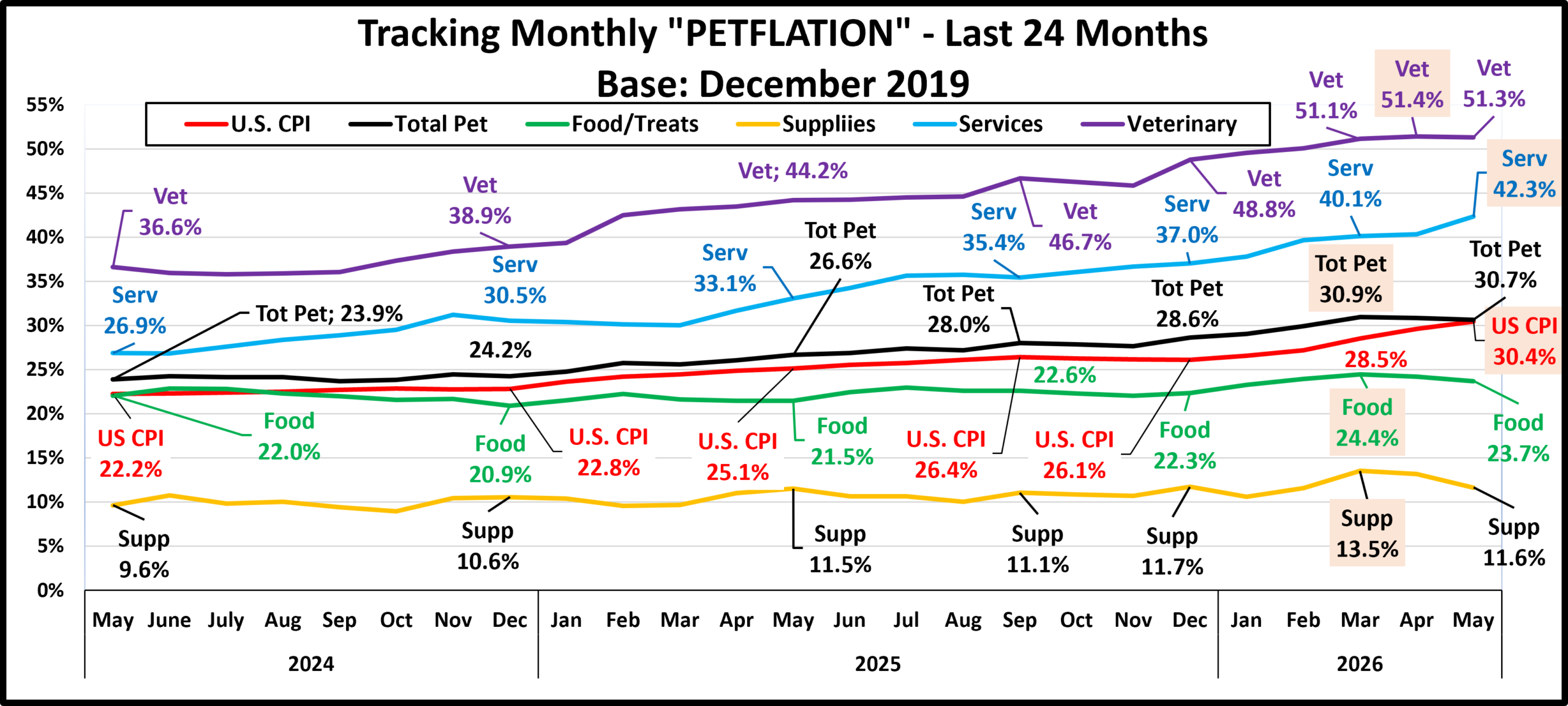
In our first graph we will track the monthly change in prices for the 24 months from Mar 24 to Mar 26. We will use December 2019 as a base number so we can track the progress from pre-pandemic times through an eventual recovery. This chart is designed to give you a visual image of the flow of pricing. You can see the similarities and differences in segment patterns and compare them to the overall U.S. CPI. The year-end numbers from 12 and 24 months earlier are included. We also included and highlighted (pink) the cumulative price peak for each segment. In Mar, Total Pet prices were up 0.8% from Feb. All segments were up & peaked. Supplies (+1.7%), Vet (+0.7%), Food (+0.4%), Services (+0.4%).

In Mar 24, the CPI was +21.5% and Pet was +24.0%. The Services segments inflated after mid-20, while Product inflation stayed low until late 21. In 22, Food prices grew but the others had mixed patterns until July 22, when all rose. In Aug>Oct Petflation took off. In Nov>Dec, Services & Food inflated while Vet & Supplies prices stabilized. In Jan>Apr 23, prices grew every month for all segments except for 1 Supplies dip. In May Products prices grew while Services slowed. In Jun/Jul this reversed. In Aug all but Services fell. In Sep/Oct this flipped. In Nov, all but Food & Vet fell. In Dec, Supp. & Vet  drove prices up. In Jan>Mar 24 Pet prices grew. In April, prices in all but Vet fell. In May, all but Food grew. In June, Products drove a lift. In July, all but Services fell. In Aug, Food drove a drop. In Sep, Products fueled a drop. In Nov all were up. Prices dropped in Mar & Oct>Nov 25, then rose Dec>Mar 26. All, including the CPI, set records in March 26.

  • U.S. CPI – Inflation was below 2% through 2020. It turned up in January 21 and grew until flattening out in Jul>Dec 22. Prices rose Jan>Sep 23, fell Oct>Dec, rose Jan>Oct 24, fell Nov, rose Dec>Sep 25, fell Nov>Dec, but hit record highs in Jan/Feb/Mar 26. 25% of the lift since Dec 19 happened from Jan>Jun 22 – 8% of the time.
  • Pet Food – Prices were at the Dec 19 level Apr 20> Sep /21. They grew & peaked May 23, then got on a roller which continues Jun/Jul, Aug, Sep↔, Oct/Nov , Dec>Mar – a new record. 93% of the lift was in 22/23.
  • Pet Supplies – Supplies prices were high in Dec 19 due to tariffs. They had a deflated roller coaster ride until mid-21 when they returned to Dec 19 prices & stayed there until 22. They turned up in Jan (record). They plateaued Feb>May, grew in June, flattened in July, then turned up in Aug>Oct to a new record. Prices stabilized Nov>Dec, grew Jan>Feb 23. fell in Mar, but the roller coaster hasn’t stopped. Jan>Feb 25, Mar>May, Jun, Jul, Aug, Sep, Oct>Nov, Dec(record), Jan 26, Feb>Mar. Prices are now at a new record high.
  • Pet Services– Inflation is usually 2+%. Perhaps due to closures, prices increased at a lower rate in 2020. In 2021 consumer demand increased but with fewer outlets. Inflation grew in 21 with the biggest lift in Jan>Apr. Inflation was strong in 22 but prices got on a roller coaster. They turned up Jul>Apr 23, fell May. Jun>Aug, Sep>Dec, Jan>Mar 24, Apr, May, Jun, Jul>Nov, Dec>Mar 25, Apr>Aug, Sep, Oct>Mar 26(record).
  • Veterinary – Inflation has been consistent. Prices turned up in Mar 20 and grew through 21. A surge began in Dec 21 which put them above the overall CPI. In May/Jun 22 prices fell below the CPI. However, they rose again & have been above the CPI since July 22. In 23>25 prices grew Jan>May, leveled Jun/Jul, fell Aug, grew Sep>Dec, fell Jan, grew Feb>May, fell Jun>Jul, grew Aug 24>Sep 25, fell Oct>Nov, grew Dec>Mar 26. (records)
  • Total Pet – Petflation is a sum of the segments. In Dec 21 the price surge began. In Mar>Jun 22 the segments had ups & downs, but Petflation grew Jul>Nov, slowed Dec, grew Jan>May 23, fell Jun>Aug, grew Sep/Oct, fell in Nov. In December prices grew through Mar 24 to a record high. Prices fell in April, rose May>Jun, fell Jul>Sep, rose Oct>Nov, fell Dec, rose Jan>Feb 25, fell Mar, grew Apr>Jul, fell Aug, rose Sep, fell Oct>Nov, rose Dec>Mar 26 (record)

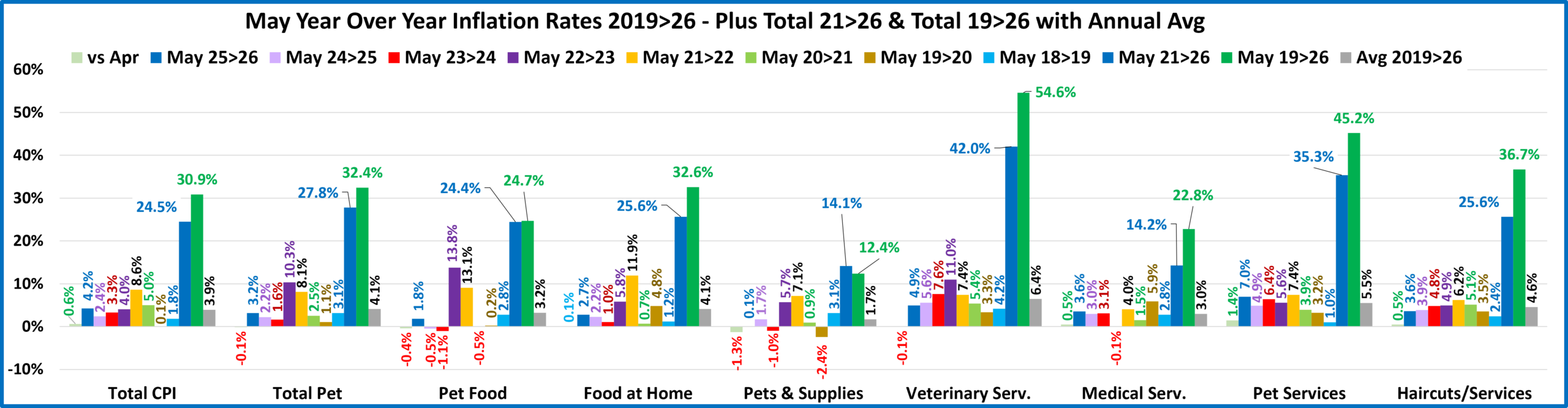
Next, we’ll turn our attention to the Year Over Year inflation rate change for March and compare it to last month, last year and to previous years. We will also show total inflation from 21>26 & 19>26. Petflation rose from 2.5% to 3.5% in Sep, fell to 2.6% in Nov, then rose to 3.5% in Dec. In Mar it is 4.3%, 30.3% above the National CPI. The chart will allow you to compare the inflation rates of 25>26 to 24>25 and other years but also see how much of the total inflation since 2019 came from the current surge. We’ve included some human categories to put the pet numbers into perspective.
Overall, prices were up 1.0% from Feb and were +3.3% vs Mar 25, up from 2.4% last month. Grocery prices dropped, -0.04% and inflation slowed to +1.9% from 2.4%. Haircut prices were also down from last month. In Feb, there were no drops. In Dec & Jan there was 1. In Nov there were 6 drops. The national YOY monthly CPI rate of 3.3% is up 37.5% from 24>25 but it’s 61% less than 21>22. The 25>26 rate is above 24>25 for all but Vet, Groceries & Haircuts. In our 2021>2025 measurement you also can see that over 80% of the cumulative inflation since 2019 has occurred in all but 4 segments, Haircuts, Medical, Vet, Pet Services. Service Segments have generally had higher inflation rates so there was a smaller pricing lift in the recent strong increase. Pet Products have a very different pattern. The 21>26 inflation surge provided 98% of their overall inflation since 2019. This happened because Pet Products prices in 2021 were still recovering from a deflationary period. Services expenditures account for 64.0% of the National CPI so they are very influential. Their current CPI is +3.1% while the CPI for Commodities jumped up from 1.2% to 3.4%. Services are the usual inflation driver, but Commodities are behind the current increase. The situation in Pet is closer to the “normal” national situation. Petflation: 4.3%. The CPI for the 2 Service Segments is 5.6%. The Pet Products CPI is 3.1%.

  • U.S. CPI– Prices are +1.0% from Feb. The YOY increase is 3.3%, up from 2.4% in Feb. It peaked at +9.1% back in June 2022. The targeted inflation rate is <2% so we are now 65+% higher than the target. The lift follows stability in Feb, a lift in Jan, stability in Dec and 2 drops in Oct & Nov. The current rate is 37.5% above 24>25 and the 21>26 rate is +24.7%, 82.6% of the total inflation since 2019. The Inflation surge was just starting in March 2021, +2.6%
  • Pet Food– Prices are +0.4% vs Feb. and +2.3% vs Mar 25, up from 1.4%. They are now 21% above the Food at Home inflation rate of +1.9%. Remember that the YOY Pet Food CPI has deflated in 15 of the last 25 months. The 2021>2026 inflation surge has generated 93.6% of the 26.7% inflation since 2019. Inflation began for Pet Food in June 2021, +0.9%, after 12 straight deflationary months. Pet Food prices just reached a new record high.
  • Food at Home – Prices are -0.04% from Feb and the YOY increase fell from 2.4% to 1.9%. This is radically lower than Jul>Sep 2022 when it exceeded 13%. The 31.4% Inflation for this category since 2019 is 5% more than the national CPI but is only in 5th place behind 3 Services expenditures and Total Pet. 82.5% of the inflation since 2019 occurred from 2021>26. This is about the same as the CPI, but we should note that Grocery prices began inflating in 2020>21 then the rate accelerated. It appears that the pandemic supply chain issues in Food which contributed to higher prices started early and foreshadowed problems in other categories and the overall CPI tsunami.
  • Pets & Supplies– Prices were +1.7% from Feb and YOY inflation rose to +3.5% from 1.8%. They still have the lowest rate vs 2019. Prices were deflated for much of 20>21. As a result, the 2021>26 inflation surge accounted for 111.0% of the total price increase since 2019. Prices set a record in Oct 22 then deflated. 3 lifts pushed them to a record high in Feb 23. Prices fell in Mar & the roller coaster continued into 25. They fell Jan/Feb 25, rose Mar>May, fell Jun, rose Jul, fell Aug, rose Sep, fell Oct>Nov, rose Dec (record), fell in Jan, rose Feb>Mar – a new record.
  • Veterinary Services– Prices are +0.7% from Feb and 5.6% from 2025, up from 5.3%. They are #2 in inflation vs last year, behind Pet Serv. but still #1 in the increase since 2019, +55.5% and 21, +43.9%. For Veterinary, high annual inflation is the norm. However, the rate has increased during the current surge, especially since 23. They have the highest Mar avg rate in 26, but only 79% of the cumulative inflation since 2019 occurred from 2021>26.
  • Medical Services – Prices turned sharply up at the start of the pandemic but then inflation slowed and fell to a low rate in 20>21. Prices rose +0.1% from Feb, but inflation vs last year slowed to +3.7% from +4.1%. Medical Services are not a big part of the current surge as only 58.5% of the 22.9%, 2019>26 increase happened from 21>26.
  • Pet Services – Inflation slowed in 20 but grew in 21. In 24 prices surged , especially in Jul>Nov. Prices fell Dec>Mar 25 to 3.9%. Apr grew, May fell, June rose, Jul rose to 6.3%. Inflation fell to 5.8% in Aug & to 4.2% in Nov. In Dec>Mar 26 it rose to 7.8%. They are #1 vs 25 and #2 vs 21 & 19. 76.9% of their 19>25 inflation is from 21>26.
  • Haircuts/Other Personal Services – Prices are -0.3% from Feb but +4.5% from Mar 25. 20 of the last 27 months have been 4.0+%. Inflation has been pretty consistent. 68.1% of the 19>26 inflation happened 21>26.

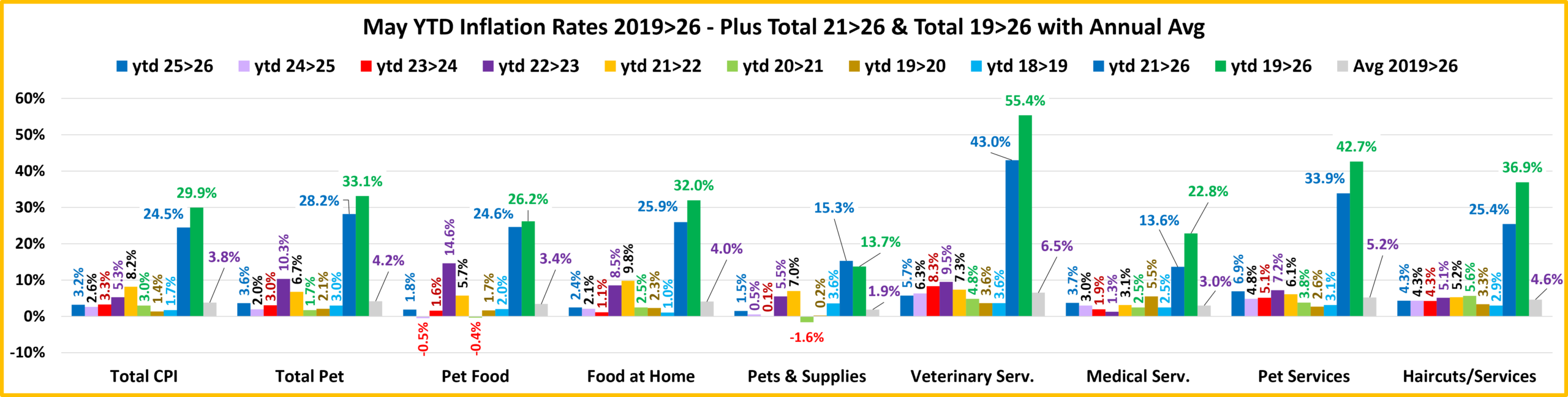
Total Pet– Petflation rose to 4.3% from 3.3%. Only Veterinary & Pet Services had a higher rate. It is 3.3 times the 24>25 rate and 30.3% more than the current U.S. CPI. Plus, it is 43.3% above the 3.0% average March rate since 1997. Feb prices rose 0.8%, driven by all. The Feb>Mar increase was well above the 0.3% 97>25 average change, but expected. Since 1997, there have been only 5 Feb>Mar price drops. Another factor in the current CPI lift was that prices fell 0.2% in Feb>Mar 25. The recovery definitely slowed. Now, we’ll look at YTD data.The 25>26 rate is equal to or higher than 24>25 for all, but Veterinary. The 22>23 inflation rate was the highest for Tot Pet, Pet Food, Groceries & Pet Services. 21>22 has the highest rate for Pet Supplies & the Natl CPI. 23>24: Vet; 20>21: Haircuts; 19>20: Medical Services. The average national inflation rate in the 7 years since 2019 is 3.8%. Only 3 of the categories are below that rate – Medical Services (3.0%), Pet Supplies (1.9%) and Pet Food (3.4%). It is no surprise that Veterinary Services has the highest average rate (6.5%), but all 4 other categories are +4.0% or higher.

  • U.S. CPI – The 25>26 rate is 2.7%, the same as 24>25 but down 16% from 23>24. It is also 66.2% less than 21>22 and 29% below the average increase from 2019>2026. However, it’s still 45% more than the average increase from 2018>21. 83% of the 29.5% inflation since 2019 occurred from 2021>26. Inflation is a problem that started recently.
  • Pet Food – Ytd prices are still inflating, 1.7%, up from 1.4%. That’s a big increase from -0.5% in 24>25, but it is still below 3.0% in 23>24 and even the 2.0% 18>20 average. Pet Food has the highest 22>23 rate but is only #6 in the 21>26 rates and #8 in 19>26. Deflation in the 1st half of 2021 kept YTD prices low then they surged in 22 and especially in 23. 92% of the inflation since 2019 occurred from 2021>26.
  • Food at Home – The 25>26 inflation rate is the same as 24>25, but at 2.1%, it is down 89% from 22>23, 76% from 21>22 and even 40% less than 20>21. However, it is 2.1 times higher than the average rate from 2018>20. It is only in 5th place for the highest inflation since 2019 but still beat the U.S. CPI by 7.1%. You can see the impact of supply chain issues on the Grocery category as 82% of the inflation since 2019 occurred from 2021>26.
  • Pets & Pet Supplies – A roller coaster, prices rose Jan>Feb 24, fell Mar>Apr, rose May>Jun, fell July, rose Aug, fell Sep>Oct, rose Nov>Dec, fell Jan>Feb 25, then rose Mar>May. Prices vs 24 flipped to deflation in June, back to +0.7% in July, fell to 0.0% in Aug, rose Sep>Dec, fell Jan 26, rose Feb>Mar. Supplies still have the lowest inflation since 2019. Their biggest YOY lifts since 2019 were in 22 & 23. The 2021 deflation created an unusual situation. Prices are up 13.8% from 2019 but 112% of this lift happened from 21>25. Prices are up 15.5% from their 2021 “bottom”.
  • Veterinary Services – Inflation was high in 2019 and steadily grew until it took off in late 2022. The rate may have peaked in 2023, but it is still going strong in 2026, +6.1%, the 2nd  highest on the chart. However, they are still #1 in inflation since 2019 and since 2021. At +6.5%, they have the highest average inflation rate since 2019. It is 71% higher than the National Average but 2.2 times higher than the Inflation average for Medical Services. Strong Inflation is the norm in Veterinary Services.
  • Medical Services – Prices went up significantly at the beginning of the pandemic, but inflation slowed in 2021. In Mar 2026 it is 3.9%, 30% above the 3.0% 2019>26 average rate. We should also note that 3.9% is 3 times higher than the 1.3% low point in 23>24.
  • Pet Services – After falling in late 2023, prices surged in 2024, then fell in 2025 until an Apr>Aug lift followed by a Sep>Nov dip and a Dec>Mar 26 lift. The 25>26 6.9% CPI is #1 on the chart, passing Veterinary. It is 35% above their 19>26 avg and more than double their 2018>20 avg. Pet Services is also 2nd in both 19>26 and 21>26 inflation.
  • Haircuts & Personal Services – The services segments, essential & non-essential, were hit hardest by the pandemic. The industry responded by raising prices. 2026 inflation is 4.8%, 15.8% below its 20/21 peak, but 47.7% above the 18>20 average. Consumers are paying over 35% more than in 2019, which usually reduces the purchase frequency.
  • Total Pet – Petflation is 3.7%, up 95% from 24>25, but 7.5% less than 23>24. However, It’s 63 % more than their 18>21 avg and 37% above the CPI. Petflation is growing again. Except for Mar/Aug/Oct/Nov, Pet prices rose in 25, which continued in Jan>Mar 26. This is primarily being driven by a flip from deflation to inflation in Pet Products and continued strong inflation in Services, especially Non-Vet.

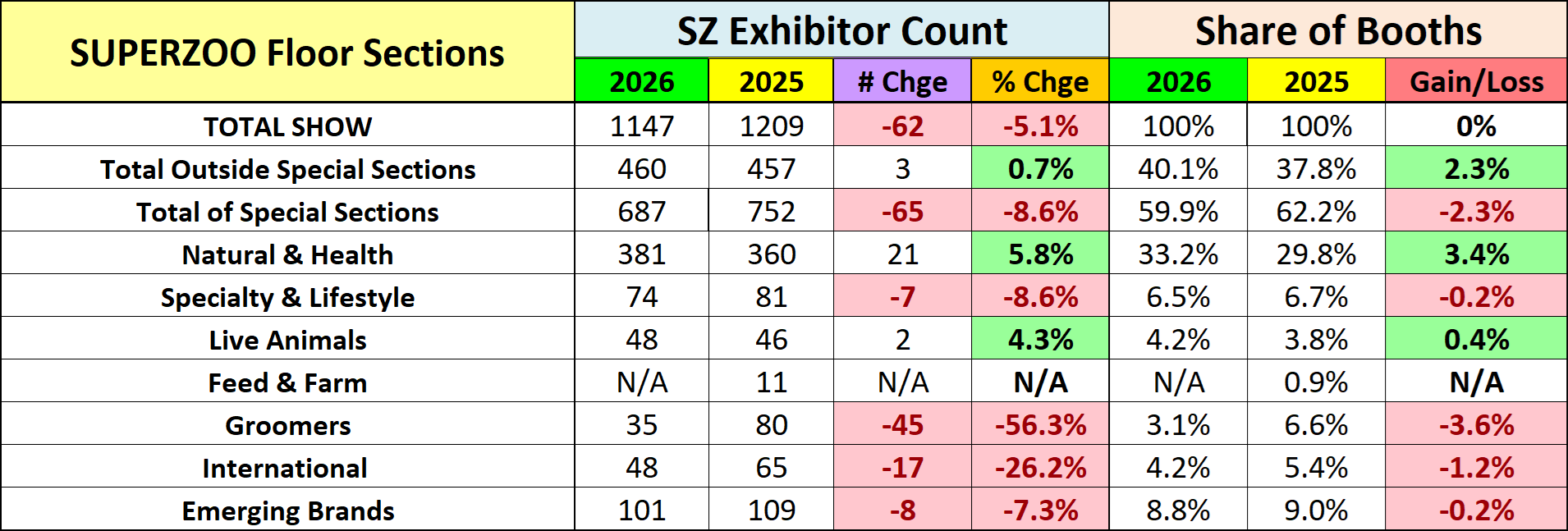
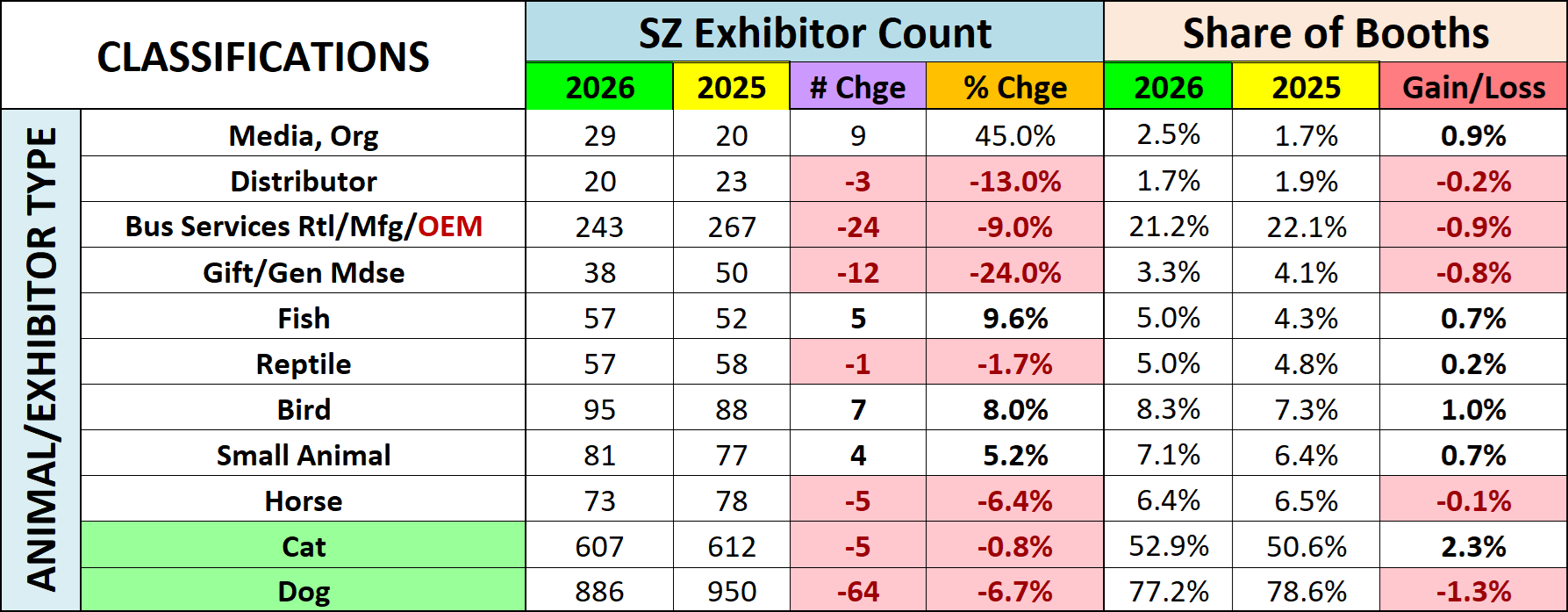
The Petflation recovery paused in Aug 24, came back Sep>Oct, paused in Nov, resumed in Dec>Jan 25, paused in Feb, restarted in Mar and paused Apr>Sep. It improved Oct/Nov but paused in Dec>Mar 26. We tend to focus on the monthly, YOY inflation in the current year and ignore the fact that inflation is cumulative. Pet prices are 29.0% above 2021 and 33.8% higher than 2019. Those are big lifts. In fact, March prices for the National CPI, Total Pet and all pet segments reached new record highs. Only Supplies prices (+15.4%) are less than 26.7% higher than 2019. Since price/value is the biggest driver in consumer spending, inflation will affect the Pet Industry. Services will be the least impacted as it is the most driven by high income CUs. Veterinary will continue to see a reduction in visit frequency. Pet Parents will just pay more. The product segments will see a more complex reaction. Supplies are more discretionary so we will likely see a reduction in purchase frequency. In Pet Food, the most needed segment, some Pet Parents may even choose to downgrade their Pet Food. However, the biggest impact in both product segments will be a strong movement to online purchasing and private label. We saw proof of this at both GPE 25 & SZ 25 as a huge # of exhibitors offer OEM services. At GPE 26, this trend continued. Strong, cumulative inflation has a widespread impact. We’ll continue to monitor the situation.

Retail Channel $ Update – January Monthly & February Advance

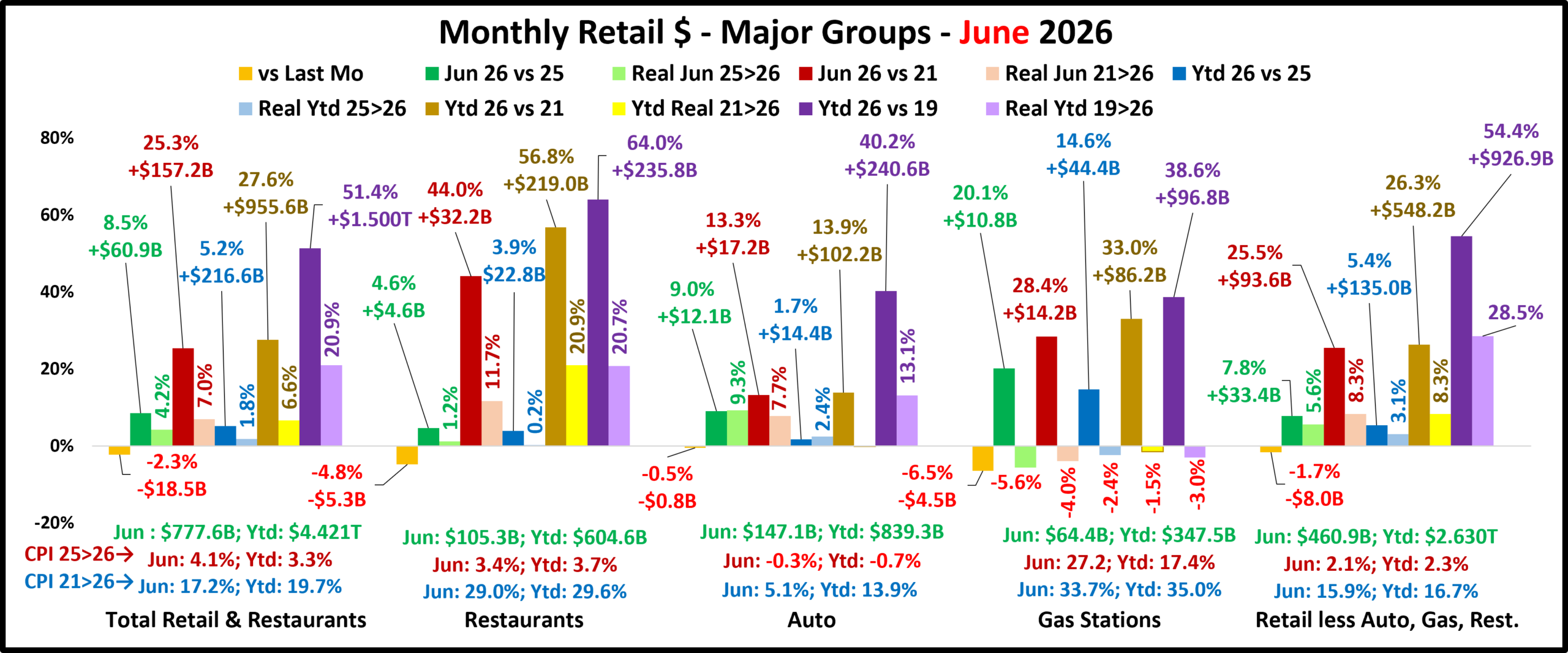
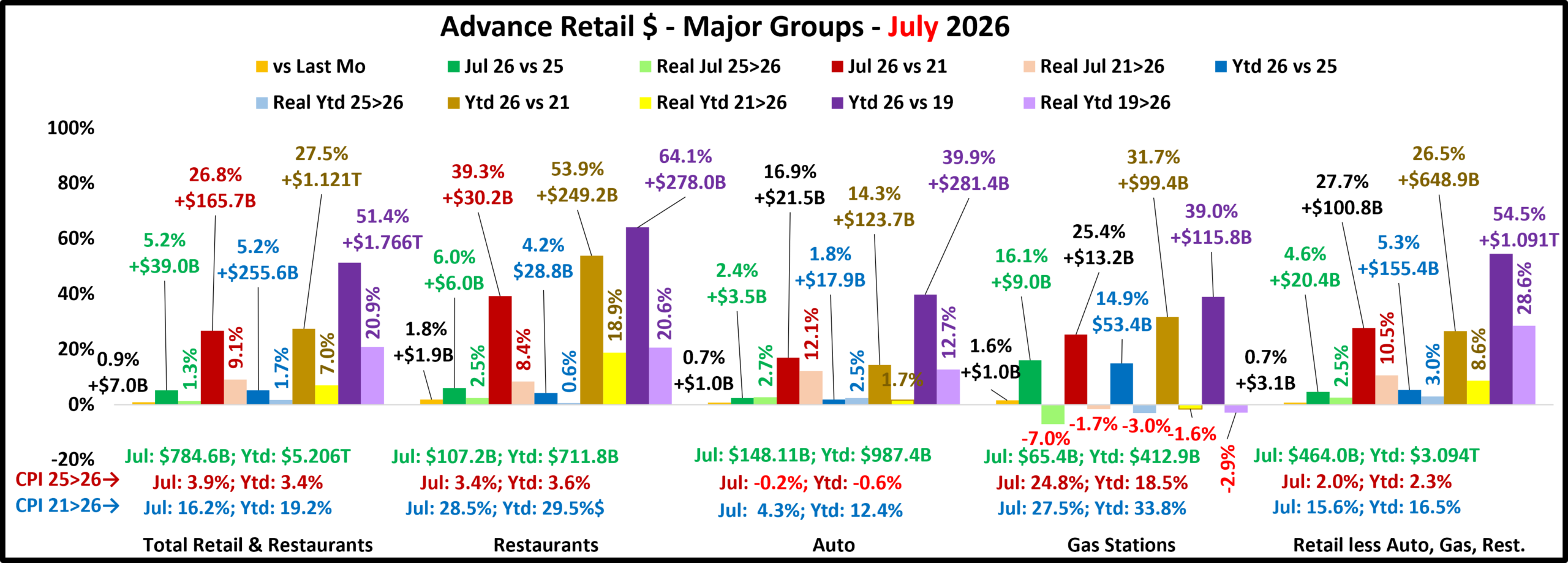
In February, YOY Commodities’ inflation rose slightly to 1.2% from 1.0%. Even with a low inflation rate, high cumulative inflation vs 21 can still impact consumer spending and slow $ales growth.  We saw evidence of this in February. Total Retail $ were +3.6% vs 25, 21.8% below the average 92>25 lift and Relevant Retail was +3.8%, still -18.5% below the February average. The situation is complex and there is still a long road to full recovery. We’ll continue to track the retail market with data from 2 reports provided by the Census Bureau and factor in a targeted CPI.

The Census Bureau Reports are the Monthly and the Advance Retail Sales Reports. Both are derived from sales data gathered from retailers across the U.S. and are published monthly at the same time. The Advance Report has a smaller sample size so it can be published quickly – normally, 2 weeks after month end. The Monthly Report includes data from all respondents, so it takes longer to compile the data – about 6 weeks. Although the sample size for the Advance report is smaller, the results over the years have proven it to be statistically accurate with the Monthly reports. The biggest difference is that the full sample in the Monthly report allows us to “drill” a little deeper into the retail channels.

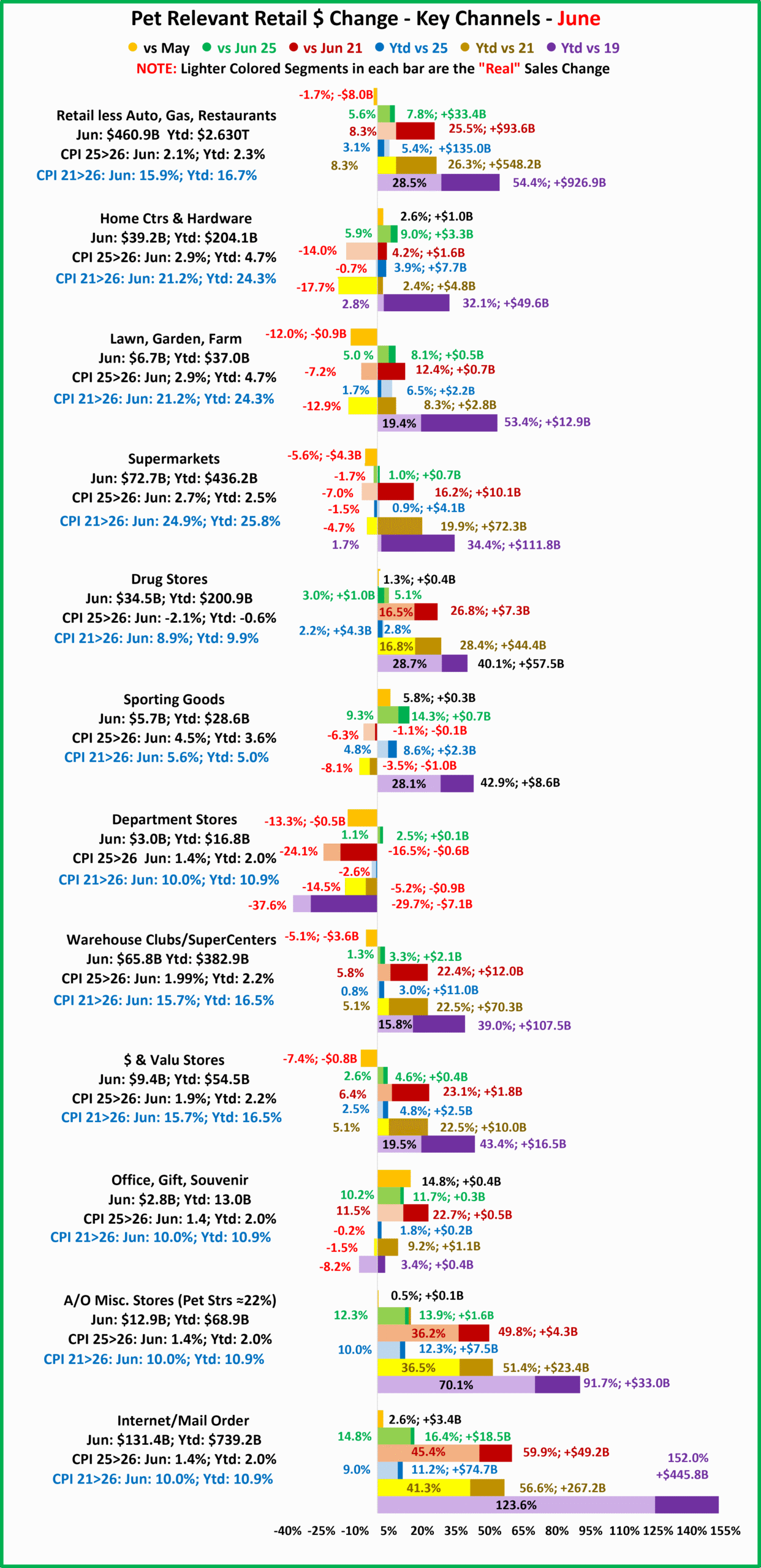
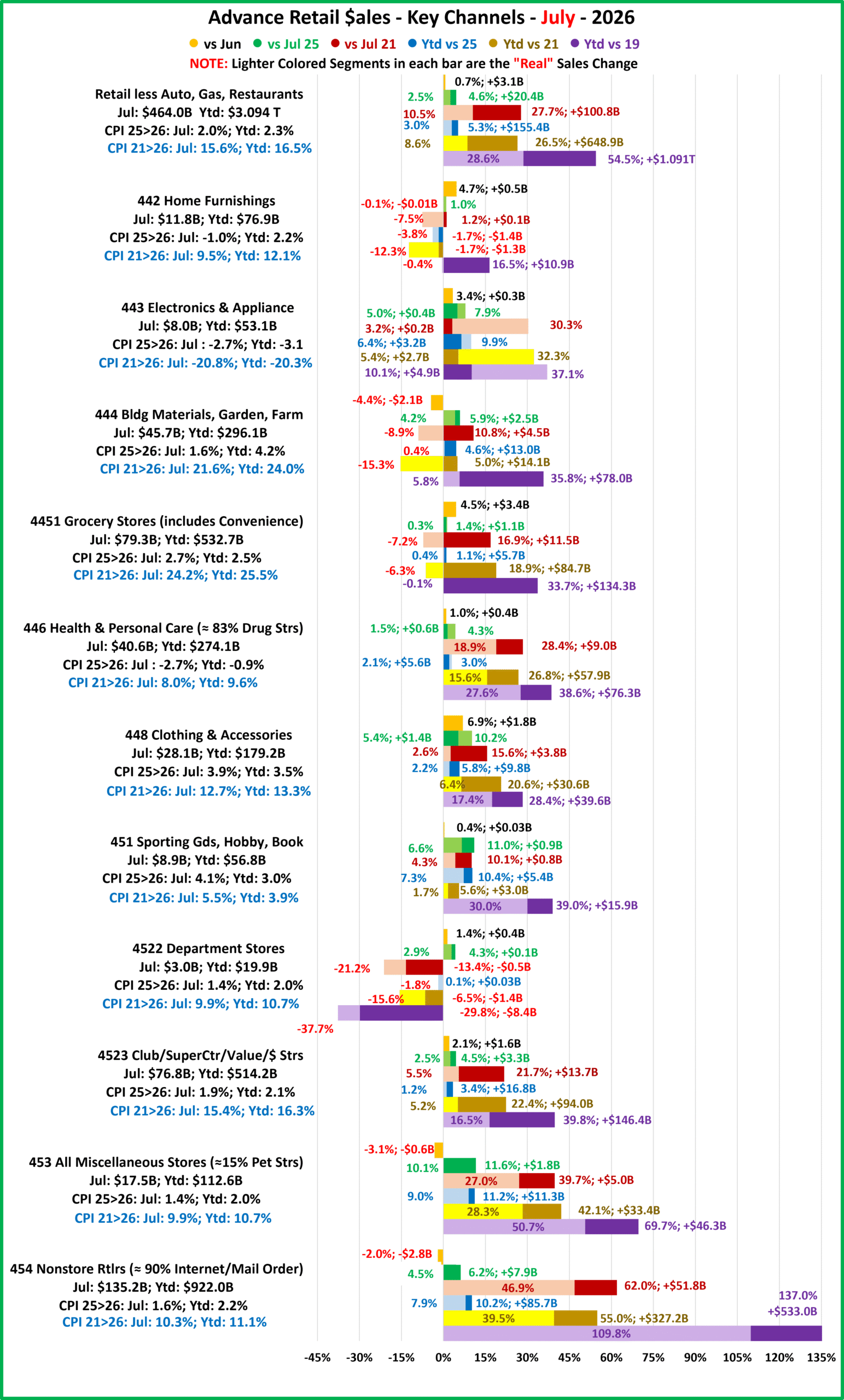
We will begin with the January Monthly Report and then go to the February Advance Report. Our focus is comparing to last year but also 21 & 19. We’ll show both actual and the “real” change in sales as we factor inflation into the data.

Both reports include the following:     (Note: January monthly data = Ytd)

  • Total Retail, Restaurants, Auto, Gas Stations and Relevant Retail (removing Restaurants, Auto and Gas)
  • Individual Channel Data – This is more detailed in the Monthly reports, and we’ll focus on Pet Relevant Channels.

The data will be presented in detailed charts to facilitate visual comparison between groups/channels. The charts will show 11 separate measurements. To save space they will be displayed in a stacked bar format for the channel charts.

  • Current Month change – % & $ vs previous month
  • Current Month change – % & $ vs same month last year and vs 2021.
    • Current Month Real change vs last year and vs 2021 – % factoring in inflation
  • Current Ytd change – % & $ for this year vs last year, 2021 & 2019.
    • Current Ytd Real change % for this year vs last year and vs 2021 and 2019
  • Monthly & Ytd $ & CPIs for this year vs last year and vs 2021 which are targeted by channel will also be shown. (CPI Details are at the end of the report)

First, the January Monthly. All were down from December but there were only 2 actual sales drops – monthly/ytd vs 25 in Gas Stations. We should note: Gas Stations are still selling a little more product than in 2019. Also, Relevant Retail is all positive again. They have been all positive in 20 of the last 22 months.            ($ are Not Seasonally Adjusted)

The December Monthly is $0.3B less than the Advance report. Restaurants: -$0.1B; Auto: +$0.4B; Gas Stations: +$0.5B; Relevant Retail: -$1.3B. Relevant Retail was the driver in the $ales drop vs December, but all were down. A Dec>Jan decrease in Total Retail  has happened every year since 1992. However, the 17.4% drop was 17.5% less than average. There were 2 drops in actual sales – Monthly/Ytd vs 25 for Gas Stations. There were no “real” sales drops, the same as December. All but Gas Stations were all positive. Restaurants still have the biggest increases vs 21 & 19 but Relevant Retail stayed at the top of “real” performance vs 2019. However, only 53.8% of their growth is real.

Now, let’s see how some Key Pet Relevant channels did in January in the Stacked Bar Graph Format

Overall– All 11 were down from December. Vs Jan 25, 9 were actually and 6 “really” up. Vs Jan 21, 10 were up but only 5 were real lifts. Vs 2019, Dept Strs & Off/Gift/Souv were actually & really down, but Home/Hdw was also really down.

  • Building Material Stores – The pandemic focus on home has produced $ growth of 27.2% since 2019. Prices for the group have inflated 26.3% from 21 and 28.9% from 2019, which is having an impact. HomeCtr/Hdwe Sales vs Dec were -11.0% & -17.6% for Farm Stores. Vs other years, HomCtr/Hdwe are actually up & really down for all. Farm stores are actually up for all, but their Real $ were down vs 25 & 21. Bldg/Mat group’s 19>26 real growth was -1.3%. (avg -0.2%) HomeCtr/Hdwe: Jan: 2.0%; Avg 19>26 Growth: 3.2%, Real: -0.5%; Farm: Jan: +5.3%; Avg: 5.2%, Real: 1.5%
  • Food & Drug – Both are essential. Except for the COVID food binge, they tend to have smaller changes in $. Vs Dec: Supermarkets: -3.4%; Drug: -14.2%. In terms of inflation, the Groceries rate is 7 times higher than Drug/Med products. Drug Stores are positive in all measurements and 64.0% of their 2019>26 growth is real. Supermarkets’ actual $ are up in all comparisons, but they are only “really” up vs 2019 and only 9.2% of their 19>26 increase is real growth. Supermarkets: Jan: +1.8%; Avg 19>26: +4.5%, Real: +0.5%; Drug Stores: Jan: +1.2%; Avg: +4.3%, Real: +2.9%.
  • Sporting Goods Stores – They also benefited from the pandemic in that consumers turned to self-entertainment, especially sports & outdoor activities. Sales are -45.3% from Dec, but their only negatives are actual & real vs 21. Prices stopped deflating vs last year. Deflation started in April 23 and was a big change from +1.1% in 22>23 & +7.9% in 21>22. This caused 74% of their 48% lift since 2019 to be real. Jan: 4.1%; Avg 19>26: +5.7%; Real: +4.4%
  • Gen Mdse Stores – Sales were -23.1% vs Dec. All YOY comparisons were up for $ Strs & SupCtr/Clubs. Dept Stores are negative in all comparisons but actual vs Jan 21. Their Actual sales are even -33.6% from 19 (Real: -40.6%). The other channels have an average of 46.9% in real growth. SupCtr/Club: Jan:+3.5%; Avg 19>26: 5.2%, Real: 2.6%; $/Value Strs: Jan: +5.6%; Avg: +5.6%, Real: +3.0%; Dept. Strs: Jan: -9.8%; Avg: -5.7%, Real: -7.2%.
  • Office, Gift & Souvenir Stores– Sales fell -35.8% from Dec. They are actually up vs Jan 21. All others are down. Their recovery started late. It was slowly restarting in Jun/Jul, but their progress had slowed. It took off in Oct, slowed in Nov, grew in Dec, then slowed in Jan. Recovery takes some time. Jan: -2.7%; Avg Growth Rate: -0.9%, Real: -2.4%
  • Internet/Mail Order – Sales are -25.9% from Dec to $116.1B, a Jan record. All YOY measurements are positive, but their YOY growth, +7.8%, is only 56.5% of their average since 2019. However, 82.3% of their 146.8% growth since 2019 is real. Jan: +7.8%; Avg Growth: +13.8%, Real: +12.0%. As expected, they are by far the growth leader since 2019.
  • A/O Miscellaneous – Pet Stores are 22>24% of total $. In May 2020 they began their recovery which reached $100B for the 1st time in 21. In 22 their $ dipped in Jan, Jul, Sep>Nov, rose Dec, fell Jan>Feb 23, grew Mar>May, fell Jun>Aug, rose Sep>Nov, fell Dec>Jan 24, grew Feb>May, fell Jun>Sep, grew Oct, fell Nov, rose Dec, fell Jan>Feb, grew Mar>May, fell Jun>Sep, rose Oct, fell Nov, rose Dec, fell Jan 26. All comparisons are positive, and they are #2 in the increase vs 2019 but now #1 vs 2021. Also, 78.7% of their 97.6% growth since 2019 is real. Jan: +12.6%; Avg 19>26: 10.2%, Real: +8.5%

Jan had its usual drop vs Dec, but the Rel Retl drop was 24% below avg. However, all small channels were down. The YOY lift vs 25 was below avg for Total: -36% & Relevant Retl: -15%, but 4 big groups & 9 smaller channels had lifts. Also, prices are only deflating in Auto & Gas Stations, but cumulative inflation has an impact, as only 5 channels were really up vs Jan 21. The Recovery is slow. In Feb, the commodities CPI rose from 1.0% in Jan to 1.2%. Let’s see if it impacts Retail.

Jan>Feb sales were down for all but Auto. A Jan>Feb Total Retail drop has happened in 65% of the years since 1992. The -3.1% drop is 4.3 times the -0.7% avg. BTW: The -5.3% Jan>Feb drop by Relevant Retail was 2.3 times bigger than their -2.3% avg. There were 2 YOY $ drops, the same as Jan. 4 Big Groups were up vs 25 but the Total Retail lift of 3.6% vs Feb 25 was 22% below their +4.6% 92>25 avg. Plus, the Relevant Retail 3.8% increase vs Feb 25 was 18.5% below their +4.6% avg. Inflation is still a factor. The CPI for all commodities rose to 1.2% from 1.0% vs last year but it is still +19.5% vs 21. There is some good “real” news. Like the Jan Monthly, no “real” measurement was down. Plus, Gas Stations are again selling more Gas than in 2019. Also, 4 Big Groups are again all positive, the same as Dec/Jan. Note: Relevant Retail has now been all positive in 21 of the last 23 months.

Overall Inflation Reality– The Total Retail CPI rose to only 1.2% but the $ lift vs 25 was still 22% below avg. The Restaurant CPI slowed to +3.8% but their $ lift was still 6% below avg. Gas prices rose to -5.5%. They are still in turmoil. Auto inflation is -0.9% vs 25 but +18.6% vs 21. Sales were +3.7% vs 25, 13.4% below their 4.3% avg change. Inflation rose to 2.2% for Relevant Retail and their lift was 18.5% below avg, but they are again all positive. Progress has slowed in 2026.

Total Retail – Since Jun 20, every month but Apr 23, Jun 24 & Feb 25 has set a monthly $ales record. In 2023>26, Sales got on a roller coaster. Up Jul>Aug, down Sep, up Oct>Dec, down Jan 24, up Feb>Mar, down April, up May, down Jun, up Jul>Aug, down Sep, up Oct>Dec, down Jan>Feb 25, up Mar, down Apr, up May, down Jun, up Jul>Aug, down Sep, up Oct, down Nov, up Dec, down Jan>Feb. Prices are 1.2% and YOY $ are +3.6%, 22% below avg. 43% of 19>26 growth is real. Inflation slowed but cumulative inflation is still impacting sales. Growth: 25>26: 3.3%; Avg 19>26: +6.0%, Real: +2.9%.

Restaurants – They were hit hard by the pandemic and didn’t begin recovery until March 2021. However, they have had strong growth since then, exceeding $1T for the 1st time in 2023. February $ are up vs 25 and they have the biggest lifts vs 21 & 19. Inflation slowed to 3.8% vs last year, but it is +29.8% vs 21 and +35.1% vs 19. Their 5.0% YOY lift is 6% below their +5.4% 92>25 avg. They are all positive again, but just 34% of their 65% growth since 2019 is real. They fell from 3rd  to 4th in performance. Recovery started late but inflation started early. Growth: 5.0%; Avg 19>26: +7.4%, Real: +2.9%.They just account for 13.8% of Total Retail $, but their strong growth has helped Total Retail.

Auto (Motor Vehicle & Parts Dealers) – They overcame the stay-at-home attitude with great deals and advertising. They finished 2020 up 1% vs 2019 and hit a record $1.48T in 2021 but much was due to high inflation. In 22, sales got on a rollercoaster. Inflation started to drop mid-year, but it caused 4 down months in actual $. Their YE real 22 sales numbers were even worse, -8.2% vs 21 and -8.9% vs 19. 23 started a sales rollercoaster but the $ hit a record, $1.595T. $ fell in Jan 24, grew Feb>Mar, fell Apr, grew May, fell June, grew Jul>Aug, fell Sep, grew Oct, fell Nov, grew Dec, fell Jan>Feb 25, grew Mar, fell Apr>Jun, rose Jul>Aug, fell Sep, rose Oct, fell Nov, rose Dec, fell Jan, rose Feb. Feb $ were +3.7% vs 25, below the 4.3% avg. They are again all positive but just 36% of 19>26 growth is real. Growth: 2.0%; Avg 19>26: +5.2%, Real: +2.1%

Gas Stations – Gas Stations were hit hard by “stay at home”. They started recovery in Mar 21, and inflation began. Sales got on a rollercoaster in 22 but set a record, $583B. Inflation started to slow in Aug and prices slightly deflated in Dec & Feb 23, then strongly fell in Mar>Jul to -20.2%. In Sep they were +2.7% but began deflating to -4.2% in Feb 24. In Mar>May $ grew, fell Jun, rose July, fell Aug/Sep, rose Oct, fell Nov>Feb 25, rose Mar>May, fell Jun, rose Jul, fell Aug>Oct, up Nov, fell Dec>Jan, rose Feb. Feb $ vs 25: -0.7% (4.3% avg). Only down vs 25. Real $ vs 19 are again positive. Growth: -1.3%; Avg 19>26:+3.5%, Real: +0.3%. They show the cumulative impact of inflation can be positive & negative.

Relevant Retail – Less Auto, Gas and Restaurants– They account for ≈60% of Total Retail $ in a variety of channels. Their only down month until Feb 25 was Apr 20, and they led the way in Retail’s recovery. Sales got on a roller coaster in 22, but all months set new records with Dec reaching a new all-time high, $481B, and an annual record of $4.81T. In 23, the roller coaster continued. A Dec lift set a new monthly record of $494.7B & an annual record of $4.997T. $ales got back on the roller coaster in 24. The ride continued as $ rose Oct>Jan 25, fell Feb, rose Mar>May, fell Jun, rose Jul, fell Aug>Sep, rose Oct>Dec, fell Jan>Feb 26. The Feb 3.8% YOY lift is 18.5% below their 92>25 avg of +4.6%, but they are all positive again and 53.1% of their 53.5% 19>26 growth is real, again #1 in Big Group performance. Growth: 3.9%; Avg 19>26: +6.3%, Real: +3.6%. In 2024 their inflation rate fell from 3.2% to 0.1%. It rose in 25 to 1.8% in Sep then slowed to 1.5% in Oct>Nov, rose to 2.0% in Dec>Jan & 2.2% in Feb. YOY Inflation is low, but its cumulative impact can slow growth.

YOY inflation is low, but cumulative & impending lifts can affect sales. In Feb, 2 actual YOY $ comparison were negative, the same as Dec/Jan. In Oct>Nov, there was 1 real drop. That fell to 0 in Dec>Feb. In Oct, all were up vs last year with below avg lifts. In Nov only Auto was down but the lifts were all below avg. In Dec, all were up and Relevant Retl’s lift was above avg. In Jan, 3 lifts, all below avg. In Feb, 4 lifts, all below avg. In Oct/Nov, 3 big groups were all positive. In Dec, there were 4, which has continued through Feb. Relevant Retail has now been all positive in 21 of 23 months. As expected, Feb Total Retail sales fell vs Jan, but the -3.1% drop was 4.3 times more than the -0.7% avg. Recovery is still slow.

Here’s a more detailed look at February by Key Channels in the Stacked Bar Graph Format

  • Relevant Retail: Ytd Growth: +3.9%; Avg 19>26: +6.3%; Real: 3.6%. % Real Growth: 53.1%. 9 of 11 were down from Jan. Vs Feb 25: 8 were up, 6 Real. Vs Feb 21: 11 were up; 7 Real. Vs 19: Dept Stores were down & real Furniture Stores.
  • All Department Stores – This group was struggling before the pandemic hit them hard. They began recovery in March 21. Sales are +18.1% from Jan but all YOY measurements but actual vs 21 are negative. Their -6.0% Feb YOY drop is 36% more than their -4.4% avg. Ytd Growth: -7.8%; Avg 19>26: -5.6%; Real: -7.2%. % Real growth: None
  • Club/SuprCtr/$- They fueled a big part of the recovery because they focus on value which has broad consumer appeal. $ales are -6.7% from Jan, but they are up in all comparisons but real vs Feb 25. Their 1.4% YOY Feb lift is -83% below their 92>25 avg of +8.2%. Ytd Growth: 2.6%; Avg 19>26: +5.1%; Real: 2.4%. % Real Growth: 43.9%
  • Grocery- They depend on frequent purchases, so their changes are usually less radical. $ales are -10.5% from Jan. They are actually down vs Feb 25 but really down for all but vs 2019. Cumulative inflation has hit them hard. Their -0.2% YOY Feb drop is a big change from a +3.0% avg. Ytd Growth: 0.8%; Avg 19>26: +4.4%; Real: 0.4%. % Real Growth: 7.4%
  • Health/Drug Stores – Many stores are essential, but consumers visit less frequently than Grocery stores. $ are -3.7% from Jan, but they are positive in all YOY comparisons. Inflation has been relatively low, so it is surprising that their +2.5% YOY lift vs Feb 25 is 49.4% below avg. Ytd Growth: 1.8 %; Avg 19>26: +4.3%; Real: 2.8%. % Real Growth: 62.9 %
  • Clothing and Accessories – Clothes mattered less if you stayed home. That changed in March 2021 with strong growth through 2022. Sales are +7.8% from Jan and positive in all YOY measurements. $ales are +7.0% vs Feb 25, 2.2 times more than their 3.2% avg. Ytd Growth: 6.2%; Avg 19>26: +3.6%; Real: 2.6%. % Real Growth: 68.4%.
  • Home Furnishings – In mid-2020 consumers’ focus turned to their homes and furniture became a priority. Inflation is up to 4.5% in Feb. $ are -1.5% from Jan and are only actually up vs 2019 & vs Feb 21. YOY vs Feb 25, they are -5.6%, far below their 3.1% avg lift. Ytd Growth: -4.8%; Avg 19>26:+2.2%; Real: -0.2%. % Real Growth: None.
  • Electronic & Appliances – They have had many issues. Sales fell in Apr>May of 2020 and didn’t reach 2019 levels until March 21. $ are -5.5% from Jan but they are up in all comparisons. Strong deflation made real sales very high. Sales are +4.9% vs Feb 25, 2.4 times above the 2.1% avg. Ytd Growth: 4.6%; Avg 19>26: 0.7%; Real: 3.9%. % Real Growth: 100+%
  • Building Material, Farm & Garden & Hardware – They truly benefited from the consumers’ focus on home. In 2022 the lift slowed as inflation grew to double digits. Prices turned up again in Apr>Sep 25, dropped Oct/Nov, rose Dec/Jan to 5.6%, fell to 4.8% in Feb. Sales are -3.0% from Jan but are actually up and really down for all YOYs but 2019. Sales vs Feb 25 were +3.7%, 4.4% below their 3.9% Avg. Ytd Growth: 3.1%; Avg 19>26: 4.0%; Real: 0.4%. % Real Growth: 8.5%
  • Sporting Goods, Hobby and Book Stores – Consumers turned their attention to recreation and Sporting Goods stores sales took off. Book & Hobby Stores recovered more slowly. They have been on a sales roller coaster since June 24 and $ are -3.3% from Jan. All other comparisons are positive. YOY Sales vs Feb 25 are +11.5%, 4 times more than their 2.8% avg. Ytd Growth: +9.2%; Avg 19>26: +4.6%; Real: 3.8%. % Real Growth: 80.6%.
  • All Miscellaneous Stores – Pet Stores have been a key part of the strong and growing recovery of this group. They finished 2020 at +0.9% but sales took off in March 21 and have continued to grow. Sales are -2.0% vs Jan, but positive in all comparisons. They are 2nd in the % increase vs 19 & vs 21. Plus, their 11.3% YOY Jan lift is 2.7 times more than their 92>25 avg of +4.1%. Ytd Growth: +11.6%; Avg 19>26: +7.9%; Real: 6.1%. % Real Growth: 73.3%.
  • NonStore Retailers – 90% of their $ comes from Internet/Mail Order/TV. The pandemic accelerated online spending. They ended 2020 +21.4%. The growth continued in 2021 as sales exceeded $100B for the 1st time and they broke the $1 Trillion barrier. $ are -5.8% from Jan and their YOY lift of 7.5% is -22.8% below the 9.7% avg. However, they are positive in all comparisons. Ytd Growth: 7.3%; Avg 19>26: +12.7%; Real: 10.8%. % Real Growth: 80.4%.

Recap – Driven by Relevant Retail, the Pandemic recovery was widespread by Y/E 21. In 22 we were hit with the strongest inflation in 40 years. Inflation has slowed considerably from its Jun 22 peak, but only 1 smaller channel is deflating. Deflation helps, but cumulative inflation can still have a negative impact – slowed YOY growth and even sales drops. As expected, $ fell from Jan for 9 of 11 channels. 7 of the 9 drops were above avg – Not Good! The biggest concern is still YOY drops and smaller lifts. Relevant Retail’s 3.8% lift vs Feb 25 was 18.5% below avg. 8 channels had a YOY lift vs last year, 1 less than Jan. 4 of the 8 lifts were above avg, 1 more than Jan, the same as Dec but far less than 7 in Oct. There are multiple factors slowing growth, but the major one is high prices from cumulative inflation. December is still the biggest retail month of year, and February is usually the worst. Total & Relevant Retail had the most sales in history for both months. The Feb Yoy lift was -35% below avg for Total and -18.5% below for Relevant. The situation is a little better than January as 7 of 11 channels (8 in Jan) had a below avg lift or a drop vs Feb 25. We’ll see what happens.

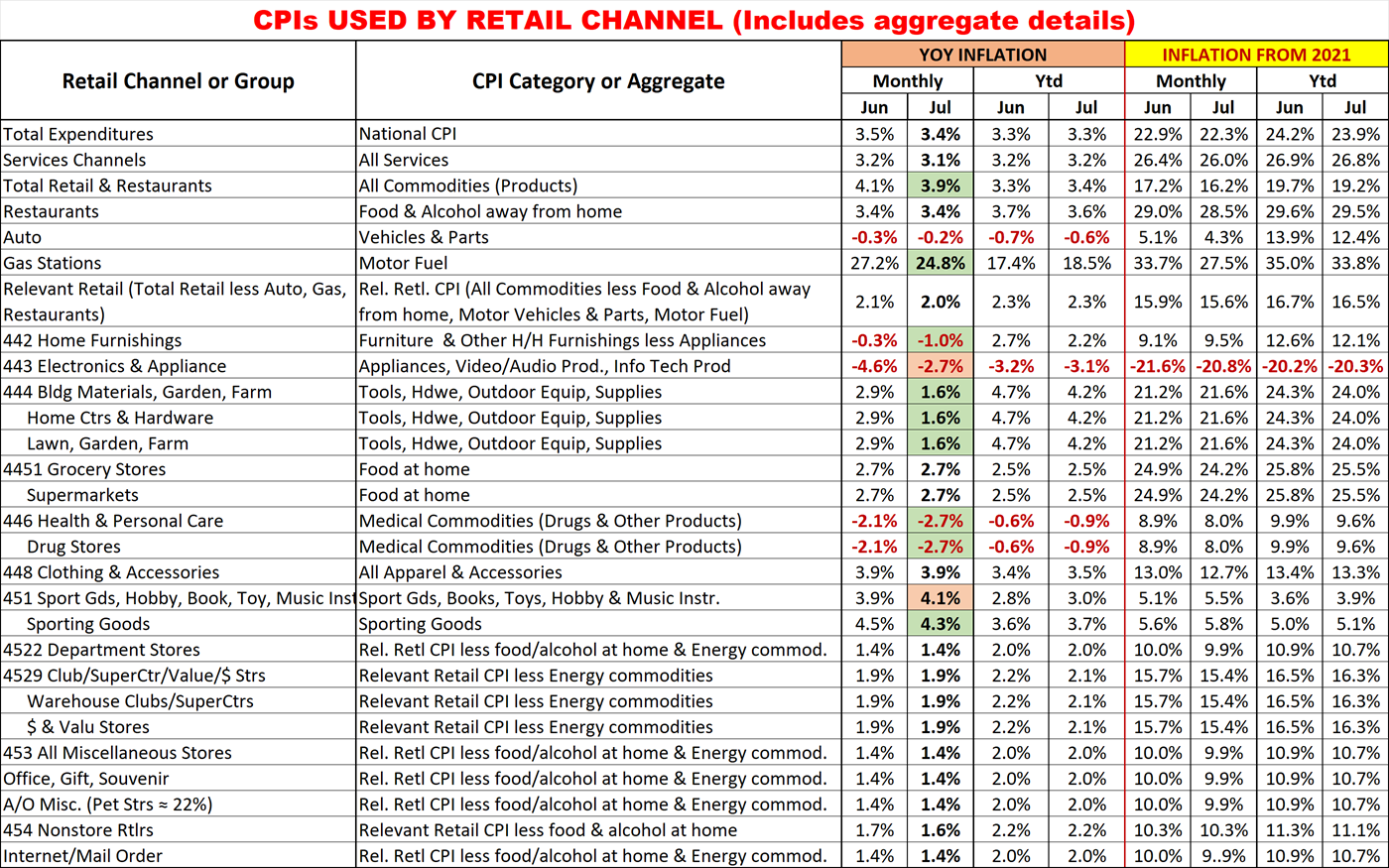
Here are the Jan/Feb inflation rates for the CPIs used to calculate the impact of inflation on retail groups and channels. This includes special aggregate CPIs created with the instruction and guidance of the US BLS. I also researched data from the last Economic Census to review the share of sales by product category for the various channels to help in selecting what expenditures to include in specific aggregates. Of course, none of these specially created aggregates are 100% accurate but they are much closer than the overall CPI or available aggregates. The data includes the CPI changes vs 21 to show cumulative inflation. Note: Jan Monthly = Ytd

Monthly YOY CPI changes of 0.2% or more are highlighted. (Green = lower; Pink = higher)

Here are some answers to some obvious questions. Note: Product Prices rose but changes by Channel were mixed.

  1. Why is the group for Nonstore different from the Internet?
    • Non-store is not all internet. It also includes Fuel Oil Dealers, the non-motor fuel Energy Commodity.
  2. Why is there no Food at home included in Nonstore or Internet
    • Online Grocery purchasing is becoming popular, but almost all is from companies whose major business is brick ‘n mortar. These online sales are recorded under their primary channel.
  3. 5 Channels have the same CPI aggregate but represent a variety of business types.
    • They also have a wide range of product types. Rather than try to build aggregates of a multitude of small expenditure categories, it seemed better to eliminate the biggest, influential groups that they don’t sell. This method is not perfect, but it is certainly closer than any existing aggregate.
  4. Why are Grocery and Supermarkets only tied to the Grocery CPI?
    • According to the Economic Census, 76% of their sales comes from Grocery products. Grocery Products are the driver. The balance of their sales comes from a collection of a multitude of categories.
  5. What about Drug/Health Stores only being tied to Medical Commodities.
    • An answer similar to the one for Grocery/Supermarkets. However, in this case Medical Commodities account for over 80% of these stores’ total sales.
  6. Why do SuperCtrs/Clubs and $ Stores have the same CPI
    • While the Big Stores sell much more fresh groceries, Groceries account for ¼ of $ Store sales. Both Channels generally offer most of the same product categories, but the actual product mix is different.


2024 Pet Food Spending was $40.04B – Where did it come from…?

As we continue to drill ever deeper into the demographic Pet spending data from the US BLS, we have now reached the level of individual Industry segments. We will start with Pet Food, now the 2nd largest, but arguably the most influential. We have noted the trendy nature of Pet Food Spending. In 2018 we broke a 20 year pattern – 2 years up then spending goes flat or turns down. We expected a small increase in 2018 but got a $2.27B decrease. This was due to the reaction to the FDA warning on grain free dog food. The warning lost credibility and spending rebounded in 2019, +$2.35B. In 2020 the market was hit by a bigger outside influence – the pandemic. In Pet Food, it created a wave of panic buying and a $5.65B lift. The panic buying was over, so spending fell -$2.44B in 2021. In 2022 spending returned to more “normal” behavior with a strong $4.29B, +12.5% increase to $38.69B. In 2023, spending skyrocketed with a record $6.81B lift and reached $45.5B. In 2024, spending fell -$5.46B, -12.0% to $40.04B, now 2nd to Veterinary. Let’s take a closer look.

First, we’ll see which groups were most responsible for the bulk of Pet Food spending and the -$5.46B decrease. The first chart details the biggest pet food spenders for each of 10 demographic categories. It shows their share of CU’s, share of pet Food spending and their spending performance (Share of spending/share of CU’s). To reach the 60% goal, 4 are different from Total Pet – Education, Occupation, Area and CU Size. The categories are presented in the order that reflects their share of Total Pet Spending. The big difference is that $70K> income has the smallest share of Food $. This difference is magnified in performance. Being Married is the most important factor in Food spending. In Total Pet and other segments, Income is the most important. Food spending is also more balanced than Total Pet Spending. This is evident by the fact that the Performance of only 5 groups exceeds 120%. In Total Pet there were 7. In 2024, Pet Food accounted for 62.6% of Pet Products $ and 33.7% of Total Pet $, down significantly from 66.4% and 38.7% in 2023. Pet Food is no longer the largest segment (Veterinary) but it is still very important & impactful to the Pet Industry.

  1. Housing – Homeowners (81.3%) – up from 77.6%. Homeownership is a huge factor in pet ownership and pet spending. In 2024, homeowners gained share and their performance rose from 119.2% to 125.3%. They rejoined the 120% club and are tied for 4th in importance. Only w/o Mtge spent more, +$1.3B. W/Mtge were -$4.1B. The increase in share and performance was driven by a -$2.7B, -26.5% drop by Renters.
  2. Race/Ethnic – White, not Hispanic (83.4%) – up from 79.9%. This large group accounts for the vast majority of spending in every segment. They gained share and their performance increased to 125.3% from 120.4%, but this category stayed #3 in terms of importance in Pet Food Spending. Hispanics, African Americans and Asians account for 33.9% of U.S. CU’s & they spend 16.6% of Food $, down from 20.1% in 2023. Only Asians spent more, +$0.55B. Whites were -$2.94B, -8.1%. Minorities were -$2.53B, -27.6%. This % disparity drove the share/performance lifts.
  3. Area – Suburban + Rural (72.7%) down from 73.8%. Their performance fell from 112.7% to 112.0% and their importance dropped to #9, from #8. All segments spent less. The Suburbs had the biggest $ drop, -$2.73B and Center City had the smallest, -$1.01B. Overall, the drop was rather balanced.
  4. Income – Over $70K (66.2%) – up from 61.0%. Their performance rose from 120.9% to 126.4% but they stayed 2nd in importance. High income is still very important in Pet Food Spending but is not at the top of the list. The 50/50 $ divide rose from $93K in 2023 to $98K in 2024 but it is still 6% below the average CU income. Only $40>49K, +$0.56B and 70>99K, +$0.53B spent more. The biggest drop was by <$40K groups, -$4.68B. The $100K> were all down, but the drop was only -$1.8B. The share and performance for $70K> strongly increased because they were only down  -$1.27B, -4.6%, while <$70K was -$4.19B, -23.6%.
  5. # in CU – 2/3 people (60.0%) – up from 54.7%. Their performance also rose from 114.7% to 125.3% and their rank is now tied for 4th. Only 2 people CUs spent more, +$0.43B, +2.6%. In 2024, 2 & 3 People CUs spent -$0.88B, 3.5% less. In 2023 they spent $3.5B more – a big change. Singles led the way down with a -$3.09B, -29.9% decrease in Food spending. Together, 1,4 & 5+ were -$4.58B, -22.2%. This caused the big lifts in share & performance.
  6. Occupation – Wage & Salaried + Self-employed (65.3%) – down from 66.9% – The group’s performance is even lower from 98.7% to 96.0%. Occupation is again last in importance. Only Mgrs/Prof, +$0.91B & All Other, Unemployed, +$0.14 spent more. The widespread spending decreases caused the drops in share & perform ance.
  7. Education – Assoc. Degree> (67.0%) – up from 64.7%. Performance rose from 110.9% to 113.6% but higher education fell from 6th to 8th in importance. Only Associates & HS grads w/some college spent more. Assoc.> were -$2.61B, -8.9%. <Assoc. were -3.09B, -19.2%. This caused the lifts in share and performance.
  8. CU Composition – Married Couples (64.0%) – up from 59.4%. They gained share and their performance rose from 123.3% to 133.3%. They stayed #1 in importance. Only Married, Couple Only & Child 18> CUs spent more. Married CUs were -$1.41B, -5.2%. All others were -$4.05B, -21.9%. This caused the Married Group’s big lifts.
  9. # Earners – 2+ CU, 1 or 2 Earners (59.7%) – up from 57.4% Their performance also rose from 114.3% to 119.2% and they moved from 9th to 6th in importance. Only No Earner, 2+ CUs spent more, +$0.60B. The 1 or 2 Earners, 2+ CUs spent -$2.17B, -8.3% less. All other CUs were -$3.29B, -17.0%. This drove the lift in share & performance.
  10. Age – 35>64 (60.0%) – up from 53.5%. Their performance rose from 102.5% to 115.8% & age moved up from #8 to #7 in importance. All but 45>64 spent less, the reverse of 2023. Age Share: 25>34: 13.9%; 35>44: 17.6%;45>54: 20.6%; 55>64: 21.8%; 65>74: 16.4%. 35>64 have the 3 highest incomes but there’s still some Balance!

The 4 top performers for Pet Food are the same as Total Pet. In 2023 there was a record lift that was widespread and more balanced. This is best illustrated by the fact that in 2023 the performance for only 3 groups exceeds 120% with the highest at 123.3%. In 2024, there was a huge drop and 120+% rose to 5, with the highest at 133.3%. To put the current balance situation into better perspective, we should note that in 2020 there were 8 at 120+%, 5 over 130%.

Now, we’ll look at 2024’s best and worst performing Pet Food spending segments in each category.

Almost all of the best and worst performers are the ones that we would expect. 2024 produced just 1 surprise winner – Married, + Adults in a repeat. There are 7 different winners from 2023 and 8 different losers. This total is 4 more than 2023, which had 6 new winners and 5 new losers. More new losers reflects the widespread nature of 2024’s huge decrease in Pet Food spending. Changes from 2023 are “boxed”. We should also note the performance gap between winner and loser widened in 9 of 12 categories. Overall, the average gap rose from 59.1% in 2023 to 77.4% in 2024. This is strong evidence of decreased spending balance. Here are some more performance specifics:

  • Income – The winner & loser are new but expected. The gap stayed at 86% and is again below 100%.
  • # Earners – Winner & loser are new. The loser has a very low income. The gap widened from 39% to 84%.
  • Occupation – Blue Collar replaced Service Workers on bottom. The gap widened from 38% to 61%.
  • Age, Generation – Gen X is now on top in both and Gen Z on the bottom. Both gaps widened. Age:+42%; Gen:+28%
  • Race – The usual winner. African Americans replaced Asians on the bottom. The gap widened from 83% to 107%.
  • Education – Both are new but, like income, very expected. The gap increased from 35% to 76%.
  • Housing – Owning a home is always important. The usual winner & loser returned. The gap widened – 74% to 79%.
  • Area – The usual winner/loser – Rural on top & Center City on the bottom. The gap narrowed a little 82% to 79%.
  • Region – Both are new and this category also had a small decrease in the performance gap – 30% to 29%.
  • CU Comp, CU Size – Comp: No change. Size: 2 replaced 3. Both gaps widened. Comp: +24%; Size: +15%

It’s time to “Show you the money”. Here are segments with the biggest $ changes in Pet Food Spending.

There are no repeats from 2023 and 17 flipped from 1st to last or vice versa. Last year there were 4 repeats and 4 flips -much more turmoil in 2024. The Surprise winners were w/o Mtge, $40>49K, Asians, Associates, A/O and Center City. The surprising losers were Boomers, w/Mtge, Whites, BA/BS and Suburbs. Spending fell -12.0% as 82.3% of demographic segments spent less. (In 23, 87.5% spent more) Plus, there was no category where all segments had increases. (5 in 23) However, in 2024 in Area, all segments spent less. Here are the specifics:

  • Generation – Gen X flipped to the top, replacing Millennials. Boomers are the new loser.
    • Winner – Gen X – Pet Food Spending: $12.91B; Up $1.48B (+13.0%)                                   2023: Millennials
    • Loser – Baby Boomers – Pet Food Spending: $13.24B; Down $3.31B (-20.0%)                 2023: Gen X
    • Comment – Much of the 2020>21 Pet Food spending boom and bust was due to the Boomers. Gen X took over the top spot in 21 & 22. In 2023, they had the only spending decrease. Millennials edged out Boomers for the win. In 2024, Gen X had the only Food lift. BTW – Millennials were -$2.0B.
  • Housing – The winner and loser flipped.
    • Winner – Homeowners w/o Mtge – Food: $12.96B; Up $1.30B (+11.2%)                        2023: Homeowners w/Mtge
    • Loser – Homeowners w/Mtge – Food: $19.60B; Down $4.06B (-17.2%)                          2023: Homeowners w/o Mtge
    • Comment – Only Homeowners w/o Mtge spent more. Renters spent -$2.70B, -26.5% less. Like 2023, all changes were double digit %. However, all were positive in 2023. In 2024, that number fell to just 1.
  • Age – The Winner and loser both flipped but the result was not surprising.
    • Winner – 45>54 yrs – Pet Food Spending: $8.23B; Up $0.78B (+10.4%)                                2023: 65>74 yrs
    • Loser – 65>74 yrs – Pet Food Spending: $6.58B; Down $2.42B (-26.9%)                               2023: 45>54 yrs
    • Comment: Only 45>64 spent more while <45 and 65> spent less. The lift was driven by Gen Xers while Millennials & Boomers drove the drop. This spending pattern is the exact opposite of 2023.
  • CU Composition – The 2023 winner flipped to the bottom. The 2024 winner is new, but not surprising.
    • Winner – Married, Couple Only – Food: $12.66B; Up $0.65B (+5.4%)                                  2023: Singles
    • Loser – Singles – Food: $7.51B; Down $3.09B (-29.2%)                                                            2023: Single Parents
    • Comment – Only Married, Couple Only and those with a Child 18>, +$0.02B, spent more. All other CUs spent $4.7B less. Married, w/children were -$1.89B, but Singles had by far the biggest drop after their huge, +$2.96B, +38.8% increase in 2023.
  • # Earners – No Earner, Singles flipped to the bottom. No Earner, 2+ CUs replaced them on top.
    • Winner –– No Earner, 2+ CUs – Pet Food Spending: $4.88B; Up $0.60B (+14.1%)                 2023: No Earner, Single
    • Loser – No Earner, Single – Pet Food Spending: $2.55B; Down $2.12B (-45.5%)                   2023: 3+ Earners
    • Comment – No Earner, 2+ CUs had the only spending increase. No Earner CUs were at the top & bottom. All CUs with any workers spent less on Pet Food.
  • Income – Both the winner & loser flipped, and the winner is again a surprise.
    • Winner – $40>49K – Pet Food Spending: $2.66B; Up $0.56B (+26.5%)                                    2023: <$30K
    • Loser – <$30K – Pet Food Spending: $3.92B; Down $2.71B (-40.9%)                                        2023: $40 to $49K
    • Comment – Only the $40>49K & $70>99K groups spent more, +$1.09B. <$40K spent -$4.68B less, which was more than double the -$1.80 decrease by $100K>. All groups over $70K still have 100+% performance.
  • Race/Ethnic – Both the winner and loser from 2023 flipped.
    • Winner – Asians – Pet Food Spending: $1.49B; Up $0.55B (+58.4%)                                         2023: White, Not Hispanic
    • Loser – White, Not Hispanic – Pet Food Spending: $33.40B; Down -$2.94B (-8.1%)             2023: Asian
    • Comment – The U.S. is becoming more racially/ethnically diverse, especially with Hispanics & African Americans but White, Not Hispanics are by far the biggest spender in every Pet Segment. Only Asians spent more, but the Minorities were still -$3.53B, -38.5%.
  • Education – Both winner and loser flipped and are surprising.
    • Winner – Associate’s Degree – Food Spending: $4.55B; Up $0.54B (+13.4%)                       2023: BA/BS Degree
    • Loser – BA/BS Degree – Food Spending: $12.03B; Down $2.40B (-16.6%)                             2023: Associate’s Degree
    • Comment – Only Associate’s degrees and High School Grads with Some College spent more. The other <College groups were -$2.98B, -33.9%. Advanced Deg. were only -$0.75B, -6.8%, so College Grads were -$3.15B, -12.4%.
  • # in CU – 1 Person flipped to the bottom and was replaced on top by 2 People.
    • Winner – 2 People – Pet Food Spending: $16.89B; Up $0.43B (+2.6%)                                 2023: 1 Person
    • Loser– 1 Person– Pet Food Spending: $7.51B; Down $3.09B (-29.2%)                                 2023: 4 People
    • Comment: Only 2 People CUs spent more. Singles were the big loser, but 3 & 4 People CUs both spent -$1.3B less. In fact, 2+ CUs were -$2.37B, -6.8%. Only 2, 3 & 5+ People CUs perform above 100%.
  • Occupation – Both winner & loser are new. The Winner, All Other, Not listed includes Unemployed was surprising.
    • Winner – All Other, Not Listed – Pet Food Spending: $4.79B; Up $0.34B (+7.7%)                2023: Retired
    • Loser – Tech/Sls/Clerical – Pet Food Spending: $5.45B; Down $1.49B (-25.8%)                    2023: Mgrs/Professionals
    • Comment – Only A/O, Unemployed spent more. Self-employed were -$0.64B, -17.5%; Retirees were -$1.48B, -14.0% and All Wage & Salary Workers were -$3.68B, -13.7%.
  • Region – The South flipped from last to 1st and the Northeast replaced them on the bottom.
    • Winner – South – Pet Food Spending: $14.96B; Up $0.15B (+1.0%)                                            2023: West
    • Loser – Northeast – Pet Food Spending: $6.22B; Down $2.38B (-27.7%)                                   2023: South
    • Comment – Only the South spent more. The drop by the Midwest, -$2.37, was virtually equal to the Northeast.
  • Area Type – The Winner and Loser both flipped.
    • Winner – Center City – Pet Food Spending: $10.90B; Down $1.01B (-8.4%)                            2023: Suburbs;
    • Loser – Suburbs 2500> – Center City: $17.23B; Down $2.73B (-13.7%)                                    2023: Ctr City/Rural – Tie          
    • Comment – In an unusual situation, all segments spent less. In 2023 Center City tied for the bottom, despite a $1.86B lift. In 2024, they won with a -$1.01B drop. Rural was -$1.73B, -12.7%.

We’ve now seen the “winners” and “losers” in terms of increase/decrease in Pet Food Spending $ for 12 Demographic Categories. In 2020, very specific segments binge bought Pet Food. In 2021, their pets “ate up” the overstock so Pet Food spending fell. 2022>23 brought a new challenge, strong inflation. However, most of America remains firmly committed to high quality Pet Food. Super premium Food already had high prices, so income is still very important in Pet Food spending. The 2023 result was 87.5% of all demographic segments spent more which drove a record lift of $6.81B, +17.6% to $45.5B. 2024 was a different story. 82.3% of demographics spent less. The result was $40.04B in spending, -$5.46B, -12.0%. We have identified the winning segments in performance and $ increase but they were not alone. Not every good performer can be a winner. Some “hidden” segments should also be recognized for their performance. They don’t win an award, but they get…

HONORABLE MENTION

Because the drop was so widespread, the possible members of this group was very limited. With 5 different categories, the group was diverse. The lifts were small, under 10% with 4 under 4%. No young groups were included. The Gen X/Boomer 55>64 yr olds spent $0.23B more. The biggest % lift came from the urban  1>2.5M people group. They are the only <100% performer, which is unusual. The smaller urban area with 100>249K people also spent $0.10B more, not unexpected in Food. A college degree mattered less as HS Grads w/some college spent more. Marriage & children matter as those with a child 18> had a miniscule, +$0.02B lift. Income matters in Pet Food spending, but the below avg $70>99K group had the biggest increase, +$0.53B. However, we should note that 3 segments had above avg income and 3 were below  avg. The group is definitely diverse.

Summary

Pet Food has been ruled by trends over the years. The drop in 2018 due to the FDA grain free warning broke a 20 year pattern of 2 years up followed by 1 year of flat or declining sales. This trendy nature increased with the move to premium foods in 2004. The 2007 Melamine crisis resulted in a series of “waves” which became a tsunami with the introduction of Super Premium Foods. The 25 to 34 yr old Millennials were the first to “get on board” with Super Premium in the 2nd  half of 2014. In 2015, many more groups began to upgrade. The result was a $5.4B spending lift. These consumers were generally more educated with higher incomes. Unfortunately, they often paid for the upgrade by spending less in other segments. In 2016, spending dropped as many value shopped, especially online. They spent some of the $3B “saved” Food $ in other segments but not enough so Total Pet Spending was down -$0.46B. In 2017, due to a price competitive market, we got a deeper penetration of Super Premium. These upgraders were mostly middle-income and not college educated. The result was a $4.6B increase but this time there was no trading of segment $.

In 2018 we were “due” a small annual increase in Pet Food, but spending fell $2.26B in reaction to the FDA warning on grain free dog food. The big decrease came directly from the groups who had fueled the 2017 increase. In fact, 71% of the demographic groups with the biggest change in Pet Food $ switched from first to last or vice versa from 2017.

That brought us to 2019. The FDA warning was false, so Pet Parents returned to Super Premium or even pricier options. Supplement $ also grew as the health of their Pet Children remained the #1 priority. Pet Food $ grew $2.35B with 75% of demographic segments spending more. Income and related categories mattered more, and Pet Food Spending became less demographically balanced. In 2020 the Pandemic accelerated this trend. Fear of shortages led to binge buying and a $5.65B increase. This behavior was driven by very specific groups. This spending disparity was manifested in the fact that the performance of 8 of 10 big spending groups exceeded 120% while 49% of all segments spent less.

In 2021, the retail market strongly recovered but the turmoil in Pet Food continued. The 2020 binge buying didn’t increase usage, so Pet Food spending fell by $2.44B. Every segment with the biggest increase in 2020 had the biggest decrease in 2021. The resulting drop in $ hid the fact that 65% of all demographic segments spent more on Pet Food.

In 2022 the situation returned to a more normal, balanced pattern in spending. Pet Parents renewed their commitment to high quality food for their children. Despite strong inflation, 82% of demographic segments increased spending generating a $4.29B (+12.5%) lift and reaching a new record high of $38.69B – even exceeding the 2020 binge by $1.85B.

In 2023 inflation grew to +10.6%, but spending was +$6.81B, a record. The lift was widespread. In 5 categories, all spent more and overall,  87.5% of demographics increased spending. 2023 was also more balanced as only 3 big groups performed over 120% and the best/worst discrepancy fell from 73.5% to 59.1%. 2023 was a great year for Pet Food.

In 2024, inflation plummeted to 0.2%, but so did Pet Food spending, -$5.46B, -12.0% to $40.04B. They are now the 2nd largest segment, behind Veterinary. The drop was widespread as 82.3% of demographics spent less and in the Area category, all segments were down. Spending  was also less balanced, as 5 big groups performed over 120%, up from 3 and the best/worst performance discrepancy rose from 59.1% to 77.4%. 2024 was a bad year for Pet Food.

Finally – The Ultimate Pet Food Spending CU is 3 people – a married couple and 1 other adult. They are 45>54 yr-old Gen Xers, White, but not Hispanic. At least one has an Advanced Degree and both work in their own business. This generates an income of $200K>. They are still paying the mortgage on their house in a rural area <2500 in the West.

2024 Pet Products Spending was $63.95B – Where did it come from…?

We looked at the Total Pet Spending for 2024 and its key demographic sources. Now we’ll start drilling down into the data. The first stop in our journey of discovery will be Pet Products – Pet Food and Supplies. These are the industry segments that are most familiar to consumers. They are stocked in over 200,000 outlets, plus the internet. Every week over 19,900,000 households buy food and/or treats for their pet children. Pet Products accounted for $63.95B (53.8%) of the $118.87B in Total Pet $ in 2024. This was down -$4.57B (-6.7%) from the $68.52B that was spent in 2023. However, inflation in 2024 was only 0.2% so the “real” drop was -6.9%. Pet Food had a huge drop after the record increase in 2023. Supplies also has been on a spending rollercoaster. After falling in 2020, there was a record surge in 2021. Spending fell in 2022, but there were small lifts in both 2023 & 2024.

Overall, in 2024 Pet Food spending fell -$5.46B while Supplies spending increased $0.89B. We’ll combine the data and see where the bulk of Pet Products spending comes from.

We will follow the same methodology that we used in our Total Pet analysis. First, we will look at Pet Products Spending in terms of the 10 demographic category groups that were responsible for 60+% of Total Pet spending. Then we will look for the best and worst performing segments in each category and finally, the segments that generated the biggest dollar gains or losses in 2024.

The first chart details the biggest pet product spenders for each demographic category. It shows their share of CU’s, share of pet products spending and their spending performance (spending share/share of CU’s). All but 2 of the biggest spending groups are the same as Total Pet. To reach 60%, Education added Associates & Area replaced Center City with Rural. The categories are in the order that reflects their share of Total Pet Spending. This highlights a lot of differences. Only 1 is the same rank – Area, and the group is different. However, we should note that, like Total Pet Spending, Income is the highest performing demographic characteristic. In Pet Products there are only 4 groups with a performance rating of 120+%, the same as last year and 3 less than Total Pet in 2024. This reflects the fact that Pet Products spending, especially on Food, is spread more evenly across the category segments.

  1. Housing – Homeowners (80.8%) up from 77.9%. Controlling your “own space” has long been the key to pet ownership and more pet spending. Their performance rose from 119.7% to 124.4% but they stayed 4th in terms of importance for increased pet products spending. They are still in the 120% club but now without rounding up their performance. Only Homeowners w/o Mtge spent more on Pet Products in 2024, a strong $2.18B, +12.6% lift. The decrease for Renters was -$2.85B, -18.8% while the drop for Homeowners w/Mtge was -$3.90B, -10.8%. They only gained in share & performance because their -3.2% decrease was less than half of the national -6.7% drop.
  2. Race/Ethnic – White, not Hispanic (82.6%) up from 81.1%. They are the largest in spending share and account for 79+% of the spending in every segment. Their performance rose from 122.2% to 125.0% but they stayed 3rd in terms of importance in Pet Products Spending demographic characteristics. Only Asian Americans spent more, +35.2%. The biggest $ drop was -$2.72B by Whites but African Americans spent -$1.72B, -44.6% less. Minorities are 33.9% of U.S. CU’s, but they only spend 17.4% of Pet Products $, down from 18.9% in 2023 but up 35.9% from 12.8% in 2020. Pet ownership is relatively high in Hispanic households, but it is significantly lower for African Americans and Asians.
  3. Area – Suburban & Rural (73.1%) down from  73.4%, but their performance grew from 112.1% to 112.6%. Suburban CUs are the biggest product spenders but all areas spent over $1B less. Center City is still by far the worst performer but they had the smallest drop, -$1.05B, -5.8%. The performance lift was due to more Center City CUs.
  4. Income – Over $70K (68.8%, up from 64.7%). Pet Parenting is common in all income groups but money is a big driver in the spending for all industry segments. Plus, their performance rose to 131.5% from 128.2%, CU income continues to be the single most important factor in increased Pet Products Spending. As a rule, Income ↑= Pet Products Spending . 2024 didn’t always follow that rule. Only incomes $40>99K and $200K> spent more. $200K had the biggest $ lift, +$1.36B but $40>49K led in %, +15.2%. Biggest Drops: $<40K, -$4.86K; $150>199K, -$2.09B.
  5. # in CU – 2>4 people (70.2%) up from 67.1%. The share for Pet Products is lower than for Total Pet, 72.5%. However, If you put 2 people together, pets very likely will follow and you must spend money on food and supplies. Their 116.6% performance is up from 112.7%. Only 2 People CUs spent more, +$0.64B, +2.6%. The biggest drop was Singles, -$3.10B. This was the most important factor in the group’s share/performance lifts.
  6. Occupation – All Wage & Salary Earners (61.2%) down from 62.4%. Their performance also fell from 102.4% to 99.1%. Only Mgrs/Professionals and All Others (Unlisted) spent more. Mgr/Prof were +0.91B, +4.4%. Biggest Drops: Tech/Sls/Clerical, -$2.62B; Blue Collar, -$1.13B. The Wage & Salary group is no longer “earning their share”.
  7. Education – Assoc Degree> (69.5%) up from 66.5%. The performance of the expanded group also rose from 114.0% to 117.8%. However, Education fell from 5th to 7th in importance in Pet Products spending. The lifts in share & performance were due to widespread -$1B drops while Associates had a $0.54B increase. The only other lift was $0.13B by HS Grads  w/some college. The biggest drops were -$2.40B by BA/BS & -$1.88B by HS Grads.
  8. CU Composition – Married Couples (62.6%) up from 60.0%. Their performance rose from 127.8% to 130.5% but they stayed 2nd in importance. Only Married, with an Oldest Child 18> (+$0.77B) and Couples Only (+$0.21B) spent more. Share/Performance grew because Married were -$1.08B (-2.6%) while All Others were -$3.49B (-12.7%).
  9. # Earners – 2+ CU, 1 or 2 Earners (59.7%) up from 57.1%. Their performance is 119.2%, up from 113.7%. This group reinforces that income is a big driver but the # of earners is much less important. The lift in share and performance was due to their -$0.95B (-2.4%) drop being much less the -$3.62B (-12.3%) by other segments. 2 Earners had the biggest lift, +$0.70B (+2.7%). The only other increase was close, +$0.68B, (+11.3) by No Earner, 2+ CUs. Along with the biggest lift, the biggest drop was also in the big share group. The 1 Earner, 2+ CUs spent -$1.65B (-12.3%) less.
  10. Age – 35>64 (61.3%) up from 56.4%. Their performance also rose from 108.0% to 118.2%. Only 45>64 (Mostly Gen X) and 75+ had increases. All other age groups, but 35>44 (-$0.67B) spent over $1B less. The biggest drop was -$2.12B by 65>74. The biggest lift was +$0.66B (+5.1%) by 45>54 but 55>64 was a close second at +$0.57B.

For Pet Products, only the Education & Area spending groups are different than Total Pet, but there are other differences. Pet Products spending behavior was totally dominated by the big drop in Pet Food $. Money matters most for both but with only 4 members of the 120 Club, compared to 7 for Total Pet, Products spending is more balanced.

Now, let’s drill deeper and look at 2024’s best and worst performing Products spending segments in each category.

Most of the best and worst performers are the ones that we would expect. However, there are 10 that are different from 2023, the same as last year but 4 more than Total Pet this year. Changes from 2023 are “boxed”. We should note that only 2 of the Product winners are different from Total Pet. Down from 6 in 2023. With the big drop in Food, the spending behavior became more consistent.

The average performance of the 2024 Product winners was 133.5%, up from 130.4%. The average for the losers was 64.7%, up from 57.9% . The gap between best and worst grew from 65.7% to 75.9%, even above 75.4% in 2022. This indicates that Pet Products spending became less balanced across America in 2024. We should also note:

  • Generation, Age – Gen X replaced the Boomers on top. Gen Z (<25) fell to the bottom replacing Born <1946 (75+).
  • Education – Adv. Degree replaced BA/BS on top. <HS replaced HS Grads at the bottom. Education matters.
  • Income, # Earners – $200K> replaced $150>199K & 2 Earners replaced 3+ Earners, minor high income changes. The importance of income is reinforced in many categories like Age, Occupation and Education.
  • CU Composition – Married, Child 18> are back on top. All Married CUs but Child <6 perform at 100+%.
  • Race/Ethnic – White, Not Hispanic are the perennial winners. African Americans have the lowest income and low pet ownership. They replaced the high-income Asians, who are increasing pet ownership and spending.
  • Region – The West has high income and lots of space. They replaced the Midwest on top.
  • Occupation – Self-Employed has the highest income & are bosses. In 2023, They replaced Managers on top. Service Workers have the lowest income of any worker and often a difficult life. Stayed on bottom. No Surprise

It’s time to “Show you the money”. Here are segments with the biggest $ changes in Pet Products Spending.

Now, we’ll see who drove Pet Products spending down. There are no repeats from 2023, and 12 Segments flipped from first to last or vice versa. This is much more turmoil than 2023 which had 5 repeats but only 4 flips. Most of the winners are not surprising but in Area, all segments spent less. 2023 had 5 categories where all segments spent more. You see that the drops are much bigger. 78% of 96 demographics spent less. In 2023, 86% spent more. Here are the specifics:

  • Housing – The winner and loser flipped, and both had double digit % change.
    • Winner – Homeowner w/o Mtge – Products: $19.44B; Up $2.18B (+12.6%)             2023: Homeowner w/Mtge
    • Loser – Homeowner w/ Mtge – Products: $32.21B; Down $3.90B (-10.8%)                2023: Homeowner w/o Mtge
    • Comment– Renters were -$2.85B (-18.8%) and had the only drop in Supplies, -$0.15B.
  • Generation – Gen X flipped to the top and replaced Millennials.
    • Winner – Gen X – Products Spending: $20.81B; Up $1.66B (+8.7%)                               2023: Millennials
    • LoserBaby Boomers – Products Spending: $19.92B; Down $3.14B (-13.6%)            2023; Gen X
    • Comment – Gen X moved to the top after 2 annual drops. Only Gen X spent more on Food, +$1.66B. All but Gen Z, -$0.35B, had small lifts in Supplies. The biggest was +$0.48B, by Millennials.
  • Income – The loser and winner are both new, but very expected.
    • Winner – $200K> – Products Spending: $12.77B; Up $1.36B (+11.9%)                           2023: $30>39K
    • Loser – <$30K – Products Spending: $5.85B; Down $2. 74B (-31.9%)                               2023: $40>49K
    • Comment – A spending rollercoaster: <$40K = -$4.86B; $40>99K = $1.30B; $100>199K = -$3.08B; 200K> = $1.36B Food & Supplies Spending Matches: <$40K = Both Down; $70>99K = Both Up
  • Region– The South flipped to the top. Only they spent more on Food and they had the biggest lift in Supplies, $0.91B
    • Winner – South – Products Spending: $22.87B; Up $1.06B (+4.9%)                                2023: Northeast
    • Loser – Midwest – Products Spending: $13.86B; Down $3.28B (-19.1%)                         2023: South
    • Comment – All regions, but the South spent less but only the Midwest spent less on Supplies.
  • Occupation – Mgrs & Professionals flipped to the top and replaced Retirees.
    • Winner – Mgrs & Professionals – Products Spending: $21.48B; Up $0.91B (+4.4%)      2023: Retired
    • Loser – Tech/Sls/Clerical – Products Spending: $8.69B; Down $2.62B (-23.2%)             2023: Mgrs/Professionals
    • Comment – Only Managers/Professionals and All Other/Unemployed spent more but only A/O had a lift in Food. Mgrs were +$1.25B in Supplies, but 5 of 8 spent more. Tech/Sls/Cler had the biggest drops in Food & Supplies.
  • Education – BA/BS flipped to the bottom and were replaced on top by Advanced Degrees.
    • Winner – Advanced Degree – Products Spending: $17.48B; Up $0.89B (+5.4%)              2023: BA/BS Degree
    • Loser – BA/BS Degree – Products Spending: $19.80B; Down $1.96B (-9.0%)                    2023: Associate Degree
    • Comment – Only Adv. Degrees spent more. Less than HS Grads had the biggest % drop, -46.1%, while Associate Degrees were only down -0.9%. Overall, <College were -$3.50B, -11.6% and College Grads were -$1.07B, -2.8%
  • CU Composition – Singles flipped to the bottom, replacing Single Parents.
    • Winner – Married, Child 18> – Products: $7.46B; Up $0.77B (+11.6%)                               2023: Singles
    • Loser – Singles – Products: $11.85B; Down $3.10B (-20.8%)                                                   2023: Single Parents
    • Comment – Married, Oldest Child 18>, Married, Couple Only and 2+ Adults, No Kids were the only segments to spend more on Products, Food & Supplies. Overall, Married couples were down -2.6% in Products (Avg: -6.7%) They had a drop in Food & lift in Supplies. 24 was very bad for Singles. Prod: -20.8%; Food: -29.2%; Supp: -0.2%.
  • # Earners – Both the winner and loser are new, but only 2 segments spent more.
    • Winner – 2 Earners – Products Spending: $26.43B; Up $0.70B (+2.7%)                              2023: 1 Earner, Single
    • Loser – 1 Earner, 2+ CU – Products Spending: $11.75B; Down $1.65B (-12.3%)                   2023: 3+ Earners
    • Comment – While income matters most, the # of Earners is still not a major factor in Pet Products spending as 1 Earner segments won in 22/23. In 24, 2 Earners won in $, but No Earner, 2+ CUs had the biggest % lift, +11.3%.
  • Age – The 65>74 yr-olds flipped from first to last and were replaced on top by 45>54.
    • Winner – 45>54 yrs – Products Spending: $13.52B; Up $0.66B (+5.1%)                          2023: 65>74 yrs
    • Loser – 65>74 yrs – Products Spending: $10.01B; Down $2.12B (-17.5%)                          2023: 55>64 yrs
    • Comment: Only 45>64 & 75> had Product $ lifts. 45>64 spent more on Food. 55>64 & 75> spent more on Supplies. Only 55>64 spent more on both. 65>74 was +$2.35B on Food in 23 and -$2.42B in 24.
  • # in CU – 1 Person flipped to the bottom and was replaced on top by 2 People.
    • Winner – 2 People – Products Spending: $25.35B; Up $0.64B (+2.6%)                          2023: 1 Person
    • Loser – 1 Person – Products Spending: $11.85B; Down $3.10B (-20.8%)                        2023: 4 People
    • Comment: Only 2 People CUs had a lift in Products or Food. They were joined in Supplies by 4 People, +$0.94B.
  • Race/Ethnic – The 2023 winner & loser, White, Non-Hispanics and Asians both flipped.
    • Winner – Asian – Products Spending: $2.18B; Up $0.57B (+35.2%)                                             2023: White, Not Hispanic
    • Loser – White, Not Hispanic – Products Spending: $52.85B; Down $2.72B (-4.9%)               2023: Asian 
    • Comment – Only Asians spent more. African Americans were (-44.6%) and Hispanics (-9.2%). All but Asians spent -$1.2>$2.9B less on Food. Asians were +$0.55B. All had had lifts in Supplies spending. The biggest was +$0.48B by Hispanics. Asians had the smallest, only +$0.02B.
  • Area Type – Center City flipped to the top with the smallest drop. All spent less. In a good year, all often spend more
    • Winner – Center City – Products Spending: $17.19B; Down $1.05B (-5.8%)                  2023: Suburbs 2500>
    • Loser – Rural – Products Spending: $18.13B; Down $2.27B (-11.1%)                                2023: Center City
    • Comment – All spent less on Food. Only Suburbs spent more on Supplies, +$1.48B but their Food $ were -$2.73B.

We’ve now seen the winners and losers in terms of increase/decrease in Pet Products $ for 12 Demographic Categories. 2024 was not a good year for Pet Products Spending. Food $ fell -$5.46B after a record lift in 2023. Supplies spending had a Binge in 21, a Bust in 22, a $1.1B lift in 23 and a $0.89B increase in 24. The 2024 result was a -6.7% drop in which 78% of 96 demographic segments spent less on Pet Products, a radical change from 86% spending more in 2023. In 2024 the good performances were limited, but not every good performer can be a winner. Some of these “hidden” segments should be recognized for their outstanding effort. I’ve found 6. They don’t win an award, but they deserve…

Honorable Mention

Pet Products spending was down -$4.57B in 2024 from a $5.5B decrease in Food and a small lift in Supplies. The drop in Pet Products spending was widespread as 78% of 96 demographic segments spent less. Income was still the most important factor, and spending became a little less balanced. It was not easy to find members for our honorable mention group. Gen Z ended their 2-year Pet Products spending surge and were -28% in Product $. <$40K incomes were -$4.86B but the 3 groups in the $40>99K range had 6% lifts and earned Honorable Mention. No Earner, 2+CUs had an 11.3% increase in Product $ so they returned to the list. The number of Earners is definitely much less important than income. but so is being “the Boss”. The 55>64 yr-olds were down in Food & Supplies in 2023. In 2024, both flipped to positive. In 2024, Center City was down -$1.05B in Product Spending. The biggest drop was -$1.21B by cities with a population of 2.5>4.9M. The only size with an increase was 1>2.5M. The lift was small, but they made the list. Married, Couple Only are often high profile but not in 2024. A lift in Food overcame a drop in Supplies so they earned their spot. The drop in Pet Products spending was definitely widespread so there were fewer “heroes”, but we found them.

Summary

Pet Products spending has seen a lot of turmoil since 2015. Consumers upgraded to Super Premium Food and cut back on Supplies in 2015. In 2016 they value shopped for Food and Spent some of the saved money on Supplies. In 2017 availability and value increased so they spent $7B more. In 2018 the FDA warning on dog food caused many consumers to downgrade and new tariffs on Supplies flattened growth. Products $ fell -$1B. In 2019 Pet Food spending rebounded to a record level but higher prices in Supplies hit home. Supplies Spending fell $2.98. Pet Products $ fell -$0.64B.

2020 brought the COVID pandemic. Pet Parents binge bought Pet Food in the 1st half of the year. As Pet Parents focused on “needs”, discretionary Supplies $ dropped significantly. However, Pet Products spending still grew by $3.99B to $52B.

In 2021, the Food binge was not repeated so spending fell, but Pet Parents caught up on purchasing all the Supplies that they had postponed buying. The result was a record increase in Supplies and a $6.21B increase in Pet Products $.

2022 was more normal. Pet Food spending increased $4.29B, +12.5% & Supplies spending fell -7.8%, producing a $2.42B, +4.2% lift. Pet Products $ were $60.63B. The lift was widespread as 70% of demographics spent more. The $ moved towards their older members in the 45>54 yr-old age group. However, the youngsters also made their presence felt as Gen Z more than doubled their Pet Products spending. Spending also became more demographically balanced. The most visible feature of this change was in the big groups doing at least 60% of the dollars. In order to reach the 60% minimum, the Education group was downgraded from College Grads to those with an Associate’s Degree or more. However, the balancing act was not limited to Education. 10 of 12 categories narrowed the gap between their best and worst performing segments. Overall, the average gap narrowed from 92.3% in 2021 to 75.4% in 2022. It definitely improved

In 2023, Food had a record lift and Supplies $ rose 4.9%. The $7.89B (+13.0%) lift was widespread. 86% of demographics had increases. While Income remains the most important factor, Pet Products spending continued to become a little more balanced. Overall, the disparity between Best & Worst performers fell from 75.4% in 2022 to 65.7% in 2023. The gap narrowed in all but Area & Region. Gen Z’s growth continued, and they were joined by the 65>. 2023 was great.

2024 was a bad year for Pet Products. A $5.47B drop in Pet Food $ overwhelmed an $0.89B lift in Supplies to produce a 23>24 change of -$4.57B, -6.7% in Products. The drop was widespread as 78% of Demographic Segments spent less and spending became a little less balanced as the Best/Worst disparity rose to 75.7%.

Finally,… The “Ultimate” 2024 Pet Products Spending CU is 3 people, a married couple with a child 18>. They are Gen Xers in the 45>54 age range and are White, but not Hispanic. At least one has an Advanced College Degree. They own their own business and both work, producing a CU income of $200K>. They still have a mortgage on their house located in a Rural area with a population <2500 in the West.

Petflation 2026 – February Update: Total Pet Prices, Another New Record

It’s time to continue with 2026 inflation. The Consumer Price Index peaked back in June 2022 at 9.1% then began to slow until it turned up in Jul/Aug 2023. Prices fell in Oct>Dec 23, then turned up Jan>Oct 24 but fell in Nov. However, they rose 10 straight months to a record high in Sep 25, fell Oct>Dec, then rose in Jan/Feb (New Records). The February CPI vs last year stayed at +2.4% because of a similar Jan>Feb lift in 25. Grocery prices rose 0.5% from Jan to a new record and their YOY inflation rose to 2.4% from 2.1%. Even minor price changes can affect consumer pet spending, especially in the discretionary pet segments, so we will continue to publish monthly reports to track petflation as it evolves in the market.

Petflation was +4.1% in Dec 21 while the overall CPI was +7.0%. The gap narrowed as Petflation accelerated. It was 96.7% of the national rate in June 22. National inflation has slowed considerably, but Petflation generally increased until June 23. It passed the CPI in July 22, fell below it from Apr>Jul 24. It passed the CPI in Aug, fell below in Sep>Oct, rose above in Nov, fell below in Dec>Aug 25, then passed it in Sep>Oct & Dec>Feb 26. All reports will include:

  • A rolling 24 month tracking of the CPI for all pet segments and the national CPI. The base number will be pre-pandemic December 2019 in this and future reports, which will facilitate comparisons.
  • Monthly comparisons of 26 vs 25 which will include Pet Segments and relevant Human spending categories. Plus
    1. CPI change from the previous month.
    2. Inflation changes for recent years (25>26, 24>25, 23>24, 22>23, 21>22, 20>21, 19>20, 18>19)
    3. Total Inflation for the current month in 2026 vs 2019 and vs 2021 to see the full inflation surge.
    4. Average annual Year Over Year inflation rate from 2019 to 2026
  • YTD comparisons
    1. YTD numbers for the monthly comparisons #2>4 above

In our first graph we will track the monthly change in prices for the 24 months from Feb 24 to Feb 26. We will use December 2019 as a base number so we can track the progress from pre-pandemic times through an eventual recovery. This chart is designed to give you a visual image of the flow of pricing. You can see the similarities and differences in segment patterns and compare them to the overall U.S. CPI. The year-end numbers from 12 and 24 months earlier are included. We also included and highlighted (pink) the cumulative price peak for each segment. In Feb, Total Pet prices were up 0.7% from Jan. All segments were up. Services (+1.3%), Supplies (+0.9%), Food (+0.5%), Vet (+0.3%).

In Feb 24, the CPI was +20.8% and Pet was +22.7%. The Services segments inflated after mid-20, while Product inflation stayed low until late 21. In 22, Food prices grew but the others had mixed patterns until July 22, when all rose. In Aug>Oct Petflation took off. In Nov>Dec, Services & Food inflated while Vet & Supplies prices stabilized. In Jan>Apr 23, prices grew every month for all segments except for 1 Supplies dip. In May Products prices grew while Services slowed. In Jun/Jul this reversed. In Aug all but Services fell. In Sep/Oct this flipped. In Nov, all but Food & Vet fell. In Dec, Supp. & Vet  drove prices up. In Jan>Mar 24 Pet prices grew. In April, prices in all but Vet fell. In May, all but Food grew. In June, Products drove a lift. In July, all but Services fell. In Aug, Food drove a drop. In Sep, Products fueled a drop. In Nov all were up. Prices dropped in Mar & Oct>Nov 25, but all set records in Dec and/or Jan/Feb 26.

  • U.S. CPI – Inflation was below 2% through 2020. It turned up in January 21 and grew until flattening out in Jul>Dec 22. Prices rose Jan>Sep 23, fell Oct>Dec, rose Jan>Oct 24, fell Nov, rose Dec>Sep 25, fell Nov>Dec, but hit record highs in Jan/Feb. 25% of the lift since Dec 19 happened from Jan>Jun 22 – 8% of the time.
  • Pet Food – Prices were at the Dec 19 level Apr 20> Sep /21. They grew & peaked May 23, then got on a roller which continues Jun/Jul, Aug, Sep↔, Oct/Nov , Dec>Feb 26 – a new record. 93% of the lift was in 22/23.
  • Pet Supplies – Supplies prices were high in Dec 19 due to tariffs. They had a deflated roller coaster ride until mid-21 when they returned to Dec 19 prices & stayed there until 22. They turned up in Jan (record). They plateaued Feb>May, grew in June, flattened in July, then turned up in Aug>Oct to a new record. Prices stabilized Nov>Dec, grew Jan>Feb 23. fell in Mar, but the roller coaster hasn’t stopped. Jan>Feb 25, Mar>May, Jun, Jul, Aug, Sep, Oct>Nov, Dec(record), Jan, Feb. Prices are now only 0.1% below the Dec 25 record high.
  • Pet Services– Inflation is usually 2+%. Perhaps due to closures, prices increased at a lower rate in 2020. In 2021 consumer demand increased but with fewer outlets. Inflation grew in 21 with the biggest lift in Jan>Apr. Inflation was strong in 22 but prices got on a roller coaster. They turned up Jul>Apr 23, fell May. Jun>Aug, Sep>Dec, Jan>Mar 24, Apr, May, Jun, Jul>Nov, Dec>Mar 25, Apr>Aug, Sep, Oct>Feb 26(record).
  • Veterinary – Inflation has been consistent. Prices turned up in Mar 20 and grew through 21. A surge began in Dec 21 which put them above the overall CPI. In May/Jun 22 prices fell below the CPI. However, they rose again & have been above the CPI since July 22. In 23>25 prices grew Jan>May, leveled Jun/Jul, fell Aug, grew Sep>Dec, fell Jan, grew Feb>May, fell Jun>Jul, grew Aug 24>Sep 25, fell Oct>Nov, grew Dec>Feb 26. (records)
  • Total Pet – Petflation is a sum of the segments. In Dec 21 the price surge began. In Mar>Jun 22 the segments had ups & downs, but Petflation grew Jul>Nov, slowed Dec, grew Jan>May 23, fell Jun>Aug, grew Sep/Oct, fell In December prices grew through Mar 24 to a record high. Prices fell in April, rose May>Jun, fell Jul>Sep, rose Oct>Nov, fell Dec, rose Jan>Feb 25, fell Mar, grew Apr>Jul, fell Aug, rose Sep, fell Oct>Nov, rose Dec>Feb (record)

Next, we’ll turn our attention to the Year Over Year inflation rate change for February and compare it to last month, last year and to previous years. We will also show total inflation from 21>26 & 19>26. Petflation rose from 2.5% to 3.5% in Sep, fell to 2.6% in Nov, then rose to 3.5% in Dec. In Feb it is 3.3% and 37.5% above the National CPI. The chart will allow you to compare the inflation rates of 25>26 to 24>25 and other years but also see how much of the total inflation since 2019 came from the current surge. We’ve included some human categories to put the pet numbers into perspective.
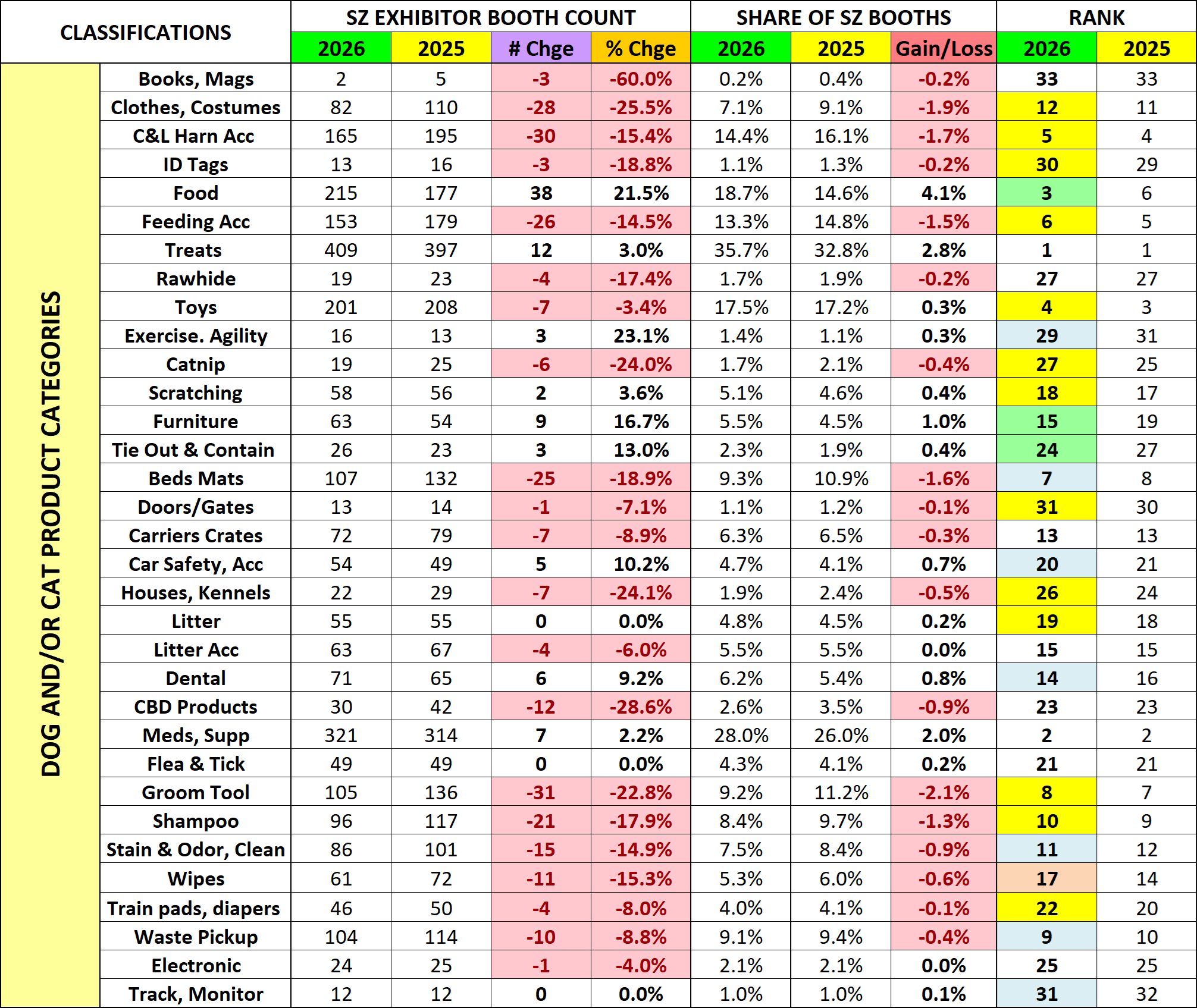
Overall, prices were up 0.5% from January and were +2.4% vs Feb 25, the same as last month. Grocery prices rose 0.5% and inflation rose to +2.4% from 2.1%. No price decreases from last month. In Dec & Jan there was 1. In Nov there were 6 drops – a big change. The national YOY monthly CPI rate of 2.4% is down 14% from 24>25 but it’s 70% less than 21>22. However, the 25>26 rate is above 24>25 for all others but Veterinary Services. In our 2021>2025 measurement you also can see that over 80% of the cumulative inflation since 2019 has occurred in all but 3 segments, Haircuts, Medical & Veterinary Services. Except for Pet Services, where prices have surged Service Segments have had higher inflation rates so there was a smaller pricing lift in the recent surge. Pet Products have a very different pattern. The 21>26 inflation surge provided 98% of their overall inflation since 2019. This happened because Pet Products prices in 2021 were still recovering from a deflationary period. Services expenditures account for 64.0% of the National CPI so they are very influential. Their current CPI is +3.1% while the CPI for Commodities is 1.2%. This clearly shows that Services are driving almost all of the current 2.4% inflation. The situation in Pet is just as bad. Petflation: 3.3%. The CPI for the 2 Service Segments is 5.1%. The Pet Products CPI is 1.9%.

  • U.S. CPI– Prices are +0.5% from Jan. The YOY increase is 2.4%, the same as Jan. It peaked at +9.1% back in June 2022. The targeted inflation rate is <2% so we are now 20+% higher than the target. The stability follows a lift in Jan, stability in Dec and 2 drops in Oct & Nov. The current rate is below 24>25 but the 21>26 rate is +24.2%, 82.6% of the total inflation since 2019. The Inflation surge hadn’t started in February 2021, +1.7%
  • Pet Food– Prices are +0.5% vs Jan. and +1.4 vs Feb 25, the same as Jan. They are still 42% below the Food at Home inflation rate of +2.4%. Remember that the YOY Pet Food CPI has deflated in 15 of the last 24 months. The 2021>2026 inflation surge has generated 92.5% of the 26.7% inflation since 2019. Inflation began for Pet Food in June 2021, +0.9%, after 12 straight deflationary months. Pet Food prices just reached a new record high.
  • Food at Home – Prices are up +0.5% from Jan and the YOY increase rose from 2.1% to 2.4%. This is radically lower than Jul>Sep 2022 when it exceeded 13%. The 31.7% Inflation for this category since 2019 is 8% more than the national CPI but is only in 5th place behind 3 Services expenditures and Total Pet. 82.6% of the inflation since 2019 occurred from 2021>26. This is the same as the CPI, but we should note that Grocery prices began inflating in 2020>21 then the rate accelerated. It appears that the pandemic supply chain issues in Food which contributed to higher prices started early and foreshadowed problems in other categories and the overall CPI tsunami.
  • Pets & Supplies– Prices were +0.9% from January and YOY inflation rose to +1.8% from 0.2%. They still have the lowest rate vs 2019. Prices were deflated for much of 20>21. As a result, the 2021>26 inflation surge accounted for 113.5% of the total price increase since 2019. Prices set a record in Oct 22 then deflated. 3 lifts pushed them to a record high in Feb 23. Prices fell in Mar & the roller coaster continued into 25. They fell Jan/Feb 25, rose Mar>May, fell Jun, rose Jul, fell Aug, rose Sep, fell Oct>Nov, rose Dec (record), fell in Jan, rose Feb – only 0.1% below a record.
  • Veterinary Services– Prices are +0.3% from Dec and +5.3% from 2025, down from 7.4%. They fell to #2 in inflation vs last year, behind Pet Serv. but are still #1 in the increase since 2019, +55.2% and 21, +42.5%. For Veterinary, high annual inflation is the norm. However, the rate has increased during the current surge, especially since 23. They have the highest Feb avg rate in 26, but only 77% of the cumulative inflation since 2019 occurred from 2021>26.
  • Medical Services – Prices turned sharply up at the start of the pandemic but then inflation slowed and fell to a low rate in 20>21. Prices rose +0.5% from Jan and inflation vs last year rose to +4.1% from +3.9%. Medical Services are not a big part of the current surge as only 58.3% of the 23.0%, 2019>26 increase happened from 21>26.
  • Pet Services – Inflation slowed in 20 but grew in 21. In 24 prices surged , especially in Jul>Nov. Prices fell Dec>Mar 25 to 3.9%. Apr grew, May fell, June rose, Jul rose to 6.3%. Inflation fell to 5.8% in Aug & to 4.2% in Nov. In Dec>Feb 26 it rose to 7.3%. They are #1 vs 25 & #2 vs 21 & 19. 84% of their 19>25 inflation is from 21>26.
  • Haircuts/Other Personal Services – Prices are +0.3% from Jan and +4.9% from Feb 25. 19 of the last 26 months have been 4.0+%. Inflation has been pretty consistent. 69.6% of the 19>26 inflation happened 21>26.
  • Total Pet– Petflation slowed to 3.3% from 3.4%. Only 4 Services categories had a higher rate. It is 37.5% above the 24>25 rate and the current U.S. CPI. Plus, it is 10% above the 3.0% average February rate since 1997. Feb prices rose 0.7%, driven by all. The Jan>Feb increase was well above the 0.4% 97>25 average change but expected. Since 1997, there has been only 1 Jan>Feb price drop, -0.1% in 2018. The big factor in the small CPI drop was that prices rose 0.8% in Jan>Feb 25. The recovery definitely slowed.

Now, we’ll look at YTD data.

The 25>26 rate is higher than 24>25 for all, but Veterinary Services & The CPI. The 22>23 inflation rate was the highest for Tot Pet, Pet Food, Groceries, Pet Services & Vet. 21>22 has the highest rate for Pet Supplies & the Natl CPI. 20>21: Haircuts; 19>20: Medical Services. The average national inflation rate in the 7 years since 2019 is 3.7%. Only 3 of the categories are below that rate – Medical Services (3.0%), Pet Supplies (1.8%) and Pet Food (3.5%). It is no surprise that Veterinary Services has the highest average rate (6.5%), but all 4 other categories are +4.0% or higher.

  • U.S. CPI – The 25>26 rate is 2.4%, down 17% from 24>25 and 23% from 23>24, but is 68.6% less than 21>22 and 35.1% below the average increase from 2019>2026. However, it’s still 33% more than the average increase from 2018>21. 83% of the 29.2% inflation since 2019 occurred from 2021>26. Inflation is a problem that started recently.
  • Pet Food – Ytd prices are still inflating, 1.4%, the same as Jan. That’s a big increase from -0.3% in 24>25, but it is still below 3.7% in 23>24 and even the 2.1% 18>20 average. Pet Food has the highest 22>23 rate but is only #6 in the 21>26 rates and #7 in 19>26. Deflation in the 1st half of 2021 kept YTD prices low then they surged in 22 and especially in 23. 91% of the inflation since 2019 occurred from 2021>26.
  • Food at Home – The 25>26 inflation rate is +21% vs the 24>25 rate, but at 2.3%, it is down 89% from 22>23, 71% from 21>22 and even 36% less than 20>21. However, it is 2.7 times higher than the average rate from 2018>20. It is only in 5th place for the highest inflation since 2019 but still beat the U.S. CPI by 8.2%. You can see the impact of supply chain issues on the Grocery category as 82% of the inflation since 2019 occurred from 2021>26.
  • Pets & Pet Supplies – A true roller coaster, prices rose Jan>Feb 24, fell Mar>Apr, rose May>Jun, fell July, rose Aug, fell Sep>Oct, rose Nov>Dec, fell Jan>Feb 25, then rose Mar>May. Prices vs 24 flipped to deflation in June, back to +0.7% in July, fell to 0.0% in Aug, rose Sep>Dec, fell Jan 26, rose Feb. Supplies still have the lowest inflation since 2019. Their biggest YOY lifts since 2019 were in 22 & 23. The 2021 deflation created an unusual situation. Prices are up 13.0% from 2019 but 113% of this lift happened from 21>26. Prices are up 14.7% from their 2021 “bottom”.
  • Veterinary Services – Inflation was high in 2019 and steadily grew until it took off in late 2022. The rate may have peaked in 2023, but it is still going strong in 2026, +6.3%, the 2nd  highest on the chart. However, they are still #1 in inflation since 2019 and since 2021. At +6.5%, they have the highest average inflation rate since 2019. It is 76% higher than the National Average but 2.2 times higher than the Inflation average for Medical Services. Strong Inflation is the norm in Veterinary Services.
  • Medical Services – Prices went up significantly at the beginning of the pandemic, but inflation slowed in 2021. In Feb 2026 it is 4.0%, 33% above the 3.0% 2019>26 average rate. We should also note that 4.0% is 5 times higher than the 0.8% low point in 23>24.
  • Pet Services – After falling in late 2023, prices surged in 2024, then fell in 2025 until an Apr>Aug lift followed by a Sep>Nov dip and a Dec>Feb 26 lift. The 25>26 6.5% CPI is #1 on the chart, passing Veterinary. It is 30% above their 19>26 avg and more than double their 2018>20 avg. Pet Services is also 2nd in both 19>26 and 21>26 inflation.
  • Haircuts & Personal Services – The services segments, essential & non-essential, were hit hardest by the pandemic. The industry responded by raising prices. 2026 inflation is 4.9%, 12.5% below its 20/21 peak, but 48.5% above the 18>20 average. Consumers are paying over 35% more than in 2019, which usually reduces the purchase frequency.
  • Total Pet – Petflation is 3.4%, up 54% from 24>25, but 17% less than 23>24. However, It’s 50 % more than their 18>21 avg and 42% above the CPI. Petflation is growing again. Except for Mar/Aug/Oct/Nov, Pet prices rose in 25, which continued in Jan & Feb 26. This is primarily being driven by a cessation of deflation in Pet Products and continued strong inflation in Services, especially Non-Vet.

The Petflation recovery paused in Aug 24, came back Sep>Oct, paused in Nov, resumed in Dec>Jan 25, paused in Feb, restarted in Mar and paused Apr>Sep. It improved in Oct/Nov but paused in Dec>Feb. We tend to focus on the monthly, YOY inflation in the current year and ignore the fact that inflation is cumulative. Pet prices are 28.1% above 2021 and 33.1% higher than 2019. Those are big lifts. In fact, February prices are within 0.1% of the record for Pet Supplies, while the prices for the National CPI, Total Pet and all other pet segments reached record levels. Only Supplies prices (+13.0%) are less than 26.8% higher than 2019. Since price/value is the biggest driver in consumer spending, inflation will affect the Pet Industry. Services will be the least impacted as it is driven by high income CUs. Veterinary will continue to see a reduction in visit frequency. The product segments will see a more complex reaction. Supplies are more discretionary so we will likely see a reduction in purchase frequency. In Pet Food, the most needed segment, some Pet Parents may even downgrade their Pet Food. However, the biggest impact in both product segments will be a strong movement to online purchasing and private label. We saw proof of this at both GPE 25 & SZ 25 as a huge # of exhibitors offer OEM services. At GPE 26, this trend will continue. Strong, cumulative inflation has a widespread impact. We’ll continue to monitor the situation.
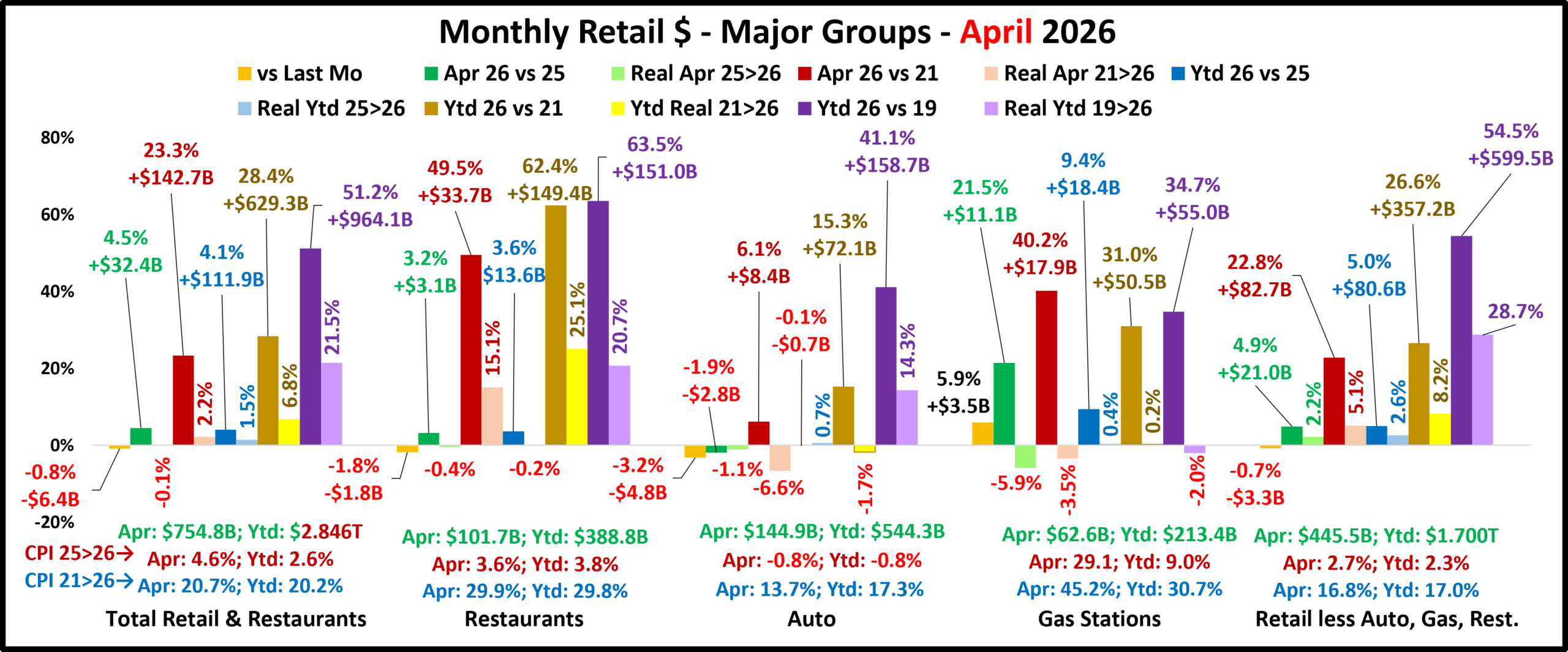
Retail Channel $ Update – December Monthly & January Advance

In January, YOY Commodities’ inflation slowed to 1.0% from 1.7%. Even with a low inflation rate, high cumulative inflation vs 21 can still impact consumer spending and slow $ales growth.  We saw evidence of this in January. Total Retail $ were +3.1% vs 25, -35% below the average 92>25 lift and Relevant Retail was +4.4%, still -8% below the January average. The situation is complex and there is still a long road to full recovery. We’ll continue to track the retail market with data from 2 reports provided by the Census Bureau and factor in a targeted CPI.

The Census Bureau Reports are the Monthly and the Advance Retail Sales Reports. Both are derived from sales data gathered from retailers across the U.S. and are published monthly at the same time. The Advance Report has a smaller sample size so it can be published quickly – normally, 2 weeks after month end. The Monthly Report includes data from all respondents, so it takes longer to compile the data – about 6 weeks. Although the sample size for the Advance report is smaller, the results over the years have proven it to be statistically accurate with the Monthly reports. The biggest difference is that the full sample in the Monthly report allows us to “drill” a little deeper into the retail channels.

We will begin with the December Monthly Report and then go to the January Advance Report. Our focus is comparing to last year but also 21 & 19. We’ll show both actual and the “real” change in sales as we factor inflation into the data.

Both reports include the following:     (Note: December Ytd data = Year-End, Annual Numbers & January data = Ytd)

  • Total Retail, Restaurants, Auto, Gas Stations and Relevant Retail (removing Restaurants, Auto and Gas)
  • Individual Channel Data – This is more detailed in the Monthly reports, and we’ll focus on Pet Relevant Channels.

The data will be presented in detailed charts to facilitate visual comparison between groups/channels. The charts will show 11 separate measurements. To save space they will be displayed in a stacked bar format for the channel charts.

  • Current Month change – % & $ vs previous month
  • Current Month change – % & $ vs same month last year and vs 2021.
    • Current Month Real change vs last year and vs 2021 – % factoring in inflation
  • Current Ytd change – % & $ for this year vs last year, 2021 & 2019.
    • Current Ytd Real change % for this year vs last year and vs 2021 and 2019
  • Monthly & Ytd $ & CPIs for this year vs last year and vs 2021 which are targeted by channel will also be shown. (CPI Details are at the end of the report)

First, the December Monthly. Only Gas Stations were down from November and there were only 2 actual sales drops – both in Gas Stations. We should note: Gas Stations are still selling a little more product than in 2019. Also, Relevant Retail is all positive again. They have been all positive in 18 of the last 20 months. ($ are Not Seasonally Adjusted)

The December Monthly is $0.1B more than the Advance report. Restaurants: No Chge; Auto: -$0.1B; Gas Stations: -$0.2B; Relevant Retail: +$0.4B. Relevant Retail was the driver in the $ales lift vs November, but only Gas Stations were down. A Nov>Dec increase in Total Retail  has happened every year since 1992. However, the 10.9% lift was 27% below average. There were 2 drops in actual sales – Monthly vs 21 and Y/E vs 24 for Gas Stations. There were no “real” sales drops, 2 less than November. All but Gas Stations were all positive. Restaurants still have the biggest increases vs 21 & 19 but Relevant Retail stayed at the top of “real” performance vs 2019. However, only 41.8% of their growth is real.
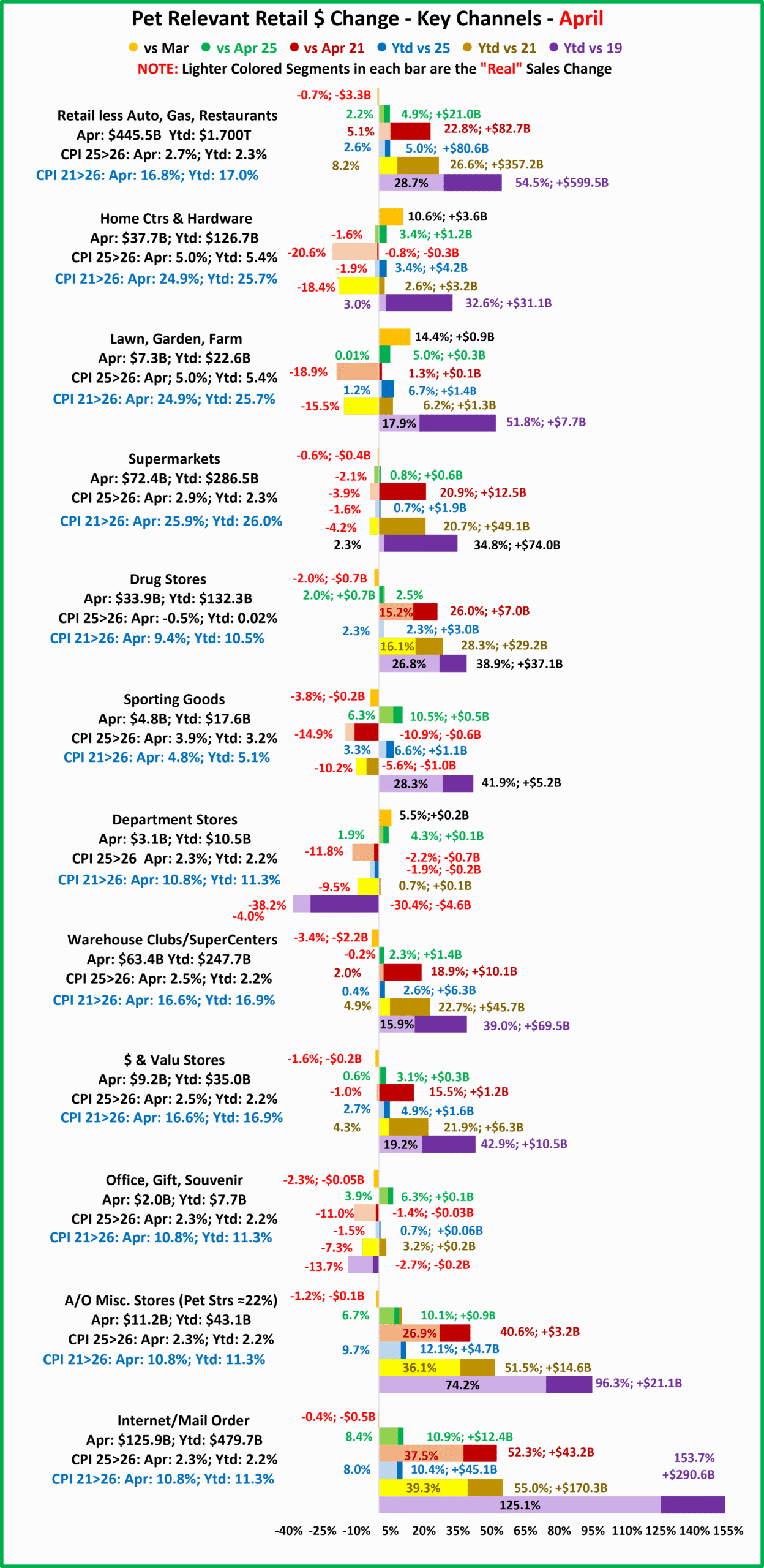
Now, let’s see how some Key Pet Relevant channels did in December in the Stacked Bar Graph Format

Overall– 10 of 11 were up from November. Vs Dec 24, 11 were actually and 7 “really” up. Vs Dec 21, 8 were up but only 6 were real increases. Vs 2019, Only Dept Stores were actually and really down, but Off/Gift/Souv were also really down.

  • Building Material Stores – The pandemic focus on home has produced $ growth of 30.2% since 2019. Prices for the group have inflated 18.0% from 21 and 24.4% from 2019 which is having an impact. HomeCtr/Hdwe Sales vs Nov were -0.7% for but 12.6% for Farm Stores. Vs other years, Farm stores are actually up for all, but their Real $ were down vs 21. HomCtr/Hdwe are only actually & really up vs 2019 & actually vs Dec 24. Only 16% of the Bldg Mat. group’s 19>25 lift was real. HomeCtr/Hdwe: Ytd: -2.6%; Avg 19>25 Growth: 4.7%, Real: 0.4%; Farm: Ytd: +4.8%; Avg: 6.4%, Real: 2.6%
  • Food & Drug – Both are essential. Except for the COVID food binge, they tend to have smaller changes in $. Vs Nov, Supermarkets: +3.9%; Drug: +15.8%. In terms of inflation, the Groceries rate is 60% higher than Drug/Med products. Drug Stores are positive in all measurements and 71.3% of their 2019>25 growth is real. Supermarkets’ actual $ are up in all comparisons, but they are only “really” up Ytd vs 21 & 19 and only 8.4% of their 19>25 increase is real growth. Supermarkets: Ytd: +3.2%; Avg 19>25: +4.9%, Real: +0.5%; Drug Stores: Ytd: +7.9%; Avg: +6.0%, Real: +4.5%.
  • Sporting Goods Stores – They also benefited from the pandemic in that consumers turned to self-entertainment, especially sports & outdoor activities. Sales are +44.3% from Nov and their only negatives are actual & real Ytd vs 21 & actual Ytd vs 24. Prices stopped deflating vs 24. Deflation started in April 23 and was a big change from +1.1% in 22>23 & +7.9% in 21>22. This caused 63% of their 36% lift since 19 to be real. Ytd: -1.3%; Avg 19>25: +4.9%; Real: +3.5%
  • Gen Mdse Stores – Sales were +14.2% vs Nov. Except for real vs Dec 24 for clubs, all YOY comparisons were up for $ Strs & SupCtr/Clubs. Dept Stores are negative in all comparisons but vs Dec 24. Their Actual sales are even -28.2% from 19 (Real: -35.2%). The other channels have an average of 40.3% in real growth. SupCtr/Club: Ytd: +2.1%; Avg 19>25: 4.9%, Real: 2.1%; $/Value Strs: Ytd: +2.1%; Avg: +5.5%, Real: +2.7%; Dept. Strs: Ytd: -0.8%; Avg: -5.4%, Real: -7.0%.
  • Office, Gift & Souvenir Stores– Sales took off, +34.4% from Nov. They are actually up in all but vs Dec 21, but still really down vs 21 & 19. Their recovery started late. It was slowly restarting in Jun/Jul, but their progress had slowed. It took off in Oct but slowed in Nov & grew in Dec. Their recovery continues. Ytd: +3.7%; Avg Growth Rate: 0.3%, Real: -1.4%
  • Internet/Mail Order – Sales are +16.7% from Nov to $156.6B, a Dec record. All YOY measurements are positive, but their YOY growth, +7.0%, is only 49.6% of their average since 2019. However, 82.1% of their 120.5% growth since 2019 is real. Ytd: +7.0%; Avg Growth: +14.1%, Real: +12.1%. As expected, they are by far the growth leader since 2019.
  • A/O Miscellaneous – Pet Stores are 22>24% of total $. In May 2020 they began their recovery which reached $100B for the 1st time in 21. In 22 their $ dipped in Jan, Jul, Sep>Nov, rose Dec, fell Jan>Feb 23, grew Mar>May, fell Jun>Aug, rose Sep>Nov, fell Dec>Jan 24, grew Feb>May, fell Jun>Sep, grew Oct, fell Nov, rose Dec, fell Jan>Feb, grew Mar>May, fell Jun>Sep, rose Oct, fell Nov, rose Dec. All comparisons are positive, and they are right behind the Internet, in the % increase vs 19 & vs 21. Also, 76% of their 69.3% growth since 2019 is real. Ytd: +10.0%; Avg 19>25: 9.2%, Real: +7.3%

Dec had its usual lift vs Nov, but the Rel Retl lift was -34% below avg. However, 10 small channels were up. The YOY lift vs 24 was below avg for Total: -20% & Relevant Retl: -13%. However, all big groups & 11 smaller channels had lifts. Also, prices are only deflating in Gas Stations, but cumulative inflation has an impact, as only 6 channels were really up vs Dec 21. The Retail Recovery is slow. In Jan, the commodities CPI fell from 1.7% in Dec to 1.0%. Let’s see if it impacts Retail.

Dec>Jan sales were down for all. A Dec>Jan Total Retail drop has happened every year since 1992. The -17.4% drop is 18% less than the -21.1% avg. There were 2 YOY $ drops, the same as Dec. Only 3 Big Groups were up vs 25 and the Total Retail lift of 3.1% vs Jan 25 was 35% below their +4.7% 92>25 avg. However, the Relevant Retail 4.4% increase vs Jan 25 was only 8% below their +4.7% avg. Inflation is still a factor. The CPI for all commodities slowed to 1.0% from 1.7% vs last year but it rose from 7.7% to 19.7% vs 21. There is some not so good “real” news. 1 “real” measurement was down, and it was Gas Stations vs 2019, so they are again selling less Gas than in 2019. Also, 3 Big Groups are again all positive, down from 4 in Dec. However, Relevant Retail has been all positive in 19 of the last 21 months.

Overall Inflation Reality– The Total Retail CPI slowed to 1.0% but the $ lift vs 25 was 35% below avg. The Restaurant CPI stayed +4.0% and their $ lift was 8% below avg. Gas prices dropped to -7.3%. They are still in turmoil. Auto inflation flipped to -0.5% vs 25 but are 19.4% vs 21. Sales fell -0.1% vs 25 – far below their 4.5% avg change. Inflation stayed 2.0% for Relevant Retail and their lift was 8% below avg, but they are again all positive. Progress slowed in January.
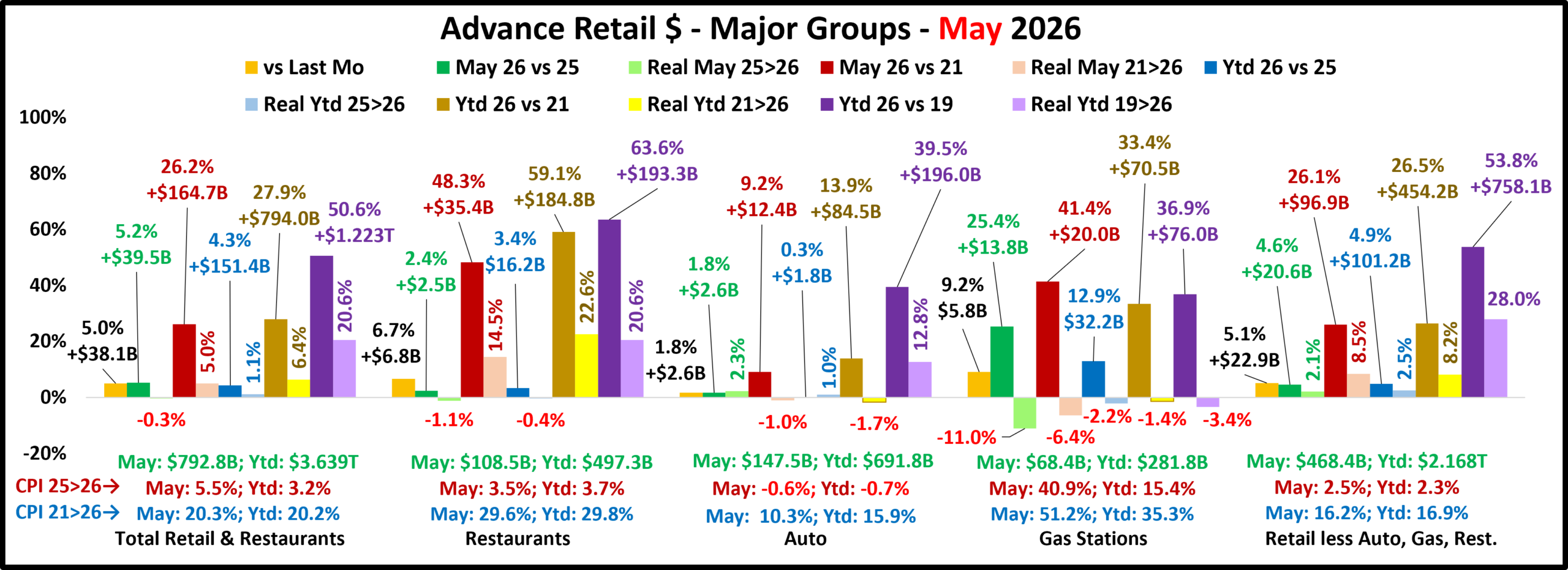
Total Retail – Since Jun 20, every month but Apr 23, Jun 24 & Feb 25 has set a monthly $ales record. In 2023>26, Sales got on a roller coaster. Up Jul>Aug, down Sep, up Oct>Dec, down Jan 24, up Feb>Mar, down April, up May, down Jun, up Jul>Aug, down Sep, up Oct>Dec, down Jan>Feb 25, up Mar, down Apr, up May, down Jun, up Jul>Aug, down Sep, up Oct, down Nov, up Dec, down Jan. Prices are 1.0% and YOY $ are +3.1%, 35% below avg. 43% of the 19>26 growth is real. Inflation slowed but cumulative inflation is still impacting sales. Growth: 25>26: 3.1%;Avg 19>26: +6.0%, Real: +2.9%.

Restaurants – They were hit hard by the pandemic and didn’t begin recovery until March 2021. However, they have had strong growth since then, exceeding $1T for the 1st time in 2023. January $ are up vs 25 and they have the biggest lifts vs 21 & 19. Inflation stayed 4.0% vs last year, but it is +29.5% vs 21 and +34.9% vs 19. Their 5.0% YOY lift is 8% below their +5.4% 92>25 avg. They are all positive again, but just 35% of their 66% growth since 2019 is real. They are 3rd in performance behind Total & Relevant Retail. Recovery started late but inflation started early. Growth: 5.0%; Avg 19>26:+7.5%, Real: +3.0%. They just account for 13.6% of Total Retail $, but their strong growth has helped Total Retail.

Auto (Motor Vehicle & Parts Dealers) – They overcame the stay-at-home attitude with great deals and advertising. They finished 2020 up 1% vs 2019 and hit a record $1.48T in 2021 but much was due to high inflation. In 22, sales got on a rollercoaster. Inflation started to drop mid-year, but it caused 4 down months in actual $. Their YE real 22 sales numbers were even worse, -8.2% vs 21 and -8.9% vs 19. 23 started a sales rollercoaster but the $ hit a record, $1.595T. $ fell in Jan 24, grew Feb>Mar, fell Apr, grew May, fell June, grew Jul>Aug, fell Sep, grew Oct, fell Nov, grew Dec, fell Jan>Feb 25, grew Mar, fell Apr>Jun, rose Jul>Aug, fell Sep, rose Oct, fell Nov, rose Dec, fell Jan. Jan $ were -0.1% vs 25. Avg: 4.5%. Plus, they are no longer all positive and just 34% of 19>26 growth is real. Growth: -0.1%; Avg 19>26: +5.1%, Real: +1.9%

Gas Stations – Gas Stations were hit hard by “stay at home”. They started recovery in Mar 21, and inflation began. Sales got on a rollercoaster in 22 but set a record, $583B. Inflation started to slow in Aug and prices slightly deflated in Dec & Feb 23, then strongly fell in Mar>Jul to -20.2%. In Aug they rose to -3.7%. In Sep they were +2.7% but began deflating to -4.2% in Feb 24. In Mar>May $ grew, fell Jun, rose July, fell Aug/Sep, rose Oct, fell Nov>Feb 25, rose Mar>May, fell Jun, rose Jul, fell Aug>Oct, up Nov, fell Dec>Jan. Jan $ vs 25: -3.2% (4.3% avg). Only down vs 25. Real $ vs 19 are again down. Growth: -3.2%; Avg 19>26:+3.4%, Real: -0.01%. They show the cumulative impact of inflation can be positive & negative.

Relevant Retail – Less Auto, Gas and Restaurants– They account for ≈60% of Total Retail $ in a variety of channels. Their only down month until Feb 25 was Apr 20, and they led the way in Retail’s recovery. Sales got on a roller coaster in 22, but all months set new records with Dec reaching a new all-time high, $481B, and an annual record of $4.81T. In 23, the roller coaster continued. A Dec lift set a new monthly record of $494.7B & an annual record of $4.997T. $ales got back on the roller coaster in 24. The ride continued as $ rose Oct>Jan 25, fell Feb, rose Mar>May, fell Jun, rose Jul, fell Aug>Sep, rose Oct>Jan 26. The Jan 4.4% YOY lift is 8% below their 92>25 avg of +4.7%, but they are all positive again and 54.2% of their 53.7% 19>26 growth is real, again #1 in Big Group performance, passing Total. Growth: 4.4%; Avg 19>26: +6.3%, Real: +3.7%. In 2024 their inflation rate dropped from 3.2% to 0.1%. It rose in 25 to 1.8% in Sep then slowed to 1.5% in Oct>Nov & rose to 2.0% in Dec>Jan 26. YOY Inflation is pretty low, but its cumulative impact can slow growth.
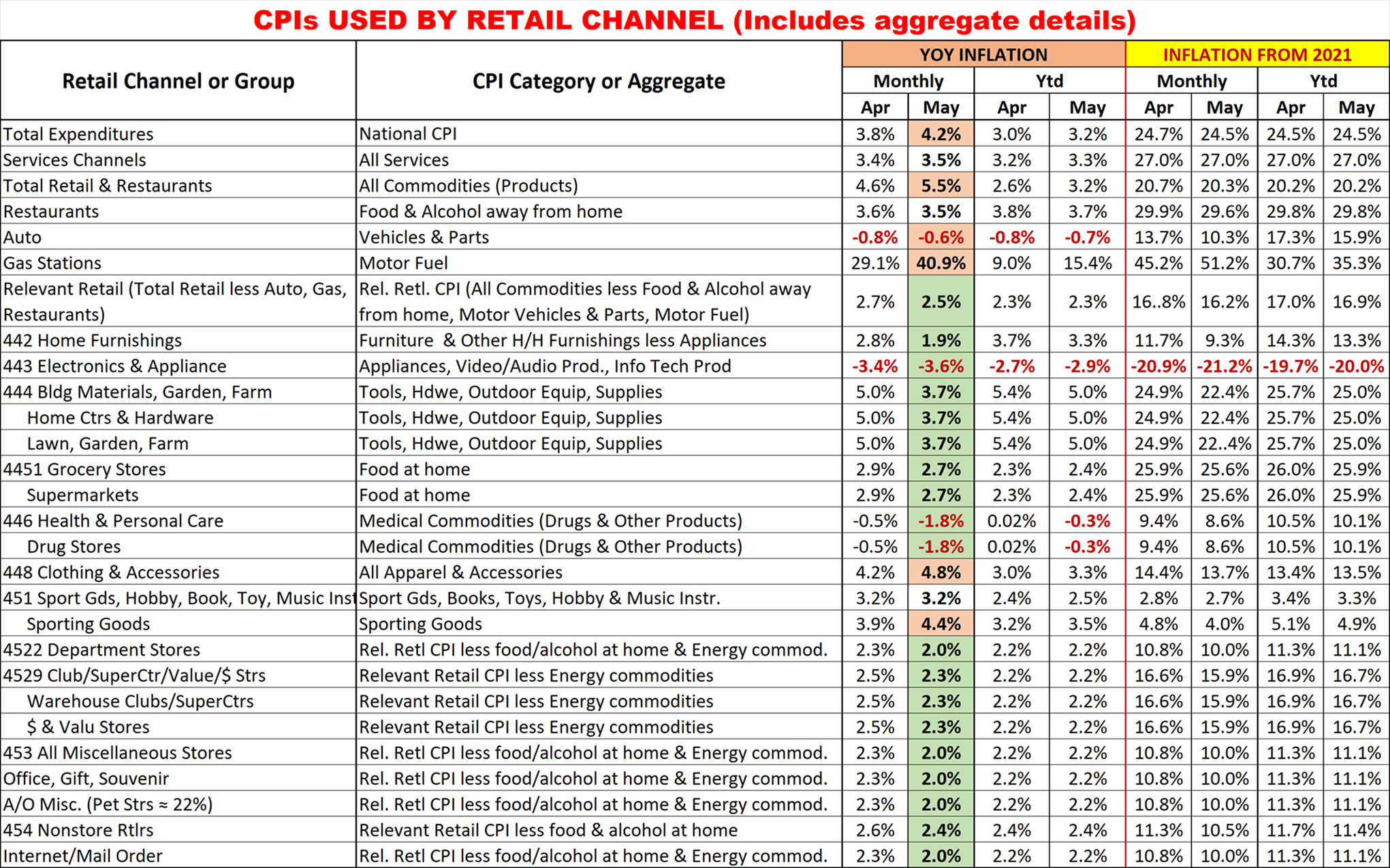
YOY inflation is low, but cumulative & impending lifts can affect sales. In Jan, 2 actual YOY $ comparison were negative, the same as Dec. In Oct>Nov, there was 1 real drop. That fell to 0 in Dec/Jan. In Oct, all were up vs last year with below avg lifts. In Nov only Auto was down but the lifts were all below avg. In Dec, all were up and Relevant Retl’s lift was above avg. In Jan, 3 lifts, all below avg. In Oct/Nov, 3 big groups were all positive. In Dec, there were 4. In Jan, they were back to 3. Relevant Retail has now been all positive in 19 of 21 months. As expected, Jan sales fell vs Dec, but the drop was 18% less than avg. Recovery is still slow.

Here’s a more detailed look at January by Key Channels in the Stacked Bar Graph Format

  • Relevant Retail: Ytd Growth: +4.4%; Avg 19>26: +6.3%; Real: 3.7%. % Real Growth: 54.2%. All 11 were down from December. Vs Jan 25: 9 were up; 7 Real. Vs Jan 21: 10 were up; 6 Real. Vs 19: Dept Stores were down & real Bldg./Farm
  • All Department Stores – This group was struggling before the pandemic hit them hard. They began recovery in March 21. Sales are -66.3% from Dec and all YOY measurements but actual vs 21 are negative. Their -9.8% Jan YOY drop is more than double their -4.5% avg. Ytd Growth: -9.8%; Avg 19>26: -5.7%; Real: -7.2%. % Real growth: None
  • Club/SuprCtr/$- They fueled a big part of the recovery because they focus on value which has broad consumer appeal. $ales are -20.2% from Dec, but they are up in all comparisons. Their 3.7% YOY Dec lift is -57% below their 92>25 avg of +8.5%. Ytd Growth: 3.7%; Avg 19>26: +5.3%; Real: 2.7%. % Real Growth: 46.9%
  • Grocery- They depend on frequent purchases, so their changes are usually less radical. $ales are -3.4% from Dec and they are really down vs Jan 25 & 21. Cumulative inflation has hit them hard, especially vs 21. Their 1.9% YOY Jan lift is 41.9% below avg. Ytd Growth: 1.9%; Avg 19>26: +4.4%; Real: 0.4%. % Real Growth: 8.7%
  • Health/Drug Stores – Many stores are essential, but consumers visit less frequently than Grocery stores. $ are -17.2% from Dec, but they are positive in all YOY comparisons. Inflation has been relatively low, so it is surprising that their +1.3% YOY lift vs Jan 25 is 75.5% below avg. Ytd Growth: 1.3%; Avg 19>26: +4.1%; Real: 2.7%. % Real Growth: 62.6%
  • Clothing and Accessories – Clothes mattered less if you stayed home. That changed in March 2021 with strong growth through 2022. Sales are -51.8% from Dec, but positive in all YOY measurements. $ales are +4.0% vs Jan 25, +23.8% above their 3.3% avg. Ytd Growth: 4.0%; Avg 19>26: +3.7%; Real: 2.7%. % Real Growth: 71.6%.
  • Home Furnishings – In mid-2020 consumers’ focus turned to their homes and furniture became a priority. Inflation is up to 3.3% in Jan. $ are -14.5% from Dec and are only actually up Ytd vs 2019. YOY vs Jan 25, they are -3.5%, far below their 3.2% avg lift. Ytd Growth: -3.5%; Avg 19>26:+2.4%; Real: -0.09%. % Real Growth: None.
  • Electronic & Appliances – They have had many issues. Sales fell in Apr>May of 2020 and didn’t reach 2019 levels until March 21. $ are -33.0% from Dec, but they are up in all comparisons. Strong deflation made real sales very high. Sales are +1.6% vs Jan 25, 23% below the 2.1% avg. Ytd Growth: 0.8%; Avg 19>26: 0.1%; Real: 3.1%. % Real Growth: 100+%
  • Building Material, Farm & Garden & Hardware – They truly benefited from the consumers’ focus on home. In 2022 the lift slowed as inflation grew to double digits. Prices turned up again in Apr>Sep 25, dropped Oct/Nov, then rose to 5.4% in Dec & 5.6% in Jan. Sales are -11.8% from Dec but are actually up and really down for all YOYs. YOY sales vs Jan 25 were +2.3%, 76.5% below their 4.1% Avg. Ytd Growth: 2.3%; Avg 19>26: 3.5%; Real: -0.2%. % Real Growth: None.
  • Sporting Goods, Hobby and Book Stores – Consumers turned their attention to recreation and Sporting Goods stores sales took off. Book & Hobby Stores recovered more slowly. They have been on a sales roller coaster since June 24 and $ are -44.1% from Dec. Only real sales vs 21 are down. YOY Sales vs Jan 25 are +2.8%, 12.4% above their 2.5% avg. Ytd Growth: +2.8%; Avg 19>26: +3.7%; Real: 2.9%. % Real Growth: 77.3%.
  • All Miscellaneous Stores – Pet Stores have been a key part of the strong and growing recovery of this group. They finished 2020 at +0.9% but sales took off in March 21 and have continued to grow. Sales are -13.9% vs Dec, but positive in all comparisons. They are 2nd in the % increase vs 19 & vs 21. Plus, their 11.4% YOY Jan lift is 2.6 times more than their 92>25 avg of +4.4%. Ytd Growth: +11.4%; Avg 19>26: +7.8%; Real: 6.1%. % Real Growth: 74.1%.
  • NonStore Retailers – 90% of their $ comes from Internet/Mail Order/TV. The pandemic accelerated online spending. They ended 2020 +21.4%. The growth continued in 2021 as sales exceeded $100B for the 1st time and they broke the $1 Trillion barrier. $ are -23.2% from Dec and their YOY lift of 8.6% is -9.3% below the 9.5% avg. However, they are positive in all comparisons. Ytd Growth: 8.6%; Avg 19>26: +12.8%; Real: 11.0%. % Real Growth: 81.4%.

Recap – Driven by Relevant Retail, the Pandemic recovery was widespread by Y/E 21. In 22 we were hit with the strongest inflation in 40 years. Inflation has slowed considerably from its Jun 22 peak, but only 1 channel is deflating. Deflation helps, but cumulative inflation can still have a negative impact – slowed YOY growth and even sales drops. As expected, $ fell from Dec for all 11 channels. 8 of the 11 drops were below avg – Good! The biggest concern is still YOY drops and smaller lifts. Relevant Retail’s 4.4% lift vs Jan was 8% below avg. 9 channels had a YOY lift vs last year, the same as last month, but only 3 of the 9 lifts were above avg, down from 4 in Dec but far less than 7 in Oct. There are multiple factors slowing growth, but the major one is high prices from cumulative inflation. December is still the biggest retail month of year and January is the 2nd worst. Total & Relevant Retail had the most sales in history for both months. The Jan Yoy lift was -35% below avg for Total and -8% below for Relevant. The situation is a little worse than December as 8 of 11 channels had a below avg lift or a drop vs Jan 25. We’ll see what happens.

Here are the Dec/Jan inflation rates for the CPIs used to calculate the impact of inflation on retail groups and channels. This includes special aggregate CPIs created with the instruction and guidance of the US BLS. I also researched data from the last Economic Census to review the share of sales by product category for the various channels to help in selecting what expenditures to include in specific aggregates. Of course, none of these specially created aggregates are 100% accurate but they are much closer than the overall CPI or available aggregates. The data includes the CPI changes vs 21 to show cumulative inflation. Note: YE/Ytd is 2025 Annual & Includes October Estimates

Monthly YOY CPI changes of 0.2% or more are highlighted. (Green = lower;Pink = higher)

Here are some answers to some obvious questions. Note: YOY Inflation slowed but changes by Channel were mixed.

  • Why is the group for Nonstore different from the Internet?
    • Non-store is not all internet. It also includes Fuel Oil Dealers, the non-motor fuel Energy Commodity.
  • Why is there no Food at home included in Nonstore or Internet?
    • Online Grocery purchasing is becoming popular, but almost all is from companies whose major business is brick ‘n mortar. These online sales are recorded under their primary channel.
  • 5 Channels have the same CPI aggregate but represent a variety of business types.
    • They also have a wide range of product types. Rather than try to build aggregates of a multitude of small expenditure categories, it seemed better to eliminate the biggest, influential groups that they don’t sell. This method is not perfect, but it is certainly closer than any existing aggregate.
  • Why are Grocery and Supermarkets only tied to the Grocery CPI?
    • According to the Economic Census, 76% of their sales comes from Grocery products. Grocery Products are the driver. The balance of their sales comes from a collection of a multitude of categories.
  • What about Drug/Health Stores only being tied to Medical Commodities.
    • An answer similar to the one for Grocery/Supermarkets. However, in this case Medical Commodities account for over 80% of these stores’ total sales.
  • Why do SuperCtrs/Clubs and $ Stores have the same CPI?
    • While the Big Stores sell much more fresh groceries, Groceries account for ¼ of $ Store sales. Both Channels generally offer most of the same product categories, but the actual product mix is different.

2024 Total Pet Spending was $118.87B – Where did it come from…?

Total Pet Spending in the U.S. was $118.87B in 2024, a $1.27B (1.1%) increase from 2023. These figures and others in this report are calculated from data in the annual Consumer Expenditure Survey conducted by the US BLS. In 2023, the Binge/Bust pattern was over. Even with 8% inflation, all segments had an increase in spending. The lifts for Supplies & Services were small, but the Food & Vet lifts were huge. This produced the 3rd largest lift in history. 2024 was a big change. Again Services & Supplies had small lifts & the Vet increase was huge but together they just barely made up for the -$5.5B drop in Food to generate a 1.1% Total Pet $. This is mediocre but the real situation was even worse. Petflation fell from 8% in 23 to 2.6% in 24. The 1.1% lift was really a -1.5% drop in amount sold. 2024 deserves a closer look!

The first question is, “Who is spending most of the $118.87 billion dollars?” There are of course multiple answers. We will first look at Total Pet Spending in terms of 10 demographic categories. In each category we will identify the group that is responsible for most of the overall spending. Our goal was to find demographic segments in each category that account for 60% or more of the total. To get the finalists, we started with the biggest spending segment then bundled it with related groups until we reached at or near 60%.

Knowing the specific group within each demographic category that was responsible for generating the bulk of Total Pet $ is the first step in our analysis. Next, we will drill even deeper to show the best and worst performing demographic segments/groups and finally, the segments that generated the biggest dollar gains or losses in 2024.

In the chart that follows, the demographic categories are ranked by Total Pet market share from highest to lowest. We also included their share of total CU’s (Financially Independent Consumer Units) and their performance rating. Performance is their share of market vs their share of CU’s. This is an important number, not just for measuring the impact of a particular demographic group, but also in measuring the importance of the whole demographic category in Spending. All are large groups with a high market share. A performance score of 120+% means that this demographic is extremely important in generating increased Pet Spending. I have highlighted the 7 groups with 120+% performance.

There were 4 group changes from 23. Urban, 2>4 CUs, 1 or 2 Earner CUs & 35>64 replaced Suburb/Rural, 2+ CUs, Everyone Works & 35>74. There were also changes in the numbers and rankings. No category in 2024 is ranked the same as in 2023. In 2024, 7 made the 120%+ club, up from 5 in 22 & 23. CU Size & # of Earners were added to the group. Formal higher education & marriage matter, but higher income remains the single most important factor in Total Pet Spending.

  1. Housing – Homeowners (81.6%) up from 81.2%. Controlling your “own space” is a key to larger pet families and more pet spending. 2024 was a good year for Homeowners, with & without Mtges. Homeowners spent $3.3B more and the group’s performance rose from 122.4% to 125.7%. A big factor in the increase was a $2.02B drop in spending by Renters. Homeowners moved up from 5th place to 4th in importance. There were some minor changes and the homeownership rate fell slightly from 65.1% to 64.9%. Those w/o a Mortgage rose from 27.3% to 28.0%.
  2. Race/Ethnic – White, not Hispanic (81.3%) down from 82.5%. This is the 2nd largest group in size and in share of Pet Spending. Their performance was down from 124.4% to 123.0% and they dropped from #4 to #6 in importance. Although this demographic, along with age, are 2 areas in which the consumers have no control, spending disparities within the group are enhanced by differences in other areas like Income, CU Composition and homeownership. There are also apparently cultural differences which impact Pet Spending. Asian Americans are first in income, education and total CU spending but they’re last in Pet Spending as a percentage of total spending – 0.52% vs a national average of 1.12%.
  3. Area – Urban: Suburban/Ctr City (80.8%) down from 81.0%. Homeownership is high in the Suburbs but low in the city. The Suburbs had a -0.72% drop in CUs. Center City gained +0.52% and Rural was +2.0%.This combination pushed Urban performance up from 91.3% to 93.1%. Center City still has the worst performance at 82.4%
  4. Income – Over $70K (74.2%) up from 70.0%. They gained share and their performance grew to 141.8% from 138.6%. A factor in the disparity was a 4.6% lift in $70K> CUs. CU income is still the most important factor in increased Pet Spending. Spending was up for all groups $40>99K & $150K>. $150K> had the biggest lift, +$5.5B, over 13%. $70K> was up +7.2%. Income matters. $100K>: 37.9% of CUs, 59.4% of Pet $. $150K>: 21.7% of CUs, 39.5% Pet $
  5. # in CU – 2>4 people (72.5%) up from 69.8%. Singles still have by far the worst performance. In 2024, there was a slight 0.3% drop in single & 5+ CUs, but they spent 7.9% less on their pets. At the same time, 2>4 people CUs spent 5.0% more. This explains the big lift in share and a strong performance of 120.4%.
  6. Occupation – All Wage & Salary Earners (65.7%) up from 64.7%. Their performance also rose slightly from 106.2% to 106.3%. Only Managers/Professionals & “All Other” spent more on their pets in 2024. Even Retirees and Self-Employed spent less on their pets in 2024, while both had double digit % increases in 2023. With a $5.85B lift, Mgrs & Profess. were the drivers behind in the slight improvement in 2024. BTW: “All Other”, includes unemployed and those not working because of illness or attending school.
  7. Education – College Grads (64.1%) up from 60.6%. Higher Education is usually tied to higher income and Pet spending. It can also be a key factor in recognizing the value in product improvements. In 2022 the Education group was expanded to hit the 60% share goal. In 2023/24, big lifts in the Veterinary segment returned Grads to the list. Their 2024 performance rose from 126.7% to 133.3% and they are now #2 in importance. In Education, only <Assoc’ Degree spent less. The gain in share and in performance came entirely from those with a formal after HS degree.
  8. CU Composition – Married Couples (63.8%) up from 61.4%. 2 people, committed to each other, is an ideal situation for Pet Parenting. In 2024, they gained share and their performance rose from 127.4% to 132.9%, but they fell to 3rd place in importance behind Income & College Grads. Their increases in share and performance were due to big spending increases by Couples Only and CUs with a child over 18.
  9. # Earners – 2+ CUs, 1 or 2 Earners (61.7%) up from 58.4%. These are 2+ people CUs where 1 or 2 adults are employed. They gained share and their performance rose from 116.3% to 123.2%. They joined the 120+% club but are only the 5th most important category. Income is important but # of Earners is less so. Only 2 Earners spent more. The lifts were entirely due to a $5.97B increase by 2 Earner CUs.
  10. Age – 35>64 (61.6%) up from 58.6%. They gained share and their performance rose from 112.3% to 118.9%. Only the 35>54 & 75+ Age groups spent more but the lift of the 45>54 group was the biggest, $3.0B. The <25 and 65>74 groups had the biggest drops. Due to the big lift from 45>54, the group was reduced from 35>74. However, Pet Spending is still relatively balanced by age group and age stayed 8th in importance.

Total Pet Spending is a sum of the spending in all four industry segments. The “big demographic spenders” listed above are determined by the total pet numbers. The share of spending and performance of these groups varies between segments. In fact, in every segment but Supplies we altered at least 1 group (4 in Pet Food) to better reflect where most of the business is coming from. There was turmoil & less balance, but in 2024 Total Pet Spending was still positive.

Performance is an important measurement. Any group that exceeds 120% indicates an increased concentration of the business which makes it easier for marketing to target the big spenders. Income over $70K is again the clear winner, but there are other strong performers. High performance also indicates the presence of segments within these categories that are seriously underperforming. These can be identified and targeted for improvement. In 2020>2022 many of the big lifts and drops in spending came from a series of buying binge/busts which affected every segment. In 23/24 the only affected segments were Food & Vet. All segments but Food had at least a small increase in 2024, but the spending turmoil continued.

Now, let’s drill deeper and look at 2024’s best and worst performing segments in each demographic category.

Most of the best and worst performers are expected but there are 4 winners & 2 losers that are different from 2023 – 1 less loser than last year. The situation is definitely becoming more normal. Changes from 2023 are “boxed”.

  • Income is important in Pet Spending, which is shown by the 190.5% performance by the $200K> group and wins by the high income 2 Earners, Mgrs/Prof, Adv College Degrees & Gen X. All groups over $100K performed at 100+%.
  • Occupation – Tech/Sls/Cler, Mgrs/Professionals & Self-Employed are still the only occupations with 100+% performance. Blue Collar (59.8%) replaced Service Workers at the bottom.
  • Age/Generation: Gen X won again but spending moved towards their younger members. <25 moved to the bottom
  • Region – The West stayed on top. The Midwest also had 100+% performance.
  • CU Size/Composition – The importance of marriage was maintained with wins by 2 People and couples with an Oldest Child 18>. Single Parents stayed on the bottom. The “magic” CU number continues to fall – from 3 to 2.

The winners reflect the continued move back towards more normal spending patterns, but from slightly younger CUs. In the next section we’ll look at the segments which literally made the biggest difference in spending in 2024.

We’ll “Show you the money”! This chart details the biggest $ changes in spending from 2023.

In 2023 there were 6 categories in which all segments spent more. In 2024, there were none. However, there was a little more stability. 6 segments held their spot from 2023 and 5 flipped from 1st to last or vice versa.  In 2023, 4 segments were stable and 3 flipped. 75% were different from last year, considerably less than 83.3% in 2023 and 87.5% in 2022. We should also note that with 2.6% inflation, the 1.1% Total Pet lift was really a -1.5% drop.

  • # Earners – Only 2+ CUs with 2 Earners or No Earner spent more.
    • Winner – 2 Earners, 2+ CU – Pet Spending: $53.53B; Up $5.97B (+12.6%)                                       2023: 2 Earners, 2+ CU
    • Loser – 1 Earner, Single – Pet Spending: $14.05B; Down -$1.76B (-11.1%)                                         2023: 3 Earners
    • Comment – Other Big Drops – No Earner, Singles: -$1.59B; 1 Earner, 2+CU: -$1.32B
  • Occupation – Both the Winner & Loser are new.
    • Winner – Managers & Professionals – Pet Spending: $46.93B; Up $5.85B (+14.2%)                      2023: Retired
    • Loser – Tech/Sales/Clerical – Pet Spending: $16.15B; Down -$2.14B (-11.7%)                                  2023: Blue Collar
    • Comment– Unemployed/All other had the only other increase, +$0.92B.
  • Generations – With a lift in all segments, the highest income Gen Xers returned to the top of the chart.
    • Winner Gen X – Pet Spending: $39.88B; Up $4.51B (+12.8%)                                                             2023: Millennials
    • Loser – Baby Boomers – Pet Spending: $33.55B; Down -$5.71B (-14.5%)                                           2023: Born <1946
    • Comment – Millennials had the 2nd biggest lift and Gen Z had the only other drop besides Boomers.
  • Education – A clear divide – Associate’s degree & above spent more. All others spent less.
    • Winner – Advanced Degree – Pet Spending: $38.14B; Up $4.43B (+13.1%)                                      2023: BA/BS Degree
    • Loser – HS Grad w/some College – Pet Spending: $16.73B; Down -$1.84B (-9.9%)                       2023: Associate’s Degree
    • Comment – The lift for BA/BS (+$0.55B) & Assoc. degree (+$0.20B) were small. The 2nd  biggest drop (-$1.66B) was by those w/o a High School Diploma. College matters. Only College Grads have 100+% performance.
  • Region – The South flipped from last in 23 to 1st in 24.
    • Winner – South – Pet Spending: $40.62B; Up $4.24B (+11.6%)                                                            2023: Northeast
    • Loser – Midwest – Pet Spending: $25.38B; Down -$2.72B (-9.7%)                                                       2023: South
    • Comment – The South was up in all segments. The Midwest was down in Products but up in Services. There were 2 Regions that spent more and 2 that spent less. Northeast: +$1.13B; West: -$1.38B.
  • CU Composition – The importance of marriage in Pet Spending was reinforced.
    • Winner – Married, Child 18> – Pet Spending: $14.858; Up $3.96B (+36.4%)                                  2023: Married, Couple Only
    • Loser – Singles – Pet Spending: $20.50B; Down -$3.35B (-14.0%)                                                       2023: Single Parent
    • Comment – Only Married, Couple Only or those with no children <6 spent more. All others spent less. Married, Couple Only had the 2nd biggest lift: +$1.45B; #2 Drop was Married w/others: -$1.09B.
  • # in CU – 2 People is a repeat winner, but 1 Person replaced 4 People on the bottom.
    • Winner – 2 People – Pet Spending: $48.68B; Up $3.56B (+7.9%)                                                        2023: 2 People
    • Loser – 1 Person – Pet Spending: $20.50B; Down -$3.35B (-14.0%)                                                    2023: 4 People
    • Comment: Only 1 & 3 people CUs spent less. 3 People were -$0.85B. The bigger CUs had increases. 4 People were the 2nd best, +$1.35B (+9.2%); 5+ People: +$0.54B (+4.6%).
  • Income – $200K> is a repeat winner but the lowest income group is now the biggest loser.
    • Winner – $200K> – Pet Spending: $27.59B; Up $3.18B (+13.0%)                                                        2023: $200K>
    • Loser – <$30K – Pet Spending: $8.42B; Down -$2.92B (-31.9%)                                                            2023: $40>49K
    • Comment – All incomes $40K>, but $100>149K had spending lifts. All <$40K spent less. $150>199K had the 2nd largest lift, +$2.36B, but $70>99K was also +$1.09B. $30>39K was -$2.16B. All performances $70K> =100+%
  • Age – The 2023 winner and loser both flipped in 2024.
    • Winner – 45>54 yrs – Pet Spending: $25.53B; Up $3.02B (+13.4%)                                                     2023: 65>74 yrs
    • Loser – 65>74 yrs – Pet Spending: $17.01B; Down -$2.70B (-13.7%)                                                     2023: 45>54 yrs
    • Comment: Only 25>54 & 75+ had lifts. The #2 lift was +$1.32B by 35>44. The #2 drop was -$1.32B by <25.
  • Housing – Homeowners w/Mtge returned to the top, but Renters replaced those w/o Mtge on the bottom.
    • Winner – Homeowner w/Mtge – Pet Spending: $65.24B; Up $1.80B (+2.8%)                                2023: Homeowner w/Mtge
    • Loser – Renters – Pet Spending: $21.92B; Down -$2.02B (-8.4%)                                                        2023: Homeowner w/o Mtge
    • Comment – Homeowners w/Mtge returned to their usual spot on top. Renters took their expected place as the big loser. We should note that Homeowners w/o a Mtge were up $1.49B, +4.9%.
  • Area Type – Both winner and loser held their positions for the 3rd straight year.
    • Winner – Suburbs 2500> – Pet Spending: $55.09B; Up $2.78B (+2.6%)                                           2023: Suburbs 2500>
    • Loser – Rural Areas <2500 – Pet Spending: $29.44B; Down -$1.23B (-4.0%)                                  2023: Rural Areas <2500
    • Comment – The same winner and loser for 3 consecutive years – stability. However, 2024 was a little different. For the 1st time since 2021, the loser had a drop in spending. Note: Center City had a $1.12B (+3.4%) lift.
  • Race/Ethnic – After stability in 2023, the Winner and Loser flipped in 2024.
    • Winner – Asians – Pet Spending: $3.92B; Up $0.73B (+22.8%)                                                             2023: White, Not Hispanic
    • Loser – White, Not Hispanic – Pet Spending: $96.58B; Down -$0.48B (-0.5%)                              2023: Asian
    • Comment – Only Whites spent less. Hispanics were up $0.61B (+5.2%). African Amer. were +$0.40B (+7.1%).

We’ve seen the best overall performers and the “winners” and “losers” in terms of increase/decrease in Total Pet Spending $ for 12 Demographic Categories. Now, here are some segments that didn’t win an award, but they deserve….

HONORABLE MENTION

2024 was not a good year for segments that are usually at or near the bottom in Pet Spending. Most stayed there but a few did well. Millennials are high profile, but they didn’t win. Their $2.7B lift should be noted. The oldsters, 75+ are still around and pet committed as shown by their 10.5% spending lift. Homeowners w/o Mtges had a 69% bigger % lift than those w/Mtge. African American have low income and low pet ownership, but they found a way to spend more on all but food. The below avg $70>99K income group makes few headlines but they spent $1.09B more on their pets. Center City has a lot of people but fewer pets due to less space. They are down in Products but a big lift in Veterinary & Services pushed them up $1.12B. Our thanks go to all 6.

Summary

We’ll start with recent history. Pet Spending reached $78.60B in 2018, a $14.28B, +22.2% lift from 2014. It was not a steady rise, Spending fell in 2016 and each segment had at least one down year. There were a number of driving factors  Positives: The move to super premium foods and the increase in Services outlets. Negatives: Value shopping, trading segment $ and outside influences like the FDA Dog Food warning and tariffs on Supplies. Inflation/deflation was also a factor in some cases.

In 2019, there was a -$0.16B (-0.2%) decrease, driven by a big drop in Supplies $ due to Tarifflation. Almost all buyers were affected & Supplies $ fell below 2014. Services $ also fell due to value shopping. The good news was that Pet Food bounced back from the impact of the 2018 FDA warning to reach a new record high. Veterinary $ also increased 2.7%. Unfortunately, this was entirely due to a 4.1% increase in prices. The amount of Vet Services sold actually decreased.

That brings us to 2020 and the Pandemic turmoil. The effect was positive for Food and Veterinary, especially Food. Out of fear of shortages, many Pet Parents binge bought Pet Food. Spending also increased in Veterinary, as consumers focused on their Pets’ needs. The discretionary segments suffered. Supplies prices stayed high, so spending continued to decline. Services saw the biggest negative pandemic impact as many outlets were subject to closures and restrictions.

In 2021 the marketplace returned to “normal”. The Food binge buying wasn’t repeated, but Pet Parents caught up with all their “children’s” wants and needs. This produced a big increase in Total Pet (+$16.23B) and in all segments but Food. Spending skewed younger and to more traditional winners, like Homeowners w/Mtges and Incomes over $200K.

In 2022, big lifts in Food & Services overcame binge drops in Vet and Supplies and produced a 2.7% increase in  $. 72% of 96 demographics spent more, down from 83% in 2021. Spending became  more balanced with strong performances from <College, Blue Collar, African Americans & Gen Z. Income is still important as Gen X stayed on top. Spending also skewed a little older towards the older Gen Xers, 45>54 yr olds. Baby Boomers are still the “heart” of the Pet Industry, but Gen X will likely lead CU spending for a number of years, until they are eventually displaced by the Millennials.

In 2023 Total Pet Spending took off, up $14.89B (+14.5%) to $117.6B. All segments had increases. The lifts in the more discretionary segments – Services & Supplies, were small but the Food & Veterinary lifts were huge. The Food increase even set a new record. The lift was widespread as 91% of 96 demographic segments spent more. Even considering 8% inflation, 78% spent more. Income is still the most important factor in all segments but Food and growing in importance. However, 2023 became a little more balanced in many categories, especially Age. Also, many underperforming segments, like Singles and Renters, had big increases. 2023 was a great year and Gen X still spent the most Pet $ per CU.

2024 was mediocre. A big increase in Vet spending along with small lifts in Supplies & Services barely overcame a big drop in Pet Food producing a $1.27B, +1.1% increase in Total Pet $. Only 50% of 96 demographic categories spent more on their pets in 24 – a huge drop from 91% in 2023. Income is #1 in importance for Total & all segments but Food (#2).

Before we go…The Ultimate Total Pet Spending CU in 2024 has 3 people, a married couple, with 1 child who is 18 or over. They are 45>54 yr-old Gen Xers. They are White, but not Hispanic and both work. At least one has an Advanced College Degree and is a Mgr/Professional. They earn $200K+. They still have a mortgage on their house located in a Rural area with a population under 2500 in the West.

2024 U.S. Pet Spending by Generation – Gen X Returns to the Top!

In 2024 Americans spent $118.87B on our companion animals, 1.12% of $10.66T in total expenditures. Pet Spending was up $1.27B (+1.1%), much  less than the $14.89B lift in 23. In fact, with a Petflation rate of 2.6%, it was actually a -1.5% drop in the amount of Products & Services sold. In 2020 Consumers focused on the necessary segments – Food and Veterinary, including a Food buying binge. The discretionary segments, Supplies and Services, suffered until 21 when Food $ fell but all other segments had record increases. In 22, Supplies & Vet $ fell while Food & Services grew. In 23, $ increased in all segments including a record in Food. In 24, a big lift in Veterinary helped overcome a big drop in Food.

In this report we will compare Pet Spending in 2024 vs 2023 for the most popular demographic measurement – by Generation. We will also include historical data going back to 2020. Note: Gen Z first had enough CUs to be recognized as a separate segment in 2019. All data comes from the US BLS Consumer Expenditure Survey.

We’ll start by defining Generations and looking at their share of CUs (Basically Households)

 GENERATIONS DEFINED

Gen Z: Born after 1996

        In 2024, Age 27 or less

Millennials: Born 1981 to 1996

In 2024, Age 28 to 43

Gen X: Born 1965 to 1980

In 2024, Age 44 to 59

Baby Boomers: Born 1946 to 1964

In 2024 Age 60 to 78

Silent/Greatest: Born before 1946

In 2024, Age 79+

  • Baby Boomers still have the largest number of CU’s at 41.5M and 30.6% of the total. They had a 0.2M increase in 2024 but generally have been losing ground. In fact, they have 3.6M fewer CU’s than in 2016.
  • The Oldest Generations will continue to lose CUs primarily due to death or movement to permanent care facilities.
  • Gen X has the third most CUs but they lost 0.6M in 2024.
  • Millennials have the largest number of individuals and now they rank second in the number of CU’s.
  • Gen Z gained 2.2M CUs as more of these youngsters established independent households.

Now let’s look at some key CU Characteristics (Note: Nationally, 1 change; CU Size back to 2.4 from 2.5 in 2023.)

CU size: for Born <1946;# Children: No Change for all; # Earners: Boomers ↓; Homeownership: for Millennials, Boomers & Born <1946; No Mtge:for Gen Z, for all others.

  • CU Size – Nationally, CU size decreased to 2.5 from 2.4. 2+ people CUs account for 69.9% of all U.S. CUs, (up from 69.8% in 2023) and 82.8% of pet $ (up from 79.7%) There were 1.1% more 2+ CUs and they spent 3.9% more on their pets (Natl. Avg: +0.3%). Millennials and now Gen Z are actively building their households. CU size, with all the related responsibilities, again peaks with the Millennials (3.0) as Gen Xers were stable at 2.9. CU size drops as we age but the numbers grew for the oldest group from 1.5 in 2023 to 1.6 in 2024.
  • # Children < 18 – 26.8% of U.S. CU’s have children, down from 27% in 2023 and they generate 32.3% of Pet Spending, up from 30.2%. There was a drop in CUs with an oldest child <6, Single Parents & Singles. The others were up. The increase in Total Pet Spending share was pretty focused. Married couples with an oldest child 18> had the biggest lift, +$3.96B. All CUs without children, but Married Couple only spent less. The net result was CUs with children spent $1.83B more while those without children decreased spending by -$0.56B. There was no change in the # of children per CU, Nationally or by Generation. Millennials, with 1.2 Children per CU, are still the leader and the only generation to average more than 1 child per CU.
  • # Earners – Pet spending is often tied to the number of earners in a CU. In 2024, only 2 segments in the # of Earners category spent more – 2+ CUs, No Earner & 2 earners. 2 Earner CUs spent the most and had the biggest increase, +$5.97B. The only change in count was that Boomers fell to 0.8 from 0.9.
  • Homeownership – Owning and controlling your own space has always been a major factor in increased Pet Ownership and spending. In 2024 homeownership fell slightly from 65.1% to 64.9%. Millennials, Boomers & Born <1946 had increases, while the others were unchanged. The homeowners’ share of Total Pet Spending rose from 79.6% to 81.6%. The increase was very defined. Homeowners’ Pet Spending increased $3.29B (3.5%), while Renters’ fell -$2.02B (-8.4%). We should also note that the percentage of homeowners w/no Mtge increased from 27.3% to 28.0%. All generations had an increase. Boomers had the largest – from 44% to 47%.
    • As expected, Gen Z are the most common renters in society. Homeownership by Millennials has moved up to 54% but it is still only 83% of the national average.
    • Gen Xers have been above the national avg since 2018, and Homeownership generally increases with age.

Next, we’ll compare the Generations to the National Avg.:

In Income, Total CU Spending, Total Pet Spending and the Pet Share of Total CU Spending

CU National Avg: Income – $104,207; Total CU Spending – $78,532; Total Pet Spending – $876.53; Pet Share – 1.12%

  • Income – Gen Xers are still at the top, but their lead fell slightly. Compared to the national average, the income of Boomers and the Silent/Greatest both fell. Millennials’ income beat the national avg in 2020 and continues to grow. The income of Gen Z passed that of the oldest Americans in 2021 and continues to grow, but slower than expected.
  • Total Spending – The Gen Xers make the most and spend the most but it’s not out of line with their income. The Millennials’ increase was almost triple the national lift, so it is now 8.6% above the national average. Boomers’ spending is 88.2% of the national average, down from 90.8%. Due to a big lift in spending compared to income, the oldest group is in a worse position. They are still deficit spending vs their after tax income. With the biggest % increase in Income and spending, the retail importance of Millennials continues to grow.
  • Pet Spending – Boomers had a 14.5% drop so now there are only 2 groups exceeding the national avg. Gen X stayed on top and their lead has grown. Gen Z fell to 58.7% from 75% while the oldest group rose to 56.8% from 50.1%.
  • Pet Spending Share of Total Spending – The national number slowed from 1.13% to 1.12%. The decrease was driven by drops from Boomers & Gen Z. In 2020 Boomers were the only group to spend more than 1% of their total expenditures on their pets. In 2021 only Gen Z spent less than 1% of their total expenditures on their pets. In 2022, only Boomers and Gen X were above 1%. In 2023 & 2024, all but the oldest group & Gen Z are above 1%. Boomers still lead. However, with 0.94% as the lowest score, the strong commitment to their pets by all is very evident.

Now, let’s look at Total Pet Spending by Generation in terms of market share as well as the actual annual $ spent for 2020 through 2024. The 2024 numbers are boxed in red (decrease) or green (increase) to note the change from 2023.

  • With lifts in all segments, Gen X regained the top spot in Pet Spending from Boomers.
  • There are a variety of spending patterns. Spending in the oldest group is low and except for lifts in 2021 & 2024, has been slowly falling. Millennials are the only group with consistent annual growth. Gen X also grew every year until 2020. They came back strong and moved to the top in 2021>22. They fell to #2 in 23 but are back at #1 in 24. The Boomers have been on a rollercoaster because they react strongly to trends and outside influences. In 20 they drove the panic buying of Food. In 21 their spending fell due to a big drop in Food $. In 22 it increased but was still below 2020. In 23, lifts in all but Supplies pushed them back to #1. In 24 the spending pattern reversed & they fell to #3. Gen Z is just getting started. $ are down in 24 but still 3.5 times more than 21. Gen X & Millennials are the leaders
  • In 24, only Gen Z & Boomers spent less. Gen X & Millennials had the biggest lifts.
    • Silent/Greatest: +$0.05B. Boomers: -$5.71B. Gen X: +$4.51B. Millennials: +$2.70B. Gen Z: -$0.28B
  • Gen X – Ave CU spent $1102.84 (+$133.10, 13.7%); 2024 Total Pet Spending = $39.88B, Up $4.51B (+12.8%)
    • 2020>24: Up $15.92B Their annual Pet spending growth since 2015 had been strong and consistent until a drop in 20. In 2021>22 they were #1 in CU Pet spending and Total $. In 23 they fell to #2. In 24 Total $, they are again #1.
  • Millennials – Ave CU spent $940.20 (+$41.42, 4.6%); 2024 Total Pet Spending = $34.87B, Up $2.70B (+8.4%)
    • 2020>24: Up $16.20B; As the income and overall spending of Millennials grows, their pet spending has also grown every year. This younger group has the biggest increase in $ since 2020 of any group, $16.20B, +87%.
  • Boomers – Ave CU spent $808.98 (-$121.35, -13.0%); 2024 Total Pet spending = $33.55B, Down -$5.71B (-14.5%)
    • 2020>24: Down $1.30B; Spending turned down and they fell to #3 in $. Plus, they’re again below 2020. Down -$0.28B (-4.7%)
  • Gen Z – Ave CU spent $514.17 (-$143.59, -21.8%); 2024 Total Pet Spending= $5.66B, Down -$0.28B (-4.7%)
    • 2020>24: Up $4.73B; They’re starting to build H/Hs but are committed Pet Parents. Pet $ are +509% vs 2020.
  • Silent/Greatest – Ave CU spent $498.04 (+$60.24, 13.8%); 2024 Total Pet Spending = $4.90B, Up $0.05B (+1.0%)
    • 2020>24: Down $0.44B; CU Spending was up, but their # of CUs has fallen -34.6% from 2020.

Gen X took back the top spot in Total Pet Spending from Boomers and the spectacular growth ended for Gen Z. Only Boomers & Gen Z spent less, but with 2.6% inflation, Born <46 also really bought less Pet Products & Services in 24.

Let’s look at the individual segments. First, Pet Food…

  • Gen X had the only increase, but they’re still below 2022. Boomers had the biggest drop, but they are still #1 in Pet Food spending. Gen Z & Millennials had double digit percentage drops , but 2024 is still their second-best year.
  • Since 2014, Millennials’ have led the way in food trends, and they are the only group with an annual increase every year 2016>23. Since their spending fell in 24, no group has had a consistent annual lift.
  • Boomers – Ave CU spent $320.12 (-$61.41, -16.1%); 2024 Pet Food spending = $13.24B, Down $3.31B (-20.0%)
    • 2020>2024: Down $6.07B They are still #1 in Total Food $ but they are below their 2020 & 22/23 spending.
  • Millennials – Ave CU spent $281.55 (-$76.92, -21.3%); 2024 Pet Food Spending = $10.65B, Down $2.02B (-15.9%)
    • 2020>2024: Up $3.79B They are the only group with increased spending every year from 2016>23. Their income is growing as is a commitment to their pets. They often pioneer food upgrades. They fell from #2 to #3 in 24.
  • Gen X – Ave CU spent $359.16 (+$38.36, +12.0%); 2024 Pet Food spending = $12.91B, Up $1.48B (+13.0%)
    • 2020>2024: Up $4.62B They reacted to the FDA warning by upgrading their food. No pandemic panic buying. In 2021>22 they were the leader in CU Pet Food Spending. In 2023, they fell to 3rd. In 2024 they moved up to #2 in $, but they are #1 in CU spending.
  • Gen Z – Ave CU spent $154.21 (-$109.85, -41.6%); 2024 Pet Food spending = $1.65B, Down $0.78B (-32.1%)
    • 2020>2024: Up $1.45B; Pets are important to these youngsters. Pet Food spending is +162% from 2021.
  • Silent/Greatest– Ave CU spent $167.43 (-$54.45, -24.5%); 2024 Pet Food spending = $1.59B, Down $0.83B (-34.3%)
    • 2020>2024: Down $0.58B; CU count is -34.6% from 2020 & prices are high, but they are committed to their pets.

Pet Food Spending is driven by trends and outside influences like FDA warnings and COVID. 2023 brought a record increase, but 2024 had a record drop. Boomers still lead but only because they have the most CUs. Now, on to Supplies

  • All groups but Gen Z spent more. Supplies spending again skewed towards the younger, higher income groups. Gen X had the smallest lift but stayed #1. Millennials had the biggest $ lift and stayed #2. Born <1946 had the biggest % lift but Gen Z still spends $0.15B (14.6%) more. In 2022, they spent -$0.02B less.
  • Gen X – Ave CU spent $70 (+$8.60, 4.1%); 2024 Pet Supplies spending = $7.89B, Up $0.18B (+2.3%)
    • 2020>24: Up $2.40B; Gen Xers are again the leader in Supplies spending. They were affected by tarifflation in 2019 but held their ground in 2020. In 2021 spending exploded, fell in 2022, then grew in 2023>24.
  • Millennials – Ave CU spent $194.04 (+$9.51, 5.2%); 2024 Pet Supplies spending = $7.14B, Up $0.48B (+7.2%)
    • 2020>24: Up $3.02B; Millennials earn their share of Supplies $. They were the least impacted by the tariffs in 2019 and spent more in 2020. Their spending then took off in 2021 and has had slow growth in 2022>24.
  • Baby Boomers – Ave CU spent $160.76 (+$3.63, 2.3%); 2024 Pet Supplies spending = $6.68B, Up $0.18B (+2.7%)
    • 2020>24: Up $2.27B In 2020 they focused on Food! In 21 a big lift; 22: +$0.07B; 23: -$0.30B; 24: +$0.18B.
  • Gen Z – Ave CU spent $105.79 (-$65.34, -38.2%); 2024 Pet Supplies spending = $1.18B, Down $0.35B (-22.7%)
    • 2020>24: Up $0.78B; With a big decrease in Food, their drop in Supplies is not surprising. They are often linked.
  • Silent/Greatest– Ave CU spent $102.32 (+$47.06, 85.2%); 2024 Pet Supplies spending = $1.01B, Up $0.40B (+64.1%)
    • 2020>24: Up $0.30B; They were hit hard by COVID & inflation. Small lifts in 21>22. A drop in 23. A big lift in 24.

In 2019, tarifflation drove spending down in all groups. In 2020 Millennials and Gen X spent a little more while the older groups spent a lot less. In 2021 spending took off in all groups. In 2022, only Gen X spent less. In 2023, the older groups spent less, but the younger groups spent more. In 2024, only Gen Z spent less, a widespread, but small lift, +$0.89B.

Next, we’ll turn our attention to the Service Segments. First, Non-Veterinary Pet Services

  • All but the Boomers spent more. Gen X had the biggest increase and stayed #1 in Services $.
  • Gen X – Ave CU spent $145.78 (+$16.29, 12.6%); 2024 Pet Services spending = $5.29B, Up $0.51B (+10.7%)
    • 2020>2024: Up $2.77B; A big drop in 2020. The 2nd biggest lifts in 21>22 but fell to #2. In 23/24 they are again #1.
  • Baby Boomers – Ave CU spent $80.96 (-$22.05, -21.4%); 2024 Pet Services spending = $3.36B, Down $0.90B (-21.1%)
    • 2020>2024: Up $1.17B; A big $ drop in 2020 but the biggest lifts in 21/22. Small lift in 23 & a drop in 24 – #3 in $.
  • Millennials – Ave CU spent $111.41 (+$10.86, 10.8%); 2024 Pet Services spending = $4.10B, Up $0.47B (+13.0%)
    • 2020>2024: Up $2.47B; In 2020 they had the smallest decrease and with the 2021>24 lifts, their spending is now 2.5 times the amount in 2020. They moved up to #2.
  • Silent/Greatest – Ave CU spent $57.56 (+$18.60, 47.7%); 2024 Pet Services spending = $0.58B, Up $0.14B (+30.9%)
    • 2020>2024: Up $0.16B; They have the need but not the $. A big lift in 24 but their spending is still 5% below 22.
  • Gen Z – Ave CU spent $29.30 (-$5.93, -16.8%); 2024 Pet Services spending = $0.33B, Up $0.01B (+4.0%)
    • 2020>2024: Up $0.20B; They still have the smallest share of the $ but their spending is 3 times more than 2021.

This segment had slow annual growth until 2017 which saw a small drop in spending due to an extremely competitive environment. In 2018, the increased number of outlets really hit home, and spending exploded. 2019 brought another small decrease as Gen Xers & Millennials looked for and found a better deal. 2020 brought pandemic restrictions and closures. 2021 saw a record lift which they exceeded in 2022. In 23/24, growth slowed, and Gen X is again #1 in $.

Now, Veterinary Services

  • Boomers had the only decrease. Gen X stayed on top in CU spending and returned to #1 in total $.
  • Except for the 2022 drop by Millennials, the younger groups have had a growing commitment to this Pet Parenting responsibility. The combined Vet $ of Millennials, Gen Z & Gen Xers is up 31% from 2023 but 111% from 2020.
  • Boomers – Ave CU spent $247.14 (-$41.52, -14.4%); 2024 Veterinary spending = $10.27B, Down -$1.67B (-14.0%)
    • 2020>2024: Up $1.34B; In 2020, Boomers focused on Food & Vet. In 21 they had a big drop in Food but a big lift in Vet $. They were #1 in Vet $ until the drop in 22 pushed them to #2. They were #1 in 23 but fell to #3 in 24.
  • Gen X – Ave CU spent $380.20 (+$69.85, 22.5%); 2024 Veterinary spending= $13.79B, Up $2.34B (+20.4%)
    • 2020>2024: Up $6.14B; They have been #1 in CU Vet spending since 2018. They are the only group with an increase in Vet $ every year since 2019. In 22 they became #1 in $. In 23 they fell to #2 but are again #1 in 24.
  • Millennials – Ave CU spent $353.20 (+$97.47, 38.1%); 2024 Veterinary Spending $12.99B, Up $3.77B (+40.8%)
    • 2020>2024: Up $6.94B; They had the biggest lift in 21, the biggest drop in 22 and big lifts in 23/24. They are #2.
  • Gen Z – Ave CU spent $224.87 (+$37.53, 20.0%); 2024 Veterinary spending = $2.51B, Up $0.84B (+50.1%)
    • 2020>2024: Up $2.31B; Their growing commitment to Pets includes Vet Services as 24 spending is 6 times 21.
  • Silent/Greatest – Ave CU spent $73 (+$49.03, 40.3%); 2024 Veterinary spending $1.71B, Up $0.34B (+24.3%)
    • 2020>2024: Down $0.31B; Their pets’ health is still a priority. Even with high prices, they had a 24% increase.

Veterinary spending continues to be important to the 3 younger groups but is a priority for all groups. Boomers had a $2.2B lift in 23 so a drop in 24 was not unexpected. Even with 7.4% inflation, everyone else bought more Vet Services.

One last chart to compare the share of spending to the share of total CU’s to see who is “earning their share”.

  • Gen X Performance – Total: 125.6%; Food: 120.8%; Supplies: 123.6%; Services: 145.0%; Veterinary: 125.1%
    • Gen Xers stayed at the top in performance. They earned their share in Total Pet and all segments. Except for the 2020 dip they increased their Total Pet Spending every year since 2016. In 2021 they had a big increase in every segment. In 2022 they had some spending dips but an overall increase as they stayed on top in Total Pet $. In 2023, they had lifts in all, but Food and they were the performance leader in all NonFood segments. 2024 was even better. They are the performance leader in Total Pet and all segments.
  • Baby Boomers Performance – Total: 92.2%; Food: 108.1%; Supplies: 91.3%; Services: 80.5%; Veterinary: 81.3%
    • Boomers led the way in building the industry, but their time may have passed. They only earn their share in Pet Food and are still the spending leader. In Total Pet and all other segments, they are #3 in $. They are still the most emotional Pet Parents, so their spending is subject to radical swings like 2020’s panic, binge buying of Pet Food. They should still be a major force in the Pet Industry for many more years, but the Gen Xers are now the top performers, and the Millennials are preparing to eventually take their turn at the top.
  • Millennials Performance – Total: 102.7%; Food: 98.2%; Supplies: 110.2%; Services: 110.8%; Veterinary: 116.2%
    • Millennials are the only group to have increased their pet spending every year since 2016. Their spending is more evenly balanced, and their performance is 100+% in all but Pet Food (98.2%). Their future as the Pet Parenting spending leaders is still aways off. Their income, home ownership and pet spending are all increasing. They are educated and well connected. Indications are that they may lead the way in adopting new trends, especially in food. Their progress is good news, but in reality, their leadership may be a decade away.
  • Gen Z Performance – Total: 58.0%; Food: 50.2%; Supplies: 60.1%; Services: 29.1%; Veterinary: 74.0%
    • Their getting started numbers are low in all but Vet. Even with a drop in 24, they are above the oldsters in Total.
  • Silent/Greatest Performance – Total: 55.8%; Food: 53.6%; Supplies: 58.1%; Services: 57.2%; Veterinary: 56.2%
    • Pet Parenting is more challenging in old age. Their performance is low, but now above the 55.6% in 22.

Baby Boomers are still the heart of the industry but no longer the $ leaders. Gen X leads in both CU $ & Total $ . They will continue to grow as they are pursued by Millennials, who are waiting to take their turn at the top. Pet Spending has become more balanced across the generations. This bodes well for the continued strong growth of the industry.

Petflation 2026 – January Update: Total Pet Prices Reach a Record High

It’s time to get started with 2026 inflation. The Consumer Price Index peaked back in June 2022 at 9.1% then began to slow until it turned up in Jul/Aug 2023. Prices fell in Oct>Dec 23, then turned up Jan>Oct 24 but fell in Nov. However, they rose 10 straight months to a record high in Sep 25, fell Oct>Dec, then rose in Jan (New Record). The CPI vs last year slowed to +2.4% from +2.7% because of a new base year. Grocery prices rose 0.6% from Dec to a new record but their YOY inflation also fell to 2.1% from 2.4%. Even minor price changes can affect consumer pet spending, especially in the discretionary pet segments, so we will continue to publish monthly reports to track petflation as it evolves in the market.

Petflation was +4.1% in Dec 21 while the overall CPI was +7.0%. The gap narrowed as Petflation accelerated. It was 96.7% of the national rate in June 22. National inflation has slowed considerably, but Petflation generally increased until June 23. It passed the CPI in July 22, fell below it from Apr>Jul 24. It passed the CPI in Aug, fell below in Sep>Oct, rose above in Nov, fell below in Dec>Aug, then passed it in Sep>Oct & Dec>Jan. All reports will include:

  • A rolling 24 month tracking of the CPI for all pet segments and the national CPI. The base number will be pre-pandemic December 2019 in this and future reports, which will facilitate comparisons.
  • Monthly comparisons of 26 vs 25 which will include Pet Segments and relevant Human spending categories. Plus
    1. CPI change from the previous month.
    2. Inflation changes for recent years (24>25, 23>24, 22>23, 21>22, 20>21, 19>20, 18>19)
    3. Total Inflation for the current month in 2026 vs 2019 and vs 2021 to see the full inflation surge.
    4. Average annual Year Over Year inflation rate from 2019 to 2026
  • YTD comparisons (Note: January = YTD, so there will be no separate YTD report this month.)
    1. YTD numbers for the monthly comparisons #2>4 above

In our first graph we will track the monthly change in prices for the 24 months from Jan 24 to Jan 26. We will use December 2019 as a base number so we can track the progress from pre-pandemic times through an eventual recovery. This chart is designed to give you a visual image of the flow of pricing. You can see the similarities and differences in segment patterns and compare them to the overall U.S. CPI. The year-end numbers from 12 and 24 months earlier are included. We also included and highlighted (pink) the cumulative price peak for each segment. In Jan, Pet prices were up 0.3% from Dec. Food (+0.8%), Vet (+0.5%) & Services (+0.6%) were up while Supplies (-1.0%) were down significantly.

In Jan 24, the CPI was +20.0% and Pet was +22.4%. The Services segments inflated after mid-20, while Product inflation stayed low until late 21. In 22, Food prices grew but the others had mixed patterns until July 22, when all rose. In Aug>Oct Petflation took off. In Nov>Dec, Services & Food inflated while Vet & Supplies prices stabilized. In Jan>Apr 23, prices grew every month for all segments except for 1 Supplies dip. In May Products prices grew while Services slowed. In Jun/Jul this reversed. In Aug all but Services fell. In Sep/Oct this flipped. In Nov, all but Food & Vet fell. In Dec, Supp. & Vet  drove prices up. In Jan>Mar 24 Pet prices grew. In April, prices in all but Vet fell. In May, all but Food grew. In June, Products drove a lift. In July, all but Services fell. In Aug, Food drove a drop. In Sep, Products fueled a drop. In Nov all were up. Prices dropped in Mar & Oct>Nov 25, but all set records in Dec and/or Jan.

  • U.S. CPI – The inflation rate was below 2% through 2020. It turned up in January 21 and continued to grow until flattening out in Jul>Dec 22. Prices rose Jan>Sep 23, fell Oct>Dec, rose Jan>Oct 24, fell Nov, rose Dec>Sep 25, fell Nov>Dec, but hit a record high in Jan. 26% of the lift since Dec 19 happened from Jan>Jun 22 – 8.2% of the time.
  • Pet Food – Prices were at the Dec 19 level Apr 20>Sep 21. They grew & peaked May 23, then got on a roller coaster. Jan/Feb 25 up, Mar>May down, Jun/Jul up, Aug down, Sep↔, Oct/Nov down, Dec/Jan up. 92% of the lift was in 22/23.
  • Pet Supplies – Supplies prices were high in Dec 19 due to tariffs. They had a deflated roller coaster ride until mid-21 when they returned to Dec 19 prices & stayed there until 22. They turned up in Jan (record). They plateaued Feb>May, grew in June, flattened in July, then turned up in Aug>Oct to a new record. Prices stabilized Nov>Dec, grew Jan>Feb 23. fell in Mar, but the roller coaster went on. Dec>Feb up , Mar/Apr down, May/Jun up , July down , Aug up, Sep/Oct down , Nov/Dec up , Jan>Feb 25 down,  Mar>May up , Jun down, Jul up , Aug down , Sep up , Oct>Nov down , Dec up (record), Jan down.
  • Pet Services– Inflation is usually 2+%. Perhaps due to closures, prices increased at a lower rate in 2020. In 2021 consumer demand increased but with fewer outlets. Inflation grew in 21 with the biggest lift in Jan>Apr. Inflation was strong in 22 but prices got on a roller coaster. They turned up Jul>Apr 23, fell May. rose Jun>Aug, fell Sep>Dec, rose Jan>Mar 24, fell Apr, rose May, fell Jun, rose Jul>Nov, fell Dec>Mar 25, rose Apr>Aug, fell Sep, rose Oct>Jan 26 (record).
  • Veterinary – Inflation has been consistent. Prices turned up in Mar 20 and grew through 21. A surge began in Dec 21 which put them above the overall CPI. In May 22 prices fell and stabilized in June and they fell below the CPI. However, they rose again & have been above the CPI since July 22. In 23>25 prices grew Jan>May, level Jun/Jul, fell Aug, grew Sep>Dec, fell Jan, grew Feb>May, fell Jun>Jul, grew Aug 24>Sep 25, fell Oct>Nov, grew Dec/Jan.
  • Total Pet – Petflation is a sum of the segments. In Dec 21 the price surge began. In Mar>Jun 22 the segments had ups & downs, but Petflation grew Jul>Nov, slowed Dec, grew Jan>May 23, fell Jun>Aug, grew Sep/Oct, fell In December prices grew through Mar 24 to a record high. Prices fell in April, rose May>Jun, fell Jul>Sep, rose Oct>Nov, fell Dec, rose Jan>Feb 25, fell Mar, grew Apr>Jul, fell Aug, rose Sep, fell Oct>Nov, rose Dec/Jan (record)

Next, we’ll turn our attention to the Year Over Year inflation rate change for January and compare it to last month, last year and to previous years. We will also show total inflation from 21>26 & 19>26. Petflation rose from 2.5% to 3.5% in Sep, fell to 2.6% in Nov, then rose to 3.5% in Dec. In Jan it is 3.4% and 41.7% above the National rate. The chart will allow you to compare the inflation rates of 25>26 to 24>25 and other years but also see how much of the total inflation since 2019 came from the current surge. We’ve included some human categories to put the pet numbers into perspective

Overall, prices were up 0.4% from December and were +2.4% vs Jan 25, down from +2.7% last month. Grocery prices rose 0.6% but inflation fell to +2.1% from 2.4%. Only Pet Supplies had a price decrease from last month. In Dec only the National CPI was down. In Nov there were 6 drops – a big change. The national YOY monthly CPI rate of 2.4% is down 20% from 24>25 and 68% less than 21>22. However, the 25>26 rate is above 24>25 for all but the CPI and Pet Supplies. In our 2021>2025 measurement you also can see that over 80% of the cumulative inflation since 2019 has occurred in all but 3 segments, Haircuts, Medical & Veterinary Services. Except for Pet Services, where prices have surged Service Segments have had higher inflation rates so there was a smaller pricing lift in the recent surge. Pet Products have a very different pattern. The 21>26 inflation surge provided 94% of their overall inflation since 2019. This happened because Pet Products prices in 2021 were still recovering from a deflationary period. Services expenditures account for 64.0% of the National CPI so they are very influential. Their current CPI is +3.2% while the CPI for Commodities is 1.0%. This clearly shows that Services are driving almost all of the current 2.4% inflation. The situation in Pet is even worse. Petflation: 3.4%. The CPI for the 2 Service Segments is 6.0%. The Pet Products CPI is 1.3%.

  • U.S. CPI– Prices are +0.4% from Dec. The YOY increase is 2.4%, down from 2.7%. It peaked at +9.1% back in June 2022. The targeted inflation rate is <2% so we are now 20+% higher than the target. The January increase follows stability in Dec and 2 drops in Oct & Nov. The current rate is below 24>25 but the 21>26 rate is +24.3%, 83.2% of the total inflation since 2019. The Inflation surge hadn’t started in January 2021, +1.4%
  • Pet Food– Prices are +0.8% vs Dec. and +1.4 vs Jan 25, up from -1.1%. They are still 33% below the Food at Home inflation rate of +2.1%. Remember that the YOY Pet Food CPI has deflated in 15 of the last 23 months. The 2021>2026 inflation surge has generated 90.3% of the 26.9% inflation since 2019. Inflation began for Pet Food in June 2021, +0.9%, after 12 straight deflationary months.
  • Food at Home – Prices are up +0.6% from Dec, but the YOY increase fell from 2.4% to 2.1%. This is radically lower than Jul>Sep 2022 when it exceeded 13%. The 31.5% Inflation for this category since 2019 is 8% more than the national CPI but is only in 5th place behind 4 Services expenditures and Total Pet. 82% of the inflation since 2019 occurred from 2021>26. This is slightly lower than the CPI, but we should note that Grocery prices began inflating in 2020>21 then the rate accelerated. It appears that the pandemic supply chain issues in Food which contributed to higher prices started early and foreshadowed problems in other categories and the overall CPI tsunami.
  • Pets & Supplies– Prices were -1.0% from December and YOY inflation fell to +0.2% from 1.0%. They still have the lowest rate vs 2019. Prices were deflated for much of 20>21. As a result, the 2021>26 inflation surge accounted for 112% of the total price increase since 2019. Prices set a record in Oct 22 then deflated. 3 lifts pushed them to a record high in Feb 23. Prices fell in Mar & the roller coaster continued into 25. They fell Jan/Feb 25, rose Mar>May, fell Jun, rose Jul, fell Aug, rose Sep, fell Oct>Nov, rose Dec (record), then fell in Jan.
  • Veterinary Services– Prices are +0.5% from Dec and +7.4% from 2025, up from 7.1%. They remain #1 in inflation vs last year & still the leader in the increase since 2019 with +56.2% and since 21, +42.8%. For Veterinary, relatively high annual inflation is the norm. However, the rate has increased during the current surge, especially since 23. They have the highest rate in 26, but only 76.0% of the cumulative inflation since 2019 occurred from 2021>26.
  • Medical Services – Prices turned sharply up at the start of the pandemic but then inflation slowed and fell to a low rate in 20>21. Prices rose +0.6% from Dec and inflation vs last year rose to +3.9% from +3.5%. Medical Services are not a big part of the current surge as only 59.2% of the 22.8%, 2019>26 increase happened from 21>26.
  • Pet Services – Inflation slowed in 20 but grew in 21. In 24 prices surged , especially in Jul>Nov. Prices fell Dec>Mar 25 to 3.9%. Apr grew, May fell, June rose, Jul rose to 6.3%. Inflation fell to 5.8% in Aug & to 4.2% in Nov. In Dec>Jan 26 it rose to 5.7%. They are #2 vs 25, 21 & 19. 84% of their 19>25 inflation is from 21>26. In Dec 23, it was 49%.
  • Haircuts/Other Personal Services – Prices are +0.6% from Dec and +5.0% from Jan 25. 18 of the last 25 months have been 4.0+%. Inflation has been pretty consistent. 69.3% of the 19>26 inflation happened 21>26.
  • Total Pet– Petflation slowed to 3.4% from 3.5%. All segments but Supplies had a higher rate. It is 70% above the 24>25 rate and 42% above the U.S. CPI. Plus, it is 10% above the 3.1% average January rate since 1997. Jan prices rose 0.3%, driven by all but Supplies. The Dec>Jan increase was slightly below the 0.4% 97>25 average change but expected. A drop has only occurred in 2 of the last 28 years. The big factor in the CPI drop was that prices rose 0.4.4% in Dec>Jan 25. In January, the recovery definitely slowed.

The Petflation recovery paused in Aug 24, came back Sep>Oct, paused in Nov, resumed in Dec>Jan, paused in Feb, restarted in Mar and paused Apr>Sep. It improved Oct/Nov but paused in Dec/Jan. We tend to focus on the monthly, YOY inflation in the current year and ignore the fact that inflation is cumulative. Pet prices are 27.6% above 2021 and 33.0% higher than 2019. Those are big lifts. In fact, January prices are within 1% of the record for Pet Supplies, while the prices for the National CPI, Total Pet and all other pet segments reached record levels. (Note: Jan Pet Food prices are still 0.06% below May 2023 but with rounding….) Only Supplies prices (+12.7%) are less than 26.9% higher than 2019. Since price/value is the biggest driver in consumer spending, inflation will affect the Pet Industry. Services will be the least impacted as it is driven by high income CUs. Veterinary will continue to see a reduction in visit frequency. The product segments will see a more complex reaction. Supplies are more discretionary so we will likely see a reduction in purchase frequency. In Pet Food, the most needed segment, some Pet Parents may even downgrade their Pet Food. However, the biggest impact in both product segments will be a strong movement to online purchasing and private label. We saw proof of this at both GPE 25 & SZ 25 as a huge # of exhibitors offer OEM services. At GPE 26, this trend will continue. Strong, cumulative inflation has a widespread impact.


Retail Channel $ Update – November Monthly & December Advance

Due to the shutdown, no CPIs were produced in Oct, but we were able to produce estimates. In Nov/Dec the situation was back to business as usual. Total Retail $ were +3.8% vs 24, 12.1% below their Dec avg (4.3%). Relevant Retail $ were +4.3% vs 24, 7.1% above the 4.0% avg. There are other factors besides the CPI impacting sales, including high cumulative inflation and tarifflation binge buying. It is a complex situation. YOY drops & the size of sales lifts are still concerning.

We’ll continue to track the retail market with data from 2 reports provided by the Census Bureau and then factor in a targeted CPI. The reports are the Monthly and the Advance Retail Sales Reports. Both are derived from sales data gathered from retailers across the U.S. and are published monthly at the same time. They are still about a month late due to the shutdown. The Monthly Report includes data from all respondents, so it takes longer to compile. Although the sample size for the Advance report is smaller, the results have proven it to be statistically accurate with the Monthly. The Advance Report has a smaller sample size so it can be published quickly. The biggest difference is that the full sample in the Monthly report allows us to “drill” a little deeper into the channels.

We will begin with the November Monthly Report and then go to the December Advance Report. Our focus is comparing to last year but also 21 & 19. We’ll show both actual and the “real” change in sales as we factor inflation into the data.

Both reports normally include the following:

  • Total Retail, Restaurants, Auto, Gas Stations and Relevant Retail (removing Restaurants, Auto and Gas)
  • Individual Channel Data – This is more detailed in the Monthly reports, and we’ll focus on Pet Relevant Channels.

The data will be presented in detailed charts to facilitate visual comparison between groups/channels. The charts will show 11 separate measurements. To save space they will be displayed in a stacked bar format for the channel charts.

  • Current Month change – % & $ vs previous month
  • Current Month change – % & $ vs same month last year and vs 2021.
    • Current Month Real change vs last year and vs 2021 – % factoring in inflation
  • Current Ytd change – % & $ for this year vs last year, 2021 & 2019. (Note: Dec Ytd data is Year-end)
    • Current Ytd Real change % for this year vs last year and vs 2021 and 2019
  • Monthly & Ytd $ & CPIs for this year vs last year and vs 2021 which are targeted by channel will also be shown. (CPI Details are at the end of the report)

First, the November Monthly. All but Relevant Retail were down from Oct and there were 3 actual YOY sales drops. Note: Gas Stations are still selling more product than in 2019. 3 groups are again “all positive”, down from 4 in Aug>Sep. Relevant Retail has been all positive in 21 of the last 25 months and in 17 of the last 19. ($ are Not Seasonally Adjusted)

The Nov Monthly is $0.7B less than the Advance report. Restaurants: +$0.3B; Auto: +$0.3B; Gas Stations: +$0.2B; Relevant Retail: -$1.4B. All but Relevant were down from Oct. An Oct>Nov drop in Total Retail  has only happened in 26% of the years since 1992. The avg. is +1.2%. There were 3 YOY drops in actual sales, the most in 2025. There was 1 “real” sales drop, the same as Oct, but up from none in Aug/Sep and far less than the 5 in Mar. 3 groups were again “all positive”, down from 4 in Aug/Sep, but equal to Mar>Jul. Restaurants still have the biggest increases vs 21 & 19 but Relevant Retl stayed at the top of “real” performance vs 2019. However, only 42.3% of their growth is real.

Now, let’s see how some Key Pet Relevant channels did in November (83% of Nov Ytd Rel Retl $)

Overall– 5 of 11 were up from Oct. Vs Nov 24, 10 were actually up & 7 were “really” up. Vs Nov 21, 7 were up but only 5 were real increases. Vs 2019, Only Dept Strs were actually & really down, but Off/Gift/Souv were also really down.

  • Building Material Stores – The pandemic focus on home has produced sales growth of 29.8% since 2019. Prices for the Bldg/Matl group have inflated 18.3% from 21 and 24.0% from 2019 which is having an impact. Sales vs Oct were -9.9% for HomeCtr/Hdwe and -10.5% for Farm Stores. Vs other years, Farm stores are actually up for all, but their Real $ were down vs 21. HomCtr/Hdwe are only actually and really up vs 2019. Plus, only 16% of the Bldg Materials group’s 19>25 lift was real. HomeCtr/Hdwe: Ytd: -3.0%; Avg 19>25 Growth: 4.1%, Real: 0.4%; Farm: Ytd: +4.3%; Avg: 6.3%, Real: 2.6%
  • Food & Drug – Both are essential. Except for the COVID food binge, they tend to have smaller changes in $. Vs: Oct Supermarkets: -0.2%; Drug: -9.5%. In terms of inflation, the Groceries rate is 73% higher than Drug/Med products. Drug Stores are positive in all measurements and 70.5% of their 2019>25 growth is real. Supermarkets’ actual $ are up in all comparisons. They are only “really” down monthly and Ytd vs 21. However, only 9% of their 19>25 increase is real growth. Supermarkets: Ytd: +3.3%; Avg 19>25: +4.9%, Real: +0.5%; Drug Stores: Ytd: +7.9%; Avg: +5.9%, Real: +4.4%.
  • Sporting Goods Stores – They also benefited from the pandemic in that consumers turned to self-entertainment, especially sports & outdoor activities. Sales are +8.2% from Oct, and their only positives are actual & real vs Nov 24 & 2019, plus real Ytd vs 24. Prices stopped deflating vs 24. Deflation started in April 23 and was a big change from +1.1% in 22>23 & +7.9% in 21>22. This caused 68% of their 32% lift since 19 to be real. Ytd: -2.0%; Avg 19>25: +4.8%; Real: +3.4%
  • Gen Mdse Stores – Sales were +4.9% vs Oct. Except for real vs 24 for clubs, all YOY $, actual & real were up for $ Stores and SupCtr/Clubs. Dept Stores are negative in all comparisons but vs Nov 24. Their Actual sales are even -28.7% from 19 (Real: -35.7%). The other channels have an average of 41.4% in real growth. SupCtr/Club: Ytd: +2.4%; Avg 19>25: 5.0%, Real: 2.2%; $/Value Strs: Ytd: +2.0%; Avg: +5.5%, Real: +2.7%; Dept. Strs: Ytd: -1.5%; Avg: -5.5%, Real: -7.4%.
  • Office, Gift & Souvenir Stores – Sales plummeted -34.0% from Oct. They are now actually up in all but vs Nov 21 but really down vs 21 & 19. Their recovery started late. It was slowly restarting in Jun/Jul, but their progress had slowed. It took off in Oct but slowed again in Nov. Their recovery continues. Ytd: +3.9%; Avg Growth Rate: 0.3%, Real: -1.4%
  • Internet/Mail Order – Sales are +7.1% from Oct to $133.5B, a Nov record. All YOY measurements are positive, but their YOY growth, +7.0%, is only 49% of their average since 2019. However, 82.3% of their 123.6% growth since 2019 is real. Ytd: +7.0%; Avg Growth: +14.3%, Real: +12.4%. As expected, they are by far the growth leader since 2019.
  • A/O Miscellaneous – Pet Stores are 22>24% of total $. In May 2020 they began their recovery which reached $100B for the first time in 2021. In 22 their $ dipped in Jan, Jul, Sep>Nov, rose Dec, fell Jan>Feb 23, grew Mar>May, fell Jun>Aug, rose Sep>Nov, fell Dec>Jan 24, grew Feb>May, fell Jun>Sep, grew Oct, fell Nov, rose Dec, fell Jan>Feb, grew Mar>May, fell Jun>Sep, rose Oct, fell Nov. All comparisons are positive, and they are right behind the Internet, in the % increase vs 19 & vs 21. Also, 76% of their 69.7% growth since 2019 is real. Ytd: +10.0%; Avg 19>25: 9.2%, Real: +7.4%

Nov was down -0.9% from Oct. All but Rel. Retl  & 5 smaller channels were down. The YOY Nov lift vs 24 was 1.9% for Total & 2.7%  for Relevant Retl. (Avg for both: 4.7%) Prices are again deflating in Sporting Gds, but this is not significant. Cumulative inflation still impacts sales as 6 channels were ‘really’ down vs Nov 21. The Retail Recovery has slowed again.

Now, Let’s Take an Advance Look at December – First the Big Groups

Nov>Dec sales were up for all but Gas Stations. A Nov>Dec Total Retail lift has happened every year since 1992. The 10.9% lift is 27% below the 15.0% avg change. There were 2 YOY $ drops, 1 less than Nov. All Big Groups were up vs Dec 24, but the Total Retail lift of 3.8% vs Dec 24 was 12% below their +4.3% 92>24 avg. However, the Relevant Retail 4.3% increase vs Dec 24 was 7% above their +4.0% avg. Inflation is still a factor. The CPI for all commodities slowed to 1.7% from 1.8% vs 24 but it fell from 8.6% to 7.7% vs 21. There is some good “real” news. No “real” measurement was down and Gas Stations are again “really” up vs 2019. Plus, 4 Big Groups are again all positive, up from 3 in Sep>Nov. Relevant Retail has been all positive in 18 of the last 20 months.

Overall Inflation Reality– The Total Retail CPI slowed to 1.7% but the $ lift vs 24 was still 12% below avg. The Restaurant CPI rose to +4.0% and their $ lift was 19% below avg. Gas prices flipped to -3.2%. They are still in turmoil. Auto inflation slowed to 0.9% vs 24 & -1.2% vs 21, but sales were only +1.9% vs 24 – 59% below their 4.6% avg change. Inflation rose to 2.0% for Relevant Retail, but their lift was 7% above avg and they are again all positive. Progress continued in December.

Total Retail – Since Jun 20, every month but Apr 23, Jun 24 & Feb 25 has set a monthly $ales record. In 2023>25, Sales were on a roller coaster. Up Jul>Aug, down Sep, up Oct>Dec, down Jan 24, up Feb>Mar, down April, up May, down Jun, up Jul>Aug, down Sep, up Oct>Dec, down Jan>Feb 25, up Mar, down Apr, up May, down Jun, up Jul>Aug, down Sep, up Oct, down Nov, up Dec. Prices are 1.7% and YOY $ are +3.8%, 12% below the avg. 42% of the 19>25 growth is real.  Inflation slowed but cumulative inflation is still impacting sales. Growth: 24>25: 3.7%; Avg 19>25: +6.2%, Real: +2.8%.

Restaurants – They were hit hard by the pandemic and didn’t begin recovery until March 2021. However, they have had strong growth since then, exceeding $1T for the 1st time in 2023. November $ are up vs 24 and they have the biggest lifts vs 21 & 19. Inflation rose to 4.0% vs 24 and it is +24.2% vs 21 and +32.3% vs 19. Their 4.5% YOY lift is 19% below their +5.5% 92>24 avg. They are all positive again, but just 32.0% of their 56.0% growth since 2019 is real. They are 3rd in performance behind Total & Relevant Retail. Recovery started late but inflation started early. Growth: 5.3%; Avg 19>25:+7.7%, Real: +2.8%. They just account for 13.6% of Total Retail $, but their strong growth has helped Total Retail.

Auto (Motor Vehicle & Parts Dealers) – They overcame the stay-at-home attitude with great deals and advertising. They finished 2020 up 1% vs 2019 and hit a record $1.48T in 2021 but much was due to high inflation. In 22, sales got on a rollercoaster. Inflation started to drop mid-year, but it caused 4 down months in actual $. Their YE real 22 sales numbers were even worse, -8.2% vs 21 and -8.9% vs 19. 23 started a sales rollercoaster but the $ hit a record, $1.595T. $ fell in Jan 24, grew Feb>Mar, fell Apr, grew May, fell June, grew Jul>Aug, fell Sep, grew Oct, fell Nov, grew Dec, fell Jan>Feb 25, grew Mar, fell Apr>Jun, rose Jul>Aug, fell Sep, rose Oct, fell Nov, rose Dec. Dec $ were +1.9% vs 24. Avg: 4.6%. However, they are again all positive but just 23.2% of 19>25 growth is real. Growth: 3.9%; Avg 19>25: +5.3%, Real: +1.4%

Gas Stations – Gas Stations were hit hard by “stay at home”. They started recovery in Mar 21, and inflation began. Sales got on a rollercoaster in 22 but set a record, $583B. Inflation started to slow in Aug and prices slightly deflated in Dec & Feb 23, then strongly fell in Mar>Jul to -20.2%. In Aug they rose to -3.7%. In Sep they were +2.7% but began deflating to -4.2% in Feb 24. In Mar>May $ grew, fell Jun, rose July, fell Aug/Sep, rose Oct, fell Nov>Feb 25, rose Mar>May, fell Jun, rose Jul, fell Aug>Oct, up Nov, fell Dec. Dec $ vs 24: +2.5% (4.3% avg). Down Ytd vs 24 & vs Dec 21. Real $ are all positive. Growth: -1.4%; Avg 19>25: +3.3%, Real: 0.2%. They show the cumulative impact of inflation can be positive & negative.

Relevant Retail – Less Auto, Gas and Restaurants– They account for ≈60% of Total Retail $ in a variety of channels. Their only down month until Feb 25 was Apr 20, and they led the way in Retail’s recovery. Sales got on a roller coaster in 22, but all months set new records with Dec reaching a new all-time high, $481B, and an annual record of $4.81T. In 23, the roller coaster continued. A Dec lift set a new monthly record of $494.7B & an annual record of $4.997T. $ales got back on the roller coaster in 24. The ride continued as $ rose Oct>Jan 25, fell Feb, rose Mar>May, fell Jun, rose Jul, fell Aug>Sep, rose Oct>Dec. The Dec 4.3% YOY lift is 7% above their 92>24 avg of +4.0%. Plus, they are all positive again but only 41.8% of their 46.4% 19>25 growth is real, now #2 in Big Group performance, behind Total. Growth: 4.0%; Avg 19>25: +6.6%, Real: +3.0%. In 2024 their inflation rate dropped from 3.2% to 0.1%. It rose in 25 to 1.8% in Sep then slowed to 1.5% in Oct>Nov & hit 2.0% in Dec. YOY Inflation is pretty low, but its cumulative impact can slow growth.

YOY inflation is low, but cumulative & impending lifts can affect sales. In Dec, 2 actual YOY $ comparison were negative, 1 less than Nov. In Oct>Nov, there was 1 real drop. That fell to 0 in Dec. In Oct, all were up vs 24 with below avg lifts. In Nov only Auto was down but the lifts were all below avg. In Dec, all were up and Relevant Retl’s lift was above avg. In Oct/Nov, 3 big groups were all positive. In Dec, there were 4. Relevant Retail has now been all positive in 18 of 20 months. As expected, Dec sales rose vs Nov, but the lift was 27% below avg. Recovery is still slow.

Here’s a more detailed look at December by Key Channels (98% of December Ytd Rel Retl $)

  • Relevant Retail: Ytd Growth: +4.0%; Avg 19>25: +6.6%; Real: 3.0%. % Real Growth: 41.8%. 10 of 11 were up from November. Vs Nov 24: 9 were up; 6 Real. Vs Nov 21: 8 were up; 7 Real. Vs 19: Only Dept Stores were down.
  • All Department Stores – This group was struggling before the pandemic hit them hard. They began recovery in March 21. Sales are +38.8% from Nov, but all YOY measurements are negative. Their -0.02% Dec YOY drop is minimal and much better their -4.7% avg. Ytd Growth: -1.3%; Avg 19>25: -5.5%; Real: -7.3%. % Real growth: None
  • Club/SuprCtr/$ – They fueled a big part of the recovery because they focus on value which has broad consumer appeal. $ales are +12.6% from Nov, and they are up in all comparisons but real vs Dec 24. Their 0.8% YOY Dec lift is -89% below their 92>24 avg of +7.0%. Ytd Growth: 2.2%; Avg 19>25: +5.0%; Real: 2.2%. % Real Growth: 40.3%
  • Grocery- They depend on frequent purchases, so their changes are usually less radical. $ales are +3.6% from Nov, but they are really down vs 21 & Dec 24. Cumulative inflation has hit them hard, especially monthly & Ytd vs 21. Their 2.2% YOY Dec lift is 29.9% below avg. Ytd Growth: 2.7%; Avg 19>25: +4.8%; Real: 0.4%. % Real Growth: 6.8%
  • Health/Drug Stores – Many stores are essential, but consumers visit less frequently than Grocery stores. $ are +17.3% from Nov and they are positive in all but real Ytd vs 21. Inflation has been relatively low, so it is no surprise that their +8.1% YOY lift vs Dec 24 is 66% above avg. Ytd Growth: 7.0%; Avg 19>25: +5.6%; Real: 4.1%. % Real Growth: 69.7%
  • Clothing and Accessories – Clothes mattered less if you stayed home. That changed in March 2021 with strong growth through 2022. Sales are +36.6% from Nov and positive in all YOY measurements but real Ytd vs 24. $ales are +5.4% vs Dec 24, more than double their 2.6% avg. Ytd Growth: 5.5%; Avg 19>25: +3.5%; Real: 2.5%. % Real Growth: 69.5%.
  • Home Furnishings – In mid-2020 consumers’ focus turned to their homes and furniture became a priority. Inflation is up to 3.1% in Dec. $ are +1.3% from Nov but are only up Ytd vs 24 & 19. YOY vs Dec 24, they are -3.7%, far below their 2.8% avg lift. Ytd Growth: 2.3%; Avg 19>25:+2.4%; Real: 0.03%. % Real Growth: 1.3%.
  • Electronic & Appliances – They have had many issues. Sales fell in Apr>May of 2020 and didn’t reach 2019 levels until March 21. $ are +19.2% from Nov and they are only down Ytd vs 21. They have had strong deflation so real sales are all up. Sales are +2.6% vs Dec 24, double the avg. Ytd Growth: 0.8%; Avg 19>25: 0.5%; Real: 3.7%. Real Growth: 11.1%
  • Building Material, Farm & Garden & Hardware – They truly benefited from the consumers’ focus on home. In 2022 the lift slowed as inflation grew to double digits. Prices turned up again in Apr>Sep 25, dropped Oct/Nov, then jumped to 5.4% in Dec. Sales are up 0.7% from Nov but only up vs Dec 24 and Ytd vs 21 & 19. YOY sales vs Dec 24 were +3.4%, 17.5% below their 4.1% Avg. Ytd Growth: -1.3%; Avg 19>25: +4.5%; Real: 0.8%. % Real Growth: 15.6%.
  • Sporting Goods, Hobby and Book Stores – Consumers turned their attention to recreation and Sporting Goods stores sales took off. Book & Hobby Stores recovered more slowly. They have been on a sales roller coaster since June 24 and $ are +34.3% from Nov. Actual & Real sales are only down Ytd vs 21. YOY Sales vs Dec 24 are +8.7%, almost 6 times their 1.5% avg. Ytd Growth: +2.5%; Avg 19>25: +4.3%; Real: 3.6%. % Real Growth; 81.5%.
  • All Miscellaneous Stores – Pet Stores have been a key part of the strong and growing recovery of this group. They finished 2020 at +0.9% but sales took off in March 21 and have continued to grow. Sales are -8.2% vs Nov, but positive in all comparisons. They are 2nd in the % increase vs 19 & 3rd vs 21. Plus, their 10.1% YOY Dec lift is 3.6 times more than their 92>24 avg of +2.8%. Ytd Growth: +9.2%; Avg 19>25: +7.1%; Real: 5.3%. % Real Growth: 70.8%.
  • NonStore Retailers – 90% of their $ comes from Internet/Mail Order/TV. The pandemic accelerated online spending. They ended 2020 +21.4%. The growth continued in 2021 as sales exceeded $100B for the 1st time and they broke the $1 Trillion barrier. $ are +17.1% from Nov but their YOY lift of 6.7% is -31% below the 9.8% avg. However, they are positive in all comparisons. Ytd Growth: 6.8%; Avg 19>25: +13.2%; Real: 11.3%. % Real Growth: 81.2%.

Recap – Driven by Relevant Retail, the Pandemic recovery was widespread by Y/E 21. In 22 we were hit with the strongest inflation in 40 years. Inflation has slowed considerably from its Jun 22 peak but only 1 channel is deflating. Deflation helps, but cumulative inflation can still have a negative impact – slowed YOY growth and even sales drops. $ rose from Nov for 10 of 11 channels. Only 1 of the 10 lifts was above avg. The biggest concern is still YOY drops and smaller lifts. Relevant Retail’s 4.3% lift vs Dec was 7% above avg. 9 channels had a YOY lift vs Dec 24, the same as last month, but only 4 of the 9 lifts were above avg, up from 3 in Nov but down from 7 in Oct and 6 in Sep. There are at least 2 major factors. High prices from cumulative inflation and the move to shop earlier for the Holidays. December is still the biggest retail month of year and Total & Relevant Retail both had the most sales in history. The Yoy lift was below avg for Total but 7% above avg for Relevant. The situation is better than Nov but still mixed due to cumulative inflation and the early holiday shopping movement. 7 of 11 channels had a below avg lift or a drop vs Dec 24. We’ll see what happens.

Here are the Nov/Dec inflation rates for the CPIs used to calculate the impact of inflation on retail groups and channels. This includes special aggregate CPIs created with the instruction and guidance of the US BLS. I also researched data from the last Economic Census to review the share of sales by product category for the various channels to help in selecting what expenditures to include in specific aggregates. Of course, none of these specially created aggregates are 100% accurate but they are much closer than the overall CPI or available aggregates. The data includes the CPI changes vs 21 to show cumulative inflation. Note: Dec Ytd is 2025 Annual & Includes October Estimates

Monthly YOY CPI changes of 0.2% or more are highlighted. (Green = lower; Pink = higher)

Here are some answers to some obvious questions. Note: Prices usually rose Nov>Dec.

  • Why is the group for Nonstore different from the Internet?
    • Non-store is not all internet. It also includes Fuel Oil Dealers, the non-motor fuel Energy Commodity.
  • Why is there no Food at home included in Nonstore or Internet?
    • Online Grocery purchasing is becoming popular, but almost all is from companies whose major business is brick ‘n mortar. These online sales are recorded under their primary channel.
  • 5 Channels have the same CPI aggregate but represent a variety of business types.
    • They also have a wide range of product types. Rather than try to build aggregates of a multitude of small expenditure categories, it seemed better to eliminate the biggest, influential groups that they don’t sell. This method is not perfect, but it is certainly closer than any existing aggregate.
  • Why are Grocery and Supermarkets only tied to the Grocery CPI?
    • According to the Economic Census, 76% of their sales comes from Grocery products. Grocery Products are the driver. The balance of their sales comes from a collection of a multitude of categories.
  • What about Drug/Health Stores only being tied to Medical Commodities.
    • An answer similar to the one for Grocery/Supermarkets. However, in this case Medical Commodities account for over 80% of these stores’ total sales.
  • Why do SuperCtrs/Clubs and $ Stores have the same CPI?
    • Big Stores sell more fresh groceries, Groceries account for ¼ of $ Store sales. Same Ctgys – different mix.