
2024 Pet Food Spending was $40.04B – Where did it come from…?
As we continue to drill ever deeper into the demographic Pet spending data from the US BLS, we have now reached the level of individual Industry segments. We will start with Pet Food, now the 2nd largest, but arguably the most influential. We have noted the trendy nature of Pet Food Spending. In 2018 we broke a 20 year pattern – 2 years up then spending goes flat or turns down. We expected a small increase in 2018 but got a $2.27B decrease. This was due to the reaction to the FDA warning on grain free dog food. The warning lost credibility and spending rebounded in 2019, +$2.35B. In 2020 the market was hit by a bigger outside influence – the pandemic. In Pet Food, it created a wave of panic buying and a $5.65B lift. The panic buying was over, so spending fell -$2.44B in 2021. In 2022 spending returned to more “normal” behavior with a strong $4.29B, +12.5% increase to $38.69B. In 2023, spending skyrocketed with a record $6.81B lift and reached $45.5B. In 2024, spending fell -$5.46B, -12.0% to $40.04B, now 2nd to Veterinary. Let’s take a closer look.
First, we’ll see which groups were most responsible for the bulk of Pet Food spending and the -$5.46B decrease. The first chart details the biggest pet food spenders for each of 10 demographic categories. It shows their share of CU’s, share of pet Food spending and their spending performance (Share of spending/share of CU’s). To reach the 60% goal, 4 are different from Total Pet – Education, Occupation, Area and CU Size. The categories are presented in the order that reflects their share of Total Pet Spending. The big difference is that $70K> income has the smallest share of Food $. This difference is magnified in performance. Being Married is the most important factor in Food spending. In Total Pet and other segments, Income is the most important. Food spending is also more balanced than Total Pet Spending. This is evident by the fact that the Performance of only 5 groups exceeds 120%. In Total Pet there were 7. In 2024, Pet Food accounted for 62.6% of Pet Products $ and 33.7% of Total Pet $, down significantly from 66.4% and 38.7% in 2023. Pet Food is no longer the largest segment (Veterinary) but it is still very important & impactful to the Pet Industry.

- Housing – Homeowners (81.3%) – up from 77.6%. Homeownership is a huge factor in pet ownership and pet spending. In 2024, homeowners gained share and their performance rose from 119.2% to 125.3%. They rejoined the 120% club and are tied for 4th in importance. Only w/o Mtge spent more, +$1.3B. W/Mtge were -$4.1B. The increase in share and performance was driven by a -$2.7B, -26.5% drop by Renters.
- Race/Ethnic – White, not Hispanic (83.4%) – up from 79.9%. This large group accounts for the vast majority of spending in every segment. They gained share and their performance increased to 125.3% from 120.4%, but this category stayed #3 in terms of importance in Pet Food Spending. Hispanics, African Americans and Asians account for 33.9% of U.S. CU’s & they spend 16.6% of Food $, down from 20.1% in 2023. Only Asians spent more, +$0.55B. Whites were -$2.94B, -8.1%. Minorities were -$2.53B, -27.6%. This % disparity drove the share/performance lifts.
- Area – Suburban + Rural (72.7%) down from 73.8%. Their performance fell from 112.7% to 112.0% and their importance dropped to #9, from #8. All segments spent less. The Suburbs had the biggest $ drop, -$2.73B and Center City had the smallest, -$1.01B. Overall, the drop was rather balanced.
- Income – Over $70K (66.2%) – up from 61.0%. Their performance rose from 120.9% to 126.4% but they stayed 2nd in importance. High income is still very important in Pet Food Spending but is not at the top of the list. The 50/50 $ divide rose from $93K in 2023 to $98K in 2024 but it is still 6% below the average CU income. Only $40>49K, +$0.56B and 70>99K, +$0.53B spent more. The biggest drop was by <$40K groups, -$4.68B. The $100K> were all down, but the drop was only -$1.8B. The share and performance for $70K> strongly increased because they were only down -$1.27B, -4.6%, while <$70K was -$4.19B, -23.6%.
- # in CU – 2/3 people (60.0%) – up from 54.7%. Their performance also rose from 114.7% to 125.3% and their rank is now tied for 4th. Only 2 people CUs spent more, +$0.43B, +2.6%. In 2024, 2 & 3 People CUs spent -$0.88B, 3.5% less. In 2023 they spent $3.5B more – a big change. Singles led the way down with a -$3.09B, -29.9% decrease in Food spending. Together, 1,4 & 5+ were -$4.58B, -22.2%. This caused the big lifts in share & performance.
- Occupation – Wage & Salaried + Self-employed (65.3%) – down from 66.9% – The group’s performance is even lower from 98.7% to 96.0%. Occupation is again last in importance. Only Mgrs/Prof, +$0.91B & All Other, Unemployed, +$0.14 spent more. The widespread spending decreases caused the drops in share & perform ance.
- Education – Assoc. Degree> (67.0%) – up from 64.7%. Performance rose from 110.9% to 113.6% but higher education fell from 6th to 8th in importance. Only Associates & HS grads w/some college spent more. Assoc.> were -$2.61B, -8.9%. <Assoc. were -3.09B, -19.2%. This caused the lifts in share and performance.
- CU Composition – Married Couples (64.0%) – up from 59.4%. They gained share and their performance rose from 123.3% to 133.3%. They stayed #1 in importance. Only Married, Couple Only & Child 18> CUs spent more. Married CUs were -$1.41B, -5.2%. All others were -$4.05B, -21.9%. This caused the Married Group’s big lifts.
- # Earners – 2+ CU, 1 or 2 Earners (59.7%) – up from 57.4% Their performance also rose from 114.3% to 119.2% and they moved from 9th to 6th in importance. Only No Earner, 2+ CUs spent more, +$0.60B. The 1 or 2 Earners, 2+ CUs spent -$2.17B, -8.3% less. All other CUs were -$3.29B, -17.0%. This drove the lift in share & performance.
- Age – 35>64 (60.0%) – up from 53.5%. Their performance rose from 102.5% to 115.8% & age moved up from #8 to #7 in importance. All but 45>64 spent less, the reverse of 2023. Age Share: 25>34: 13.9%; 35>44: 17.6%;45>54: 20.6%; 55>64: 21.8%; 65>74: 16.4%. 35>64 have the 3 highest incomes but there’s still some Balance!
The 4 top performers for Pet Food are the same as Total Pet. In 2023 there was a record lift that was widespread and more balanced. This is best illustrated by the fact that in 2023 the performance for only 3 groups exceeds 120% with the highest at 123.3%. In 2024, there was a huge drop and 120+% rose to 5, with the highest at 133.3%. To put the current balance situation into better perspective, we should note that in 2020 there were 8 at 120+%, 5 over 130%.
Now, we’ll look at 2024’s best and worst performing Pet Food spending segments in each category.
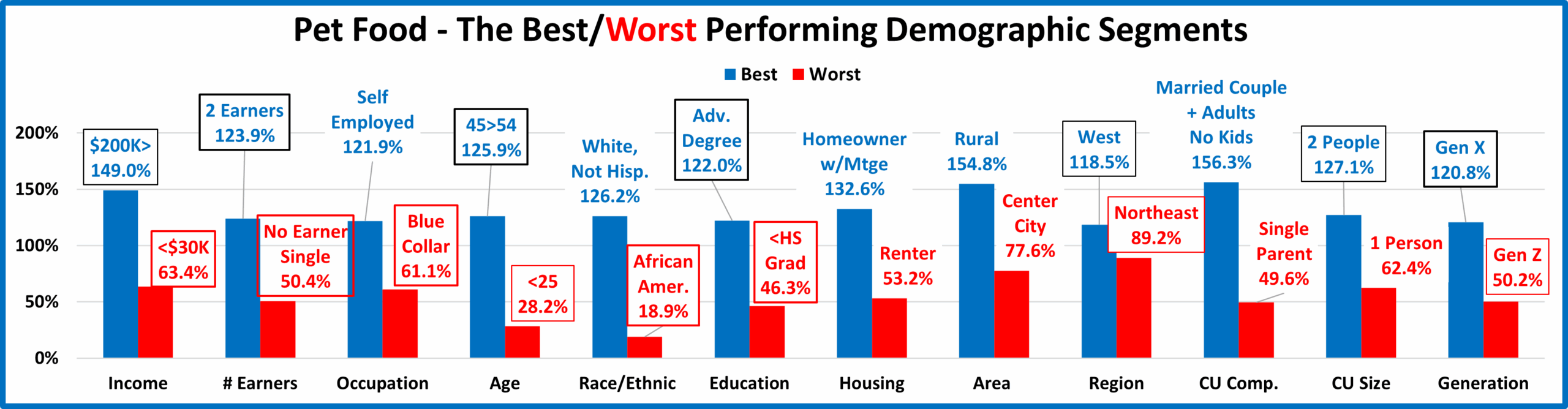
Almost all of the best and worst performers are the ones that we would expect. 2024 produced just 1 surprise winner – Married, + Adults in a repeat. There are 7 different winners from 2023 and 8 different losers. This total is 4 more than 2023, which had 6 new winners and 5 new losers. More new losers reflects the widespread nature of 2024’s huge decrease in Pet Food spending. Changes from 2023 are “boxed”. We should also note the performance gap between winner and loser widened in 9 of 12 categories. Overall, the average gap rose from 59.1% in 2023 to 77.4% in 2024. This is strong evidence of decreased spending balance. Here are some more performance specifics:
- Income – The winner & loser are new but expected. The gap stayed at 86% and is again below 100%.
- # Earners – Winner & loser are new. The loser has a very low income. The gap widened from 39% to 84%.
- Occupation – Blue Collar replaced Service Workers on bottom. The gap widened from 38% to 61%.
- Age, Generation – Gen X is now on top in both and Gen Z on the bottom. Both gaps widened. Age:+42%; Gen:+28%
- Race – The usual winner. African Americans replaced Asians on the bottom. The gap widened from 83% to 107%.
- Education – Both are new but, like income, very expected. The gap increased from 35% to 76%.
- Housing – Owning a home is always important. The usual winner & loser returned. The gap widened – 74% to 79%.
- Area – The usual winner/loser – Rural on top & Center City on the bottom. The gap narrowed a little 82% to 79%.
- Region – Both are new and this category also had a small decrease in the performance gap – 30% to 29%.
- CU Comp, CU Size – Comp: No change. Size: 2 replaced 3. Both gaps widened. Comp: +24%; Size: +15%
It’s time to “Show you the money”. Here are segments with the biggest $ changes in Pet Food Spending.
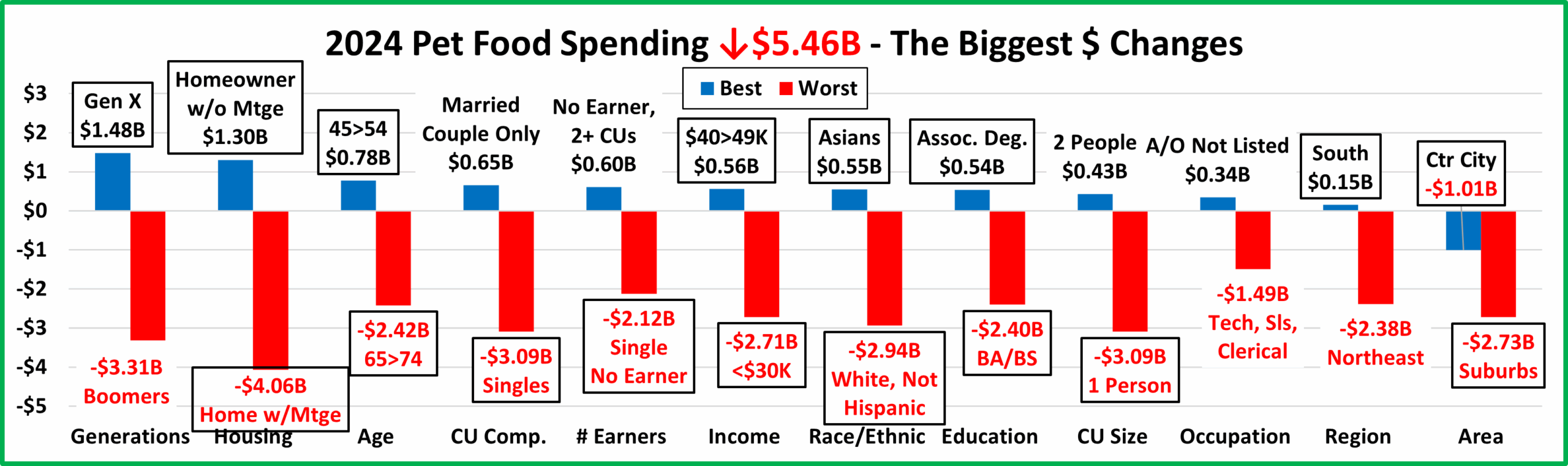
There are no repeats from 2023 and 17 flipped from 1st to last or vice versa. Last year there were 4 repeats and 4 flips -much more turmoil in 2024. The Surprise winners were w/o Mtge, $40>49K, Asians, Associates, A/O and Center City. The surprising losers were Boomers, w/Mtge, Whites, BA/BS and Suburbs. Spending fell -12.0% as 82.3% of demographic segments spent less. (In 23, 87.5% spent more) Plus, there was no category where all segments had increases. (5 in 23) However, in 2024 in Area, all segments spent less. Here are the specifics:
- Generation – Gen X flipped to the top, replacing Millennials. Boomers are the new loser.
- Winner – Gen X – Pet Food Spending: $12.91B; Up $1.48B (+13.0%) 2023: Millennials
- Loser – Baby Boomers – Pet Food Spending: $13.24B; Down $3.31B (-20.0%) 2023: Gen X
- Comment – Much of the 2020>21 Pet Food spending boom and bust was due to the Boomers. Gen X took over the top spot in 21 & 22. In 2023, they had the only spending decrease. Millennials edged out Boomers for the win. In 2024, Gen X had the only Food lift. BTW – Millennials were -$2.0B.
- Housing – The winner and loser flipped.
- Winner – Homeowners w/o Mtge – Food: $12.96B; Up $1.30B (+11.2%) 2023: Homeowners w/Mtge
- Loser – Homeowners w/Mtge – Food: $19.60B; Down $4.06B (-17.2%) 2023: Homeowners w/o Mtge
- Comment – Only Homeowners w/o Mtge spent more. Renters spent -$2.70B, -26.5% less. Like 2023, all changes were double digit %. However, all were positive in 2023. In 2024, that number fell to just 1.
- Age – The Winner and loser both flipped but the result was not surprising.
- Winner – 45>54 yrs – Pet Food Spending: $8.23B; Up $0.78B (+10.4%) 2023: 65>74 yrs
- Loser – 65>74 yrs – Pet Food Spending: $6.58B; Down $2.42B (-26.9%) 2023: 45>54 yrs
- Comment: Only 45>64 spent more while <45 and 65> spent less. The lift was driven by Gen Xers while Millennials & Boomers drove the drop. This spending pattern is the exact opposite of 2023.
- CU Composition – The 2023 winner flipped to the bottom. The 2024 winner is new, but not surprising.
- Winner – Married, Couple Only – Food: $12.66B; Up $0.65B (+5.4%) 2023: Singles
- Loser – Singles – Food: $7.51B; Down $3.09B (-29.2%) 2023: Single Parents
- Comment – Only Married, Couple Only and those with a Child 18>, +$0.02B, spent more. All other CUs spent $4.7B less. Married, w/children were -$1.89B, but Singles had by far the biggest drop after their huge, +$2.96B, +38.8% increase in 2023.
- # Earners – No Earner, Singles flipped to the bottom. No Earner, 2+ CUs replaced them on top.
- Winner –– No Earner, 2+ CUs – Pet Food Spending: $4.88B; Up $0.60B (+14.1%) 2023: No Earner, Single
- Loser – No Earner, Single – Pet Food Spending: $2.55B; Down $2.12B (-45.5%) 2023: 3+ Earners
- Comment – No Earner, 2+ CUs had the only spending increase. No Earner CUs were at the top & bottom. All CUs with any workers spent less on Pet Food.
- Income – Both the winner & loser flipped, and the winner is again a surprise.
- Winner – $40>49K – Pet Food Spending: $2.66B; Up $0.56B (+26.5%) 2023: <$30K
- Loser – <$30K – Pet Food Spending: $3.92B; Down $2.71B (-40.9%) 2023: $40 to $49K
- Comment – Only the $40>49K & $70>99K groups spent more, +$1.09B. <$40K spent -$4.68B less, which was more than double the -$1.80 decrease by $100K>. All groups over $70K still have 100+% performance.
- Race/Ethnic – Both the winner and loser from 2023 flipped.
- Winner – Asians – Pet Food Spending: $1.49B; Up $0.55B (+58.4%) 2023: White, Not Hispanic
- Loser – White, Not Hispanic – Pet Food Spending: $33.40B; Down -$2.94B (-8.1%) 2023: Asian
- Comment – The U.S. is becoming more racially/ethnically diverse, especially with Hispanics & African Americans but White, Not Hispanics are by far the biggest spender in every Pet Segment. Only Asians spent more, but the Minorities were still -$3.53B, -38.5%.
- Education – Both winner and loser flipped and are surprising.
- Winner – Associate’s Degree – Food Spending: $4.55B; Up $0.54B (+13.4%) 2023: BA/BS Degree
- Loser – BA/BS Degree – Food Spending: $12.03B; Down $2.40B (-16.6%) 2023: Associate’s Degree
- Comment – Only Associate’s degrees and High School Grads with Some College spent more. The other <College groups were -$2.98B, -33.9%. Advanced Deg. were only -$0.75B, -6.8%, so College Grads were -$3.15B, -12.4%.
- # in CU – 1 Person flipped to the bottom and was replaced on top by 2 People.
- Winner – 2 People – Pet Food Spending: $16.89B; Up $0.43B (+2.6%) 2023: 1 Person
- Loser– 1 Person– Pet Food Spending: $7.51B; Down $3.09B (-29.2%) 2023: 4 People
- Comment: Only 2 People CUs spent more. Singles were the big loser, but 3 & 4 People CUs both spent -$1.3B less. In fact, 2+ CUs were -$2.37B, -6.8%. Only 2, 3 & 5+ People CUs perform above 100%.
- Occupation – Both winner & loser are new. The Winner, All Other, Not listed includes Unemployed was surprising.
- Winner – All Other, Not Listed – Pet Food Spending: $4.79B; Up $0.34B (+7.7%) 2023: Retired
- Loser – Tech/Sls/Clerical – Pet Food Spending: $5.45B; Down $1.49B (-25.8%) 2023: Mgrs/Professionals
- Comment – Only A/O, Unemployed spent more. Self-employed were -$0.64B, -17.5%; Retirees were -$1.48B, -14.0% and All Wage & Salary Workers were -$3.68B, -13.7%.
- Region – The South flipped from last to 1st and the Northeast replaced them on the bottom.
- Winner – South – Pet Food Spending: $14.96B; Up $0.15B (+1.0%) 2023: West
- Loser – Northeast – Pet Food Spending: $6.22B; Down $2.38B (-27.7%) 2023: South
- Comment – Only the South spent more. The drop by the Midwest, -$2.37, was virtually equal to the Northeast.
- Area Type – The Winner and Loser both flipped.
- Winner – Center City – Pet Food Spending: $10.90B; Down $1.01B (-8.4%) 2023: Suburbs;
- Loser – Suburbs 2500> – Center City: $17.23B; Down $2.73B (-13.7%) 2023: Ctr City/Rural – Tie
- Comment – In an unusual situation, all segments spent less. In 2023 Center City tied for the bottom, despite a $1.86B lift. In 2024, they won with a -$1.01B drop. Rural was -$1.73B, -12.7%.
We’ve now seen the “winners” and “losers” in terms of increase/decrease in Pet Food Spending $ for 12 Demographic Categories. In 2020, very specific segments binge bought Pet Food. In 2021, their pets “ate up” the overstock so Pet Food spending fell. 2022>23 brought a new challenge, strong inflation. However, most of America remains firmly committed to high quality Pet Food. Super premium Food already had high prices, so income is still very important in Pet Food spending. The 2023 result was 87.5% of all demographic segments spent more which drove a record lift of $6.81B, +17.6% to $45.5B. 2024 was a different story. 82.3% of demographics spent less. The result was $40.04B in spending, -$5.46B, -12.0%. We have identified the winning segments in performance and $ increase but they were not alone. Not every good performer can be a winner. Some “hidden” segments should also be recognized for their performance. They don’t win an award, but they get…
HONORABLE MENTION

Because the drop was so widespread, the possible members of this group was very limited. With 5 different categories, the group was diverse. The lifts were small, under 10% with 4 under 4%. No young groups were included. The Gen X/Boomer 55>64 yr olds spent $0.23B more. The biggest % lift came from the urban 1>2.5M people group. They are the only <100% performer, which is unusual. The smaller urban area with 100>249K people also spent $0.10B more, not unexpected in Food. A college degree mattered less as HS Grads w/some college spent more. Marriage & children matter as those with a child 18> had a miniscule, +$0.02B lift. Income matters in Pet Food spending, but the below avg $70>99K group had the biggest increase, +$0.53B. However, we should note that 3 segments had above avg income and 3 were below avg. The group is definitely diverse.
Summary
Pet Food has been ruled by trends over the years. The drop in 2018 due to the FDA grain free warning broke a 20 year pattern of 2 years up followed by 1 year of flat or declining sales. This trendy nature increased with the move to premium foods in 2004. The 2007 Melamine crisis resulted in a series of “waves” which became a tsunami with the introduction of Super Premium Foods. The 25 to 34 yr old Millennials were the first to “get on board” with Super Premium in the 2nd half of 2014. In 2015, many more groups began to upgrade. The result was a $5.4B spending lift. These consumers were generally more educated with higher incomes. Unfortunately, they often paid for the upgrade by spending less in other segments. In 2016, spending dropped as many value shopped, especially online. They spent some of the $3B “saved” Food $ in other segments but not enough so Total Pet Spending was down -$0.46B. In 2017, due to a price competitive market, we got a deeper penetration of Super Premium. These upgraders were mostly middle-income and not college educated. The result was a $4.6B increase but this time there was no trading of segment $.
In 2018 we were “due” a small annual increase in Pet Food, but spending fell $2.26B in reaction to the FDA warning on grain free dog food. The big decrease came directly from the groups who had fueled the 2017 increase. In fact, 71% of the demographic groups with the biggest change in Pet Food $ switched from first to last or vice versa from 2017.
That brought us to 2019. The FDA warning was false, so Pet Parents returned to Super Premium or even pricier options. Supplement $ also grew as the health of their Pet Children remained the #1 priority. Pet Food $ grew $2.35B with 75% of demographic segments spending more. Income and related categories mattered more, and Pet Food Spending became less demographically balanced. In 2020 the Pandemic accelerated this trend. Fear of shortages led to binge buying and a $5.65B increase. This behavior was driven by very specific groups. This spending disparity was manifested in the fact that the performance of 8 of 10 big spending groups exceeded 120% while 49% of all segments spent less.
In 2021, the retail market strongly recovered but the turmoil in Pet Food continued. The 2020 binge buying didn’t increase usage, so Pet Food spending fell by $2.44B. Every segment with the biggest increase in 2020 had the biggest decrease in 2021. The resulting drop in $ hid the fact that 65% of all demographic segments spent more on Pet Food.
In 2022 the situation returned to a more normal, balanced pattern in spending. Pet Parents renewed their commitment to high quality food for their children. Despite strong inflation, 82% of demographic segments increased spending generating a $4.29B (+12.5%) lift and reaching a new record high of $38.69B – even exceeding the 2020 binge by $1.85B.
In 2023 inflation grew to +10.6%, but spending was +$6.81B, a record. The lift was widespread. In 5 categories, all spent more and overall, 87.5% of demographics increased spending. 2023 was also more balanced as only 3 big groups performed over 120% and the best/worst discrepancy fell from 73.5% to 59.1%. 2023 was a great year for Pet Food.
In 2024, inflation plummeted to 0.2%, but so did Pet Food spending, -$5.46B, -12.0% to $40.04B. They are now the 2nd largest segment, behind Veterinary. The drop was widespread as 82.3% of demographics spent less and in the Area category, all segments were down. Spending was also less balanced, as 5 big groups performed over 120%, up from 3 and the best/worst performance discrepancy rose from 59.1% to 77.4%. 2024 was a bad year for Pet Food.
Finally – The Ultimate Pet Food Spending CU is 3 people – a married couple and 1 other adult. They are 45>54 yr-old Gen Xers, White, but not Hispanic. At least one has an Advanced Degree and both work in their own business. This generates an income of $200K>. They are still paying the mortgage on their house in a rural area <2500 in the West.

